Australian Dollar Price Forecast: Rising risks of a deeper pullback
- AUD/USD rapidly faded Wednesday’s uptick, resuming the downside below 0.6500.
- The US Dollar traded on the back foot for the third day in a row on Fed, US shutdown.
- The Australian labour market data reinforced the case for RBA rate cuts.

The Australian Dollar (AUD) quickly gave up Wednesday’s gains, slipping back below the 0.6500 mark against the US Dollar (USD) despite the Greenback also struggling.
Lingering tensions between the US and China kept pressure on the Aussie, while softer labour market figures added to speculation that the Reserve Bank of Australia (RBA) could cut its Official Cash Rate (OCR) at its next meeting.
Local data appear mixed
Even with markets leaning risk-off, Australia’s domestic data hasn’t fallen apart. September’s final manufacturing and services PMIs eased slightly but stayed above 50, signalling ongoing expansion.
Retail Sales rose 1.2% in June, and the August trade surplus narrowed only modestly to A$1.825 billion. Business investment also continued to rise in Q2, while GDP expanded 0.6% on the quarter and 1.8% over the last twelve months, steady, if not spectacular.
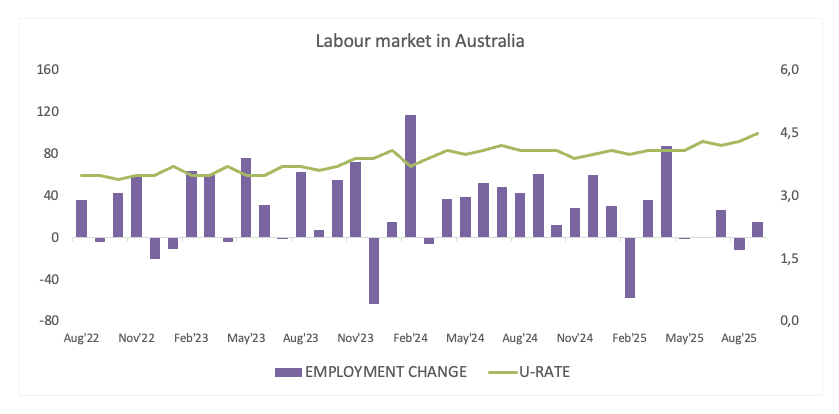
The jobs market, though, is showing signs of fatigue. The Unemployment Rate climbed to 4.5% in September from 4.3%, while the Employment Change rose by just 14.9K individuals, short of forecasts. It’s not a red flag yet, but it does hint that momentum in hiring is slowing.
RBA keeps the focus on inflation and jobs
Inflation and employment remain front and centre for the RBA. The August Monthly CPI Indicator (Weighted Mean) edged up to 3.0% from 2.8%, while Q2 CPI rose 0.7% inter-quarter and 2.1% YoY. Furthermore, the Melbourne Institute’s October Consumer Inflation Expectations also ticked higher to 4.8%.
The trimmed mean CPI, at an annualised 2.7% in Q2, still sits neatly within the RBA’s 2–3% target range.
At its 30 September meeting, the RBA held the OCR at 3.60%, as expected, but softened its earlier hints of potential easing. Policymakers noted that disinflation might be slowing after the CPI surprise, with Q3 inflation likely to come in hotter than previously thought.
Governor Michele Bullock has stuck to a data-dependent message, emphasising that each decision will be made meeting by meeting. Rate cuts haven’t been ruled out, but she’s made clear the RBA wants to see more evidence that supply and demand pressures are easing.
Speaking again on Thursday, Bullock added that stronger consumer spending and slightly firmer inflation had prompted policymakers to rethink the case for further cuts. With current rates only mildly restrictive and financial conditions already loosening, the RBA seems in no rush to move.
Markets now expect around 24 basis points of easing by the end of this year and about 43 basis points by late 2026.
China still calling the shots
Australia’s outlook remains tightly linked to China’s uneven recovery. Chinese GDP grew 5.2% from a year earlier in Q2, but August retail sales undershot expectations at 3.4%. September’s PMIs were mixed, as manufacturing stayed in contraction at 49.8, while services barely held steady at 50.0.
China’s trade surplus narrowed to $90.45 billion in September (from $103.33 billion), and consumer prices remained in deflation, down 0.3% YoY in the same period.
Meanwhile, the People’s Bank of China (PBoC) left its Loan Prime Rates (LPR) unchanged last month, keeping the one-year at 3.00% and the five-year at 3.50%, as anticipated.
Thin flows, quiet market
Speculative activity in the Aussie remains muted. With Commodity Futures Trading Commission (CFTC) data delayed by the US government shutdown, the latest available figures as of 23 September still showed non-commercial traders holding net short positions, suggesting much of the bearish sentiment is already priced in.
Technical views
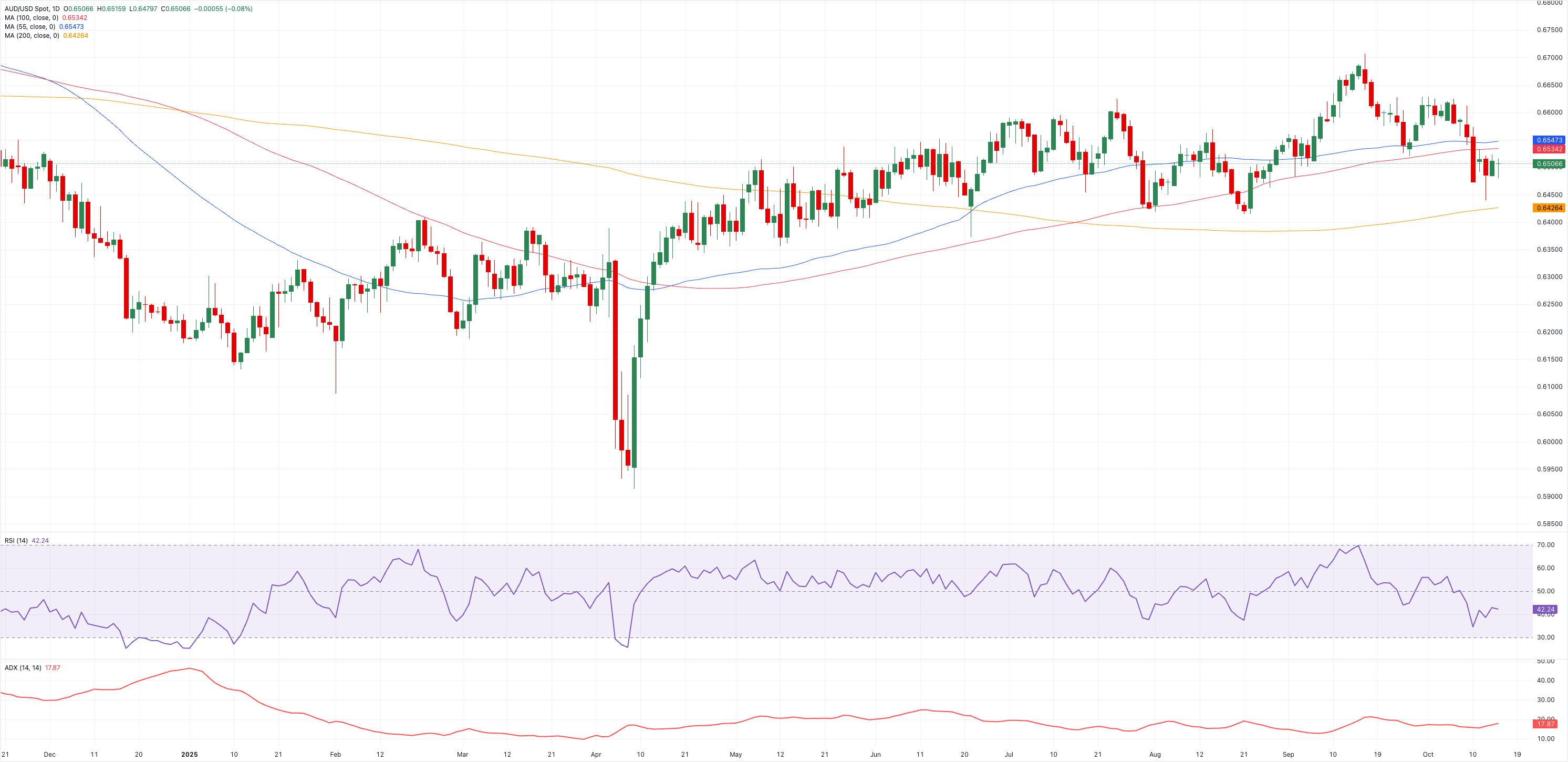
If sellers remain in control, AUD/USD might put its key 200-day SMA near 0.6430 to the test sooner rather than later.
That said, the loss of that region could prompt spot to revisit the August trough at 0.6414 (August 21) before the June base at 0.6372 (June 23). A deeper drop from here could see the next support of significance at the key 0.6000 threshold, ahead of the 2025 bottom at 0.5913 (April 9).
Conversely, there is a provisional hurdle at the 100-day and 55-day SMAs at 0.6532 and 0.6545, respectively. Further north emerges the October peak at 0.6629 (October 1), seconded by the 2025 high at 0.6707 (September 17). Up from here sits the 2024 ceiling at 0.6942 (September 30), just before the 0.7000 round level.
Momentum indicators lean bearish: the Relative Strength Index (RSI) eases to around the 41 region, suggesting that further losses look increasingly likely; the Average Directional Index (ADX) approaching 18 indicates that the current trend appears to be picking up pace.
AUD/USD daily chart
Waiting for a catalyst
Overall, AUD/USD remains trapped in a broad 0.6400–0.6700 range, looking for a clear driver to break out. A stronger run of Chinese data, a more dovish shift from the Fed, or a softer tone from the RBA could be the spark that finally gives the pair direction.
Employment FAQs
Labor market conditions are a key element to assess the health of an economy and thus a key driver for currency valuation. High employment, or low unemployment, has positive implications for consumer spending and thus economic growth, boosting the value of the local currency. Moreover, a very tight labor market – a situation in which there is a shortage of workers to fill open positions – can also have implications on inflation levels and thus monetary policy as low labor supply and high demand leads to higher wages.
The pace at which salaries are growing in an economy is key for policymakers. High wage growth means that households have more money to spend, usually leading to price increases in consumer goods. In contrast to more volatile sources of inflation such as energy prices, wage growth is seen as a key component of underlying and persisting inflation as salary increases are unlikely to be undone. Central banks around the world pay close attention to wage growth data when deciding on monetary policy.
The weight that each central bank assigns to labor market conditions depends on its objectives. Some central banks explicitly have mandates related to the labor market beyond controlling inflation levels. The US Federal Reserve (Fed), for example, has the dual mandate of promoting maximum employment and stable prices. Meanwhile, the European Central Bank’s (ECB) sole mandate is to keep inflation under control. Still, and despite whatever mandates they have, labor market conditions are an important factor for policymakers given its significance as a gauge of the health of the economy and their direct relationship to inflation.
Author

Pablo Piovano
FXStreet
Born and bred in Argentina, Pablo has been carrying on with his passion for FX markets and trading since his first college years.

















