Australian Dollar Price Forecast: Recovery looks firm
- AUD/USD advances to three-week highs past the 0.6600 barrier on Wednesday.
- The US Dollar clocked marginal losses prior to the Federal Reserve’s meeting.
- Australian inflation ran hotter than expected in the third quarter.

The Australian Dollar (AUD) kept heading north on Wednesday, with AUD/USD breaking above the key 0.6600 mark and touching fresh three-week highs.
That move came in response to a persistent pullback in the US Dollar (USD). Markets took heart from signs of easing US–China trade tensions, growing confidence that the Federal Reserve (Fed) could deliver more rate cuts in the months ahead, and a bit of lingering uncertainty around a potential US government shutdown.
Domestic data still holding up
The Australian economy isn’t booming, but it’s holding up better than many expected. The preliminary October PMIs were mixed: manufacturing slipped to 49.7 (from 51.4), while services improved to 53.1 (from 52.4).
Retail Sales rose 1.2% in June, and the August trade surplus narrowed only slightly to A$1.25 billion. Business investment grew through Q2, with GDP expanding 0.6% on the quarter and 1.1% YoY. Not eye-catching figures, but decent enough to show the economy still has a bit of momentum.
The labour market, though, is starting to cool. The Unemployment Rate nudged up to 4.5% in September (from 4.3%), while Employment Change came in at just 14.9K. Nothing dramatic, but it does suggest hiring is losing some pace.
RBA watching inflation closely
The Reserve Bank of Australia (RBA) remains laser-focused on inflation and jobs.
The latest data showed price pressures stayed sticky through the third quarter: headline inflation rose 1.3% inter-quarter and 3.2% from a year earlier, while the Monthly CPI Indicator gained 3.5% in September.
Among the RBA’s preferred measures, the Weighted Median CPI was up 2.8% YoY, and the Trimmed Mean ran at 3.0%, brushing the top of its 2–3% target band.
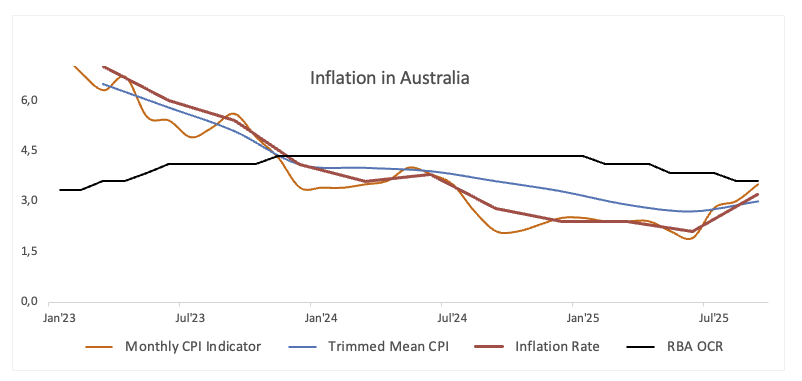
A glance at the September meeting saw the RBA holding the Official Cash Rate (OCR) steady at 3.60%, as widely expected. Policymakers, however, sounded a little more cautious, warning that the recent disinflation trend might be losing traction after the latest CPI surprise. They also hinted Q3 inflation could again come in hotter than hoped.
Governor Michele Bullock has kept her message simple: every meeting is “data-dependent” and “meeting by meeting.” She hasn’t ruled out rate cuts, but she’s made it clear the board wants stronger evidence that inflation and demand are genuinely cooling before making that call.
Speaking last Friday, Bullock said that if core inflation rises above forecasts, it would be a “material miss” the RBA couldn’t ignore. She also played down the uptick in unemployment, noting that monthly numbers can be volatile and still broadly align with the RBA’s expectations. In short, softer jobs data probably won’t shake the bank, but a hot inflation print could delay any talk of cuts.
Markets now see roughly a 91% chance that the RBA holds rates unchanged on November 4, and just about 6 basis points of easing priced in by year-end.
China still setting the tone
Australia’s outlook continues to hinge on how China’s economy fares. Chinese GDP grew 4.0% year-on-year in Q3, while Retail Sales rose 3.0% over the year to September. But PMI data told a more uneven story — manufacturing stayed below 50 at 49.x, while services hovered right around the threshold.
China’s trade surplus also narrowed, from $103.33 billion to $90.45 billion in September, and CPI remained in negative territory, down 0.3% year-on-year.
Earlier this month, the People’s Bank of China (PBoC) left its Loan Prime Rates unchanged at 3.00% (one-year) and 3.50% (five-year), as expected.
Technical outlook
The firmer-than-expected inflation prints in Australia have lent support to the view that the RBA will refrain from lowering its OCR next week, further underpinning the move higher in spot.
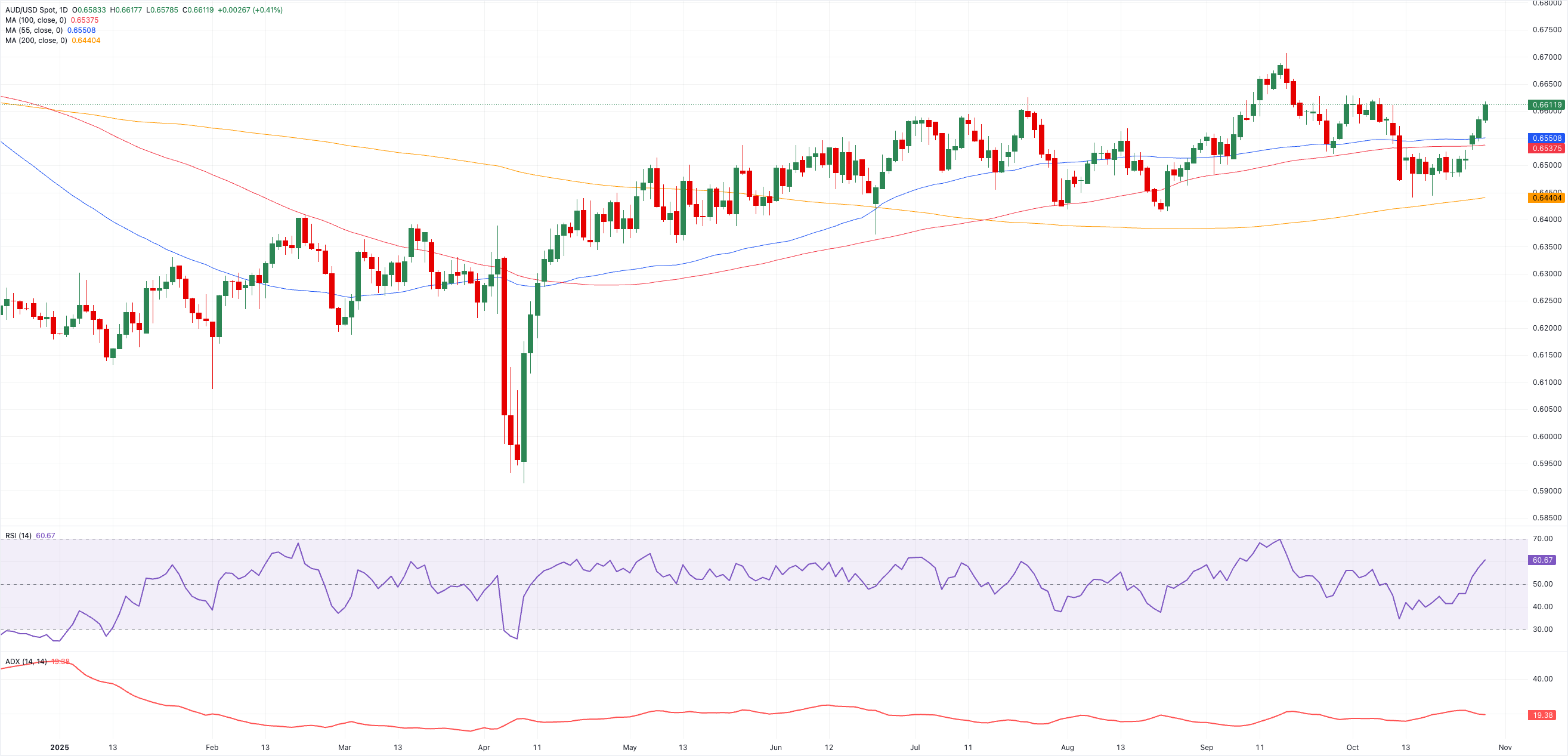
The continuation of the ongoing rebound should meet the next resistance at the October high of 0.6629 (October 1), prior to the 2025 ceiling of 0.6707 (September 17). Further north emerges the 2024 peak at 0.6942 (September 30), ahead of the 0.7000 round level.
Occasional bouts of weakness could prompt a visit to the October floor at 0.6440 (October 14) to re-emerge on the horizon, a region also reinforced by the key 200-day SMA. The loss of the latter could open the door to a move toward the August base at 0.6414 (August 21), seconded by the June trough of 0.6372 (June 23).
Momentum indicators seem to favour extra advances in the short-term horizon. That said, the Relative Strength Index (RSI) climbed past the 60 level, suggesting that further gains could be waiting. Meanwhile, the Average Directional Index (ADX) above 19 indicates that the current trend still looks pale.
AUD/USD daily chart
Bottom line
For now, AUD/USD remains boxed between 0.6400 and 0.6700, waiting for a clear catalyst to break the range, whether that comes from China’s economic pulse, the Fed’s next move, the RBA’s tone, or developments on the US–China trade front.
Inflation FAQs
Inflation measures the rise in the price of a representative basket of goods and services. Headline inflation is usually expressed as a percentage change on a month-on-month (MoM) and year-on-year (YoY) basis. Core inflation excludes more volatile elements such as food and fuel which can fluctuate because of geopolitical and seasonal factors. Core inflation is the figure economists focus on and is the level targeted by central banks, which are mandated to keep inflation at a manageable level, usually around 2%.
The Consumer Price Index (CPI) measures the change in prices of a basket of goods and services over a period of time. It is usually expressed as a percentage change on a month-on-month (MoM) and year-on-year (YoY) basis. Core CPI is the figure targeted by central banks as it excludes volatile food and fuel inputs. When Core CPI rises above 2% it usually results in higher interest rates and vice versa when it falls below 2%. Since higher interest rates are positive for a currency, higher inflation usually results in a stronger currency. The opposite is true when inflation falls.
Although it may seem counter-intuitive, high inflation in a country pushes up the value of its currency and vice versa for lower inflation. This is because the central bank will normally raise interest rates to combat the higher inflation, which attract more global capital inflows from investors looking for a lucrative place to park their money.
Formerly, Gold was the asset investors turned to in times of high inflation because it preserved its value, and whilst investors will often still buy Gold for its safe-haven properties in times of extreme market turmoil, this is not the case most of the time. This is because when inflation is high, central banks will put up interest rates to combat it. Higher interest rates are negative for Gold because they increase the opportunity-cost of holding Gold vis-a-vis an interest-bearing asset or placing the money in a cash deposit account. On the flipside, lower inflation tends to be positive for Gold as it brings interest rates down, making the bright metal a more viable investment alternative.
Author

Pablo Piovano
FXStreet
Born and bred in Argentina, Pablo has been carrying on with his passion for FX markets and trading since his first college years.
















