Australian Dollar Price Forecast: Provisional support comes at 0.6550-0.6530
- AUD/USD added to the weekly correction, revisiting 0.6530 on Thursday.
- The US Dollar extended its rebound to two-month highs.
- Australian Export and Import Prices fell 0.9% and 0.4%, respectively, in Q3.

The Australian Dollar (AUD) remained on the back foot for the second straight day on Thursday, with AUD/USD retreating to as low as the 0.6530 region, where some initial contention appears to have resurfaced.
That move followed a steady rebound in the US Dollar (USD) after the Federal Reserve’s (Fed) rate cut on Wednesday, alongside some optimism from the recent trade truce between the US and China following the Trump–Xi meeting.
The local picture: still ticking along
Australia’s economy isn’t firing on all cylinders, but it’s proving more resilient than many expected. The preliminary October Purchasing Managers’ Indexes (PMIs) painted a mixed picture: manufacturing slipped into contraction at 49.7 (from 51.4), while services improved to 53.1 (from 52.4).
Retail Sales rose by 1.2% in June, and the August trade surplus narrowed only slightly to A$1.25 billion. Business investment continued to grow through Q2, with Gross Domestic Product (GDP) expanding 0.6% on the quarter and 1.1% year-on-year. Hardly stellar numbers, but enough to show the economy still has some momentum.
The labour market, though, is showing signs of fatigue. The Unemployment Rate ticked up to 4.5% in September (from 4.3%), while Employment Change came in at just 14.9K. Nothing alarming, but clearly the pace of hiring has slowed.
RBA keeping its eyes on inflation
The Reserve Bank of Australia (RBA) remains firmly focused on inflation and jobs.
Latest figures show price pressures stayed stubborn through Q3: headline inflation rose 1.3% QoQ and 3.2% on a yearly basis, while the Monthly CPI Indicator was up 3.5% in September.
Among the RBA’s preferred measures, the Weighted Median CPI climbed 2.8% from a year earlier, and the Trimmed Mean ran at 3.0% YoY, right at the top of the 2–3% target band.
At its September meeting, the RBA left the Official Cash Rate (OCR) unchanged at 3.60%, as expected. But the tone was a little more cautious, with policymakers noting that the disinflation trend may be stalling after the latest CPI surprise. They also hinted Q3 inflation might again come in hotter than hoped.
Governor Michele Bullock has stuck to a consistent line: decisions are “data-dependent” and assessed “meeting by meeting.” She hasn’t ruled out rate cuts, but the board wants clearer evidence that inflation and demand are cooling before moving in that direction.
Speaking last Friday, Bullock said that if core inflation overshoots forecasts, it would be a “material miss” the RBA couldn’t overlook. She also downplayed the uptick in unemployment, noting that monthly numbers can be volatile and still broadly in line with expectations. In short, weaker jobs data probably won’t shift the bank’s stance, but a hot inflation print could delay any talk of cuts.
Markets now price in roughly a 93% chance the RBA holds rates steady on November 4, and just over 5 basis points of easing by year-end.
China still calling the tune
Australia’s outlook remains heavily tied to how China’s economy performs. Chinese GDP grew at an annualised 4.0% in Q3, while Retail Sales rose 3.0% over the year to September.
However, September’s PMI readings were uneven: manufacturing stayed in contraction at 49.8, while services hovered right around the 50 mark. Investors will be watching closely for Friday’s October data from the National Bureau of Statistics (NBS).
China’s trade surplus also narrowed, from $103.33 billion to $90.45 billion in September, while CPI stayed in negative territory, down 0.3% over the last twelve months.
Earlier this month, the People’s Bank of China (PBoC) left its Loan Prime Rates unchanged: the One-year at 3.00% and the Five-year at 3.50%, as largely estimated.
Technical landscape
The ongoing sharp rebound in the US Dollar keeps the risk complex and the Australian Dollar under pressure.
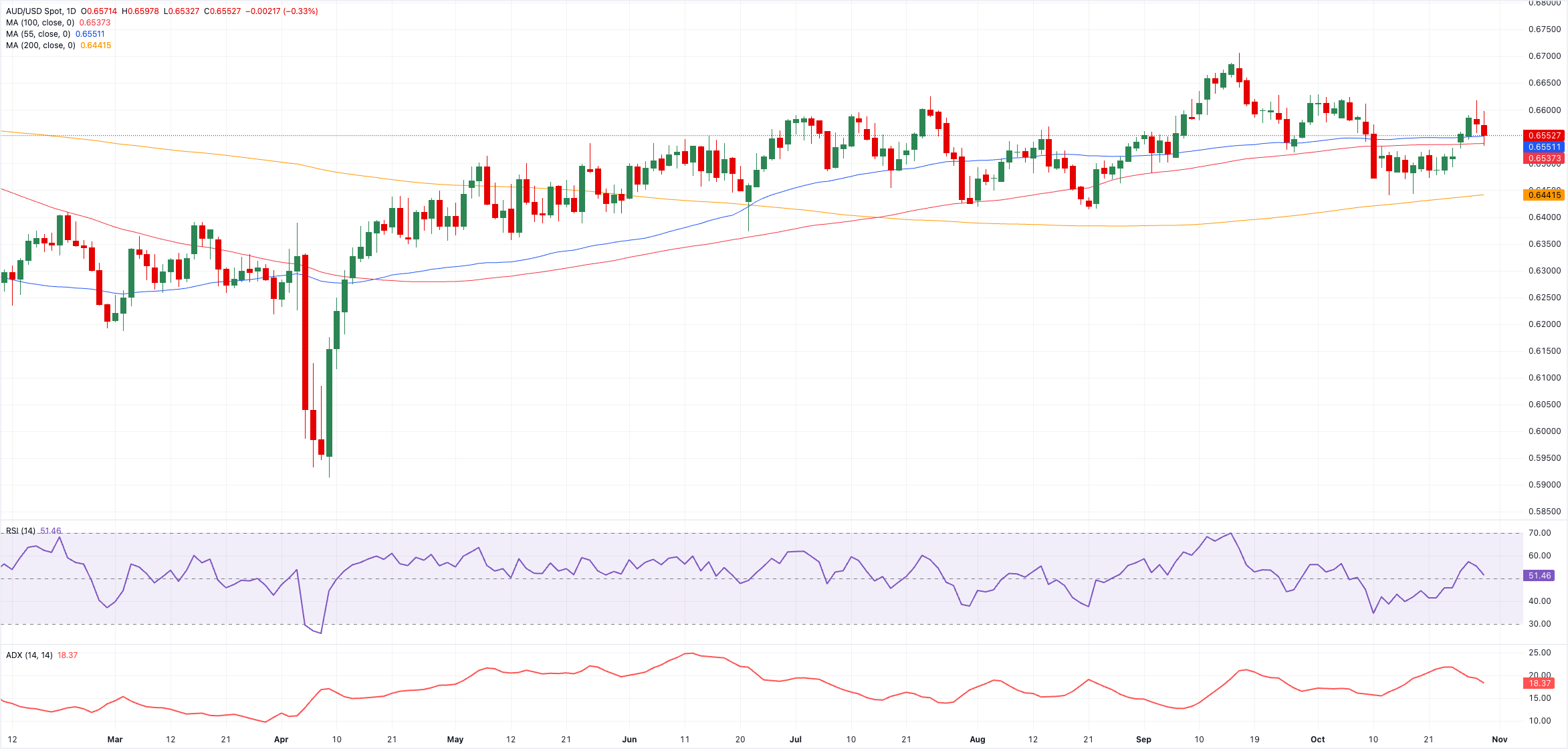
That said, there is provisional support at the 55-day and 100-day SMAs at 0.6550 and 0.6536, respectively. The loss of this region could pave the way for a potential drop to the October low at 0.6440 (October 14), which remains underpinned by the key 200-day SMA. Further south comes the August trough at 0.6414 (August 21), ahead of the June base of 0.6372 (June 23).
In case bulls regain the upper hand, AUD/USD faces immediate resistance at the weekly high at 0.6617 (October 27), prior to the October peak of 0.6629 (October 1), and the 2025 ceiling of 0.6707 (September 17). Extra gains from here should retarget the 2024 top at 0.6942 (September 30), before the 0.7000 milestone.
Momentum indicators keep pointing to further gains, although momentum shrinks a tad. Indeed, the Relative Strength Index (RSI) eased just below the 52 level, indicating that extra advances still remain on the table. Additionally, the Average Directional Index (ADX) near 18 suggests that the current trend appears unconvincing.
AUD/USD daily chart
The takeaway
For now, AUD/USD remains boxed between 0.6400 and 0.6700, waiting for a clear catalyst to break out, whether that’s China’s growth pulse, the Fed’s next move, the RBA’s tone, or the next twist in the US–China trade story.
US-China Trade War FAQs
Generally speaking, a trade war is an economic conflict between two or more countries due to extreme protectionism on one end. It implies the creation of trade barriers, such as tariffs, which result in counter-barriers, escalating import costs, and hence the cost of living.
An economic conflict between the United States (US) and China began early in 2018, when President Donald Trump set trade barriers on China, claiming unfair commercial practices and intellectual property theft from the Asian giant. China took retaliatory action, imposing tariffs on multiple US goods, such as automobiles and soybeans. Tensions escalated until the two countries signed the US-China Phase One trade deal in January 2020. The agreement required structural reforms and other changes to China’s economic and trade regime and pretended to restore stability and trust between the two nations. However, the Coronavirus pandemic took the focus out of the conflict. Yet, it is worth mentioning that President Joe Biden, who took office after Trump, kept tariffs in place and even added some additional levies.
The return of Donald Trump to the White House as the 47th US President has sparked a fresh wave of tensions between the two countries. During the 2024 election campaign, Trump pledged to impose 60% tariffs on China once he returned to office, which he did on January 20, 2025. With Trump back, the US-China trade war is meant to resume where it was left, with tit-for-tat policies affecting the global economic landscape amid disruptions in global supply chains, resulting in a reduction in spending, particularly investment, and directly feeding into the Consumer Price Index inflation.
Author

Pablo Piovano
FXStreet
Born and bred in Argentina, Pablo has been carrying on with his passion for FX markets and trading since his first college years.

















