Australian Dollar Price Forecast: Outlook is seen negative below the 200-day SMA
- AUD/USD resumes its decline on Thursday, revisiting the 0.6470 zone.
- The US Dollar faces renewed downward bias and corrects from recent tops.
- The Australian trade surplus widened to nearly A$4 billion in September.

The Australian Dollar (AUD) rapidly faded Wednesday’s gains, forcing AUD/USD to resume its weekly move lower and to slip back below the key 0.6500 support zone once more.
The pullback comes on the back of another bearish day in the US Dollar (USD), with traders locking in profits following its recent strong bounce. At the same time, expectations for a December rate cut by the Federal Reserve (Fed) are fading fast, which should keep the downside somewhat contained.
Meanwhile, the prolonged US government shutdown, now officially the longest on record, is keeping risk sentiment on edge, with little sign of a breakthrough in sight.
Australia’s economy: steady, but showing a few cracks
Australia’s economy isn’t exactly firing on all cylinders, but it’s doing better than many had expected. The latest October PMIs were a mixed bag: manufacturing slipped back below 50 to 49.7 (from 51.4), while services edged higher to 53.1 (from 52.4).
Retail Sales rose 1.2% in June, and the September trade surplus widened sharply to A$3.938 billion. Business investment also picked up in Q2, helping GDP grow 0.6% QoQ and 1.1% YoY. Not spectacular, but enough to show there’s still some life in the economy.
That said, the labour market is starting to cool a bit: the unemployment rate ticked up to 4.5% in September (from 4.3%), and job growth slowed to 14.9K. Nothing dramatic yet, but hiring momentum seems to be losing some pace.
RBA plays it cool
The Reserve Bank of Australia (RBA) kept rates steady at 3.60% for the second straight meeting on Tuesday, right in line with expectations. The message was clear: no rush to move either way.
The RBA noted that inflation is still a touch sticky, but the labour market remains tight despite the modest uptick in unemployment. Governor Michele Bullock described the current stance as “pretty close to neutral,” with no strong lean toward tightening or easing.
She also reminded markets that the 75 bps of cuts already delivered haven’t fully filtered through the economy yet. Policymakers are watching closely to see if demand starts running ahead of supply.
For now, markets are pricing in just around 4 bps of easing by the December 9 meeting, and roughly 20 bps by early 2026.
China still calling the tune
Australia’s outlook remains closely tied to China’s performance. Chinese GDP grew 4.0% YoY in Q3, while retail sales rose 3.0%. The RatingDog Manufacturing PMI eased to 50.6, and the Services PMI dipped to 52.6 in October, signs that growth momentum is cooling.
China’s trade surplus also narrowed from $103.33 billion to $90.45 billion in September, while CPI stayed in negative territory at –0.3% YoY.
Earlier in October, the People’s Bank of China (PBoC) left its Loan Prime Rates (LPR) unchanged at 3.00% (one-year) and 3.50% (five-year), as expected.
Technical view
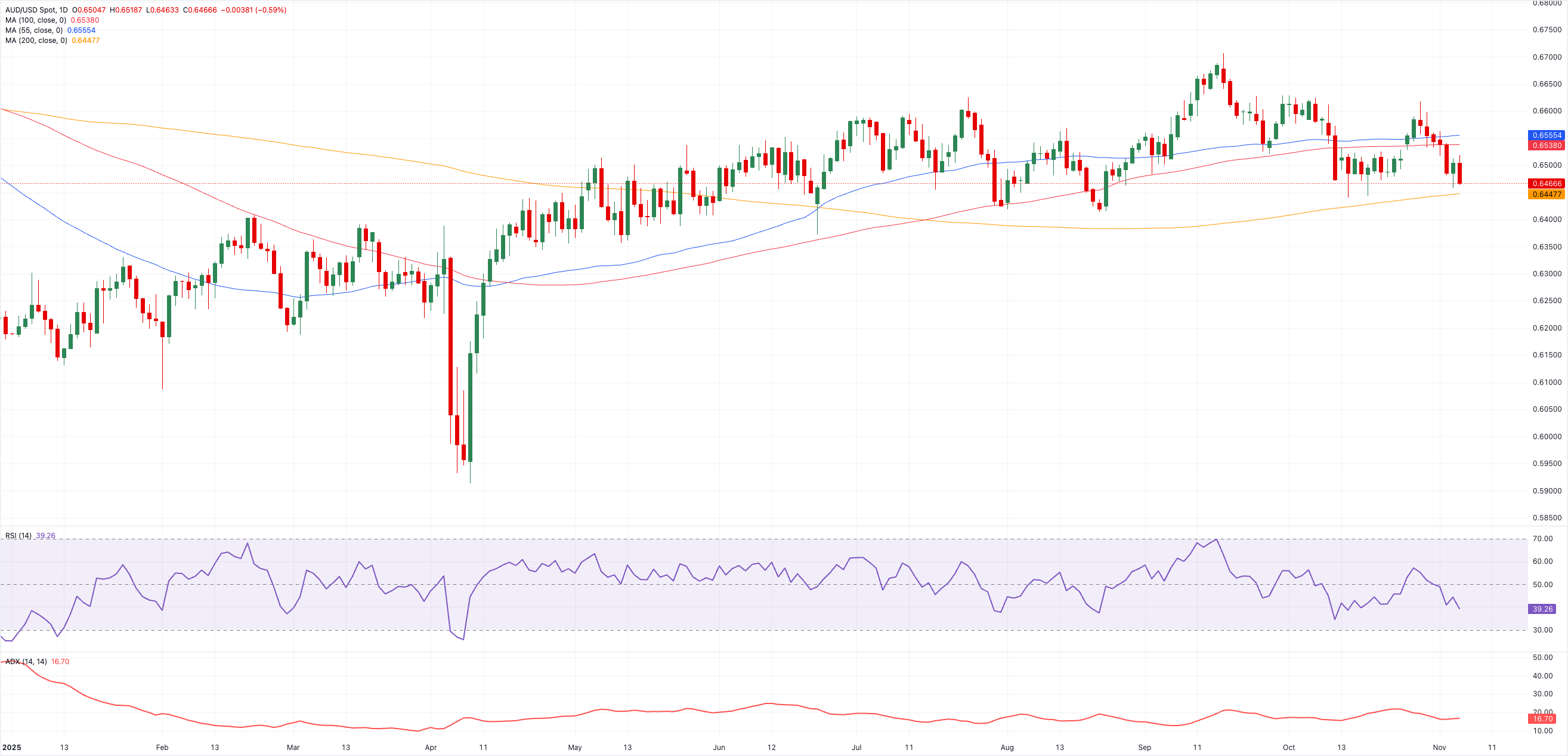
The near-term outlook for AUD/USD now looks deteriorated, paving the way for further losses, while a challenge to the key 200-day SMA just below 0.6450 returning to the radar.
So, the loss of the 200-day SMA could pave the way for a test of the October base at 0.6440 (October 14), seconded by the August floor at 0.6414 (August 21), and the June low of 0.6372 (June 23).
Conversely, the pair is expected to hit its initial hurdle at the October top of 0.6629 (October 1). Once this level is cleared, the next obstacle emerges at the 2025 ceiling of 0.6707 (September 17), prior to the 2024 high at 0.6942 (September 30), all before the 0.7000 milestone.
In addition, momentum indicators remain bearish: the Relative Strength Index (RSI) breaks below the 40 level, suggesting that extra losses appear likely, while the Average Directional Index (ADX) above 16 signals the absence of a strong trend.
Bottom line
For now, AUD/USD is still stuck in familiar territory between 0.6400 and 0.6700, waiting for a spark, whether it’s data out of China, the Fed’s next move, the RBA’s tone, or a shift in the broader US–China trade narrative.
US-China Trade War FAQs
Generally speaking, a trade war is an economic conflict between two or more countries due to extreme protectionism on one end. It implies the creation of trade barriers, such as tariffs, which result in counter-barriers, escalating import costs, and hence the cost of living.
An economic conflict between the United States (US) and China began early in 2018, when President Donald Trump set trade barriers on China, claiming unfair commercial practices and intellectual property theft from the Asian giant. China took retaliatory action, imposing tariffs on multiple US goods, such as automobiles and soybeans. Tensions escalated until the two countries signed the US-China Phase One trade deal in January 2020. The agreement required structural reforms and other changes to China’s economic and trade regime and pretended to restore stability and trust between the two nations. However, the Coronavirus pandemic took the focus out of the conflict. Yet, it is worth mentioning that President Joe Biden, who took office after Trump, kept tariffs in place and even added some additional levies.
The return of Donald Trump to the White House as the 47th US President has sparked a fresh wave of tensions between the two countries. During the 2024 election campaign, Trump pledged to impose 60% tariffs on China once he returned to office, which he did on January 20, 2025. With Trump back, the US-China trade war is meant to resume where it was left, with tit-for-tat policies affecting the global economic landscape amid disruptions in global supply chains, resulting in a reduction in spending, particularly investment, and directly feeding into the Consumer Price Index inflation.
Author

Pablo Piovano
FXStreet
Born and bred in Argentina, Pablo has been carrying on with his passion for FX markets and trading since his first college years.