Australian Dollar Price Forecast: Near-term consolidation appears likely
- AUD/USD rebounded from multi-day lows near 0.6550 on Wednesday.
- The US Dollar maintained its constructive bias despite declining US yields.
- Australia’s Consumer Inflation Expectations survey is next on tap on the docket.

The Australian dollar (AUD) spent Wednesday flipping between small gains and losses against the US dollar (USD), with AUD/USD hovering near 0.6580 after dipping to multi-day lows around 0.6550 earlier in the session.
The choppy action reflected another round of strength in the Greenback, as the US Dollar Index (DXY) climbed to new two-month highs, just shy of the 99.00 mark.
Domestic resilience holds up
Despite the softer market tone, Australia’s economy continues to show resilience. September’s final manufacturing and services PMIs eased slightly but stayed above 50, signalling that activity is still expanding.
Retail sales rose 1.2% in June, the August trade surplus narrowed only marginally to A$1.825 billion, and business investment kept rising through Q2. GDP grew 0.6% inter quarter and 1.8% over the last twelve months, not spectacular, but steady enough.
The labour market has cooled a little over the summer. The jobless rate stayed at 4.2% in August, but total employment slipped by 5.4K people. It’s not a major concern, though it hints that momentum is starting to soften at the edges.
RBA remains wary
Inflation remains a sticking point for the Reserve Bank of Australia (RBA). The August Monthly CPI Indicator (Weighted Mean) edged up to 3.0% from 2.8%, while Q2 CPI rose 0.7% QoQ and 2.1% YoY.
That was enough for the RBA to stay cautious at its 30 September meeting. The cash rate was left at 3.60%, as expected, but officials toned down earlier hints of potential easing. Policymakers warned that disinflation might be slowing after the latest CPI surprise, with Q3 inflation possibly running hotter than the 2.6% forecast.
Governor Michele Bullock reiterated that decisions will stay data-driven and made one meeting at a time. Rate cuts aren’t ruled out, but the RBA wants clearer signs that supply and demand pressures are genuinely easing.
For now, the trimmed mean CPI at 2.7% YoY in Q2 sits comfortably inside the RBA’s 2–3% target band. Markets are pricing in around 15 bps of easing by year-end and roughly 30 bps by the end of 2026.
China still steering the story
Australia’s outlook remains tightly linked to China’s uneven recovery. Q2 GDP rose 5.2% YoY, but August retail sales missed at 3.4%. September PMIs painted a mixed picture, with manufacturing staying in contraction at 49.8, and services barely holding the 50.0 line. Meanwhile, August CPI fell 0.4% YoY, keeping deflation risks in play.
Furthermore, the People’s Bank of China (PBoC) kept its Loan Prime Rates (LPR) unchanged in September: the one-year at 3.00% and the five-year at 3.50%, as widely anticipated.
Traders remain cautious
Speculative appetite for the Aussie remains limited. With new Commodity Futures Trading Commission (CFTC) data delayed by the US government shutdown, the latest available figures to September 23 showed net shorts rising to two-week highs around 101.6K contracts, while open interest ticked up to 160.8K contracts.
Technicals levels to consider
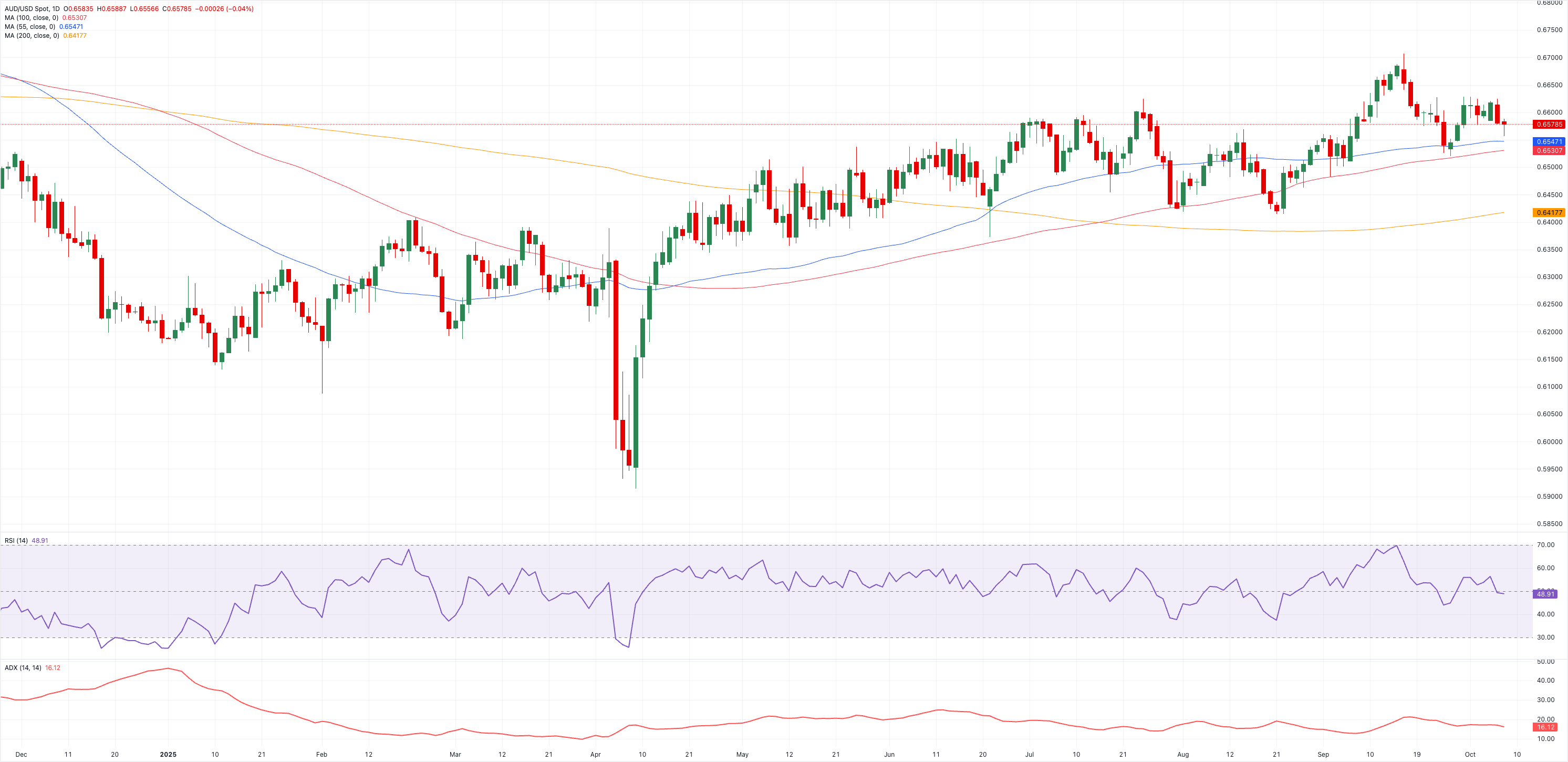
AUD/USD could be in the early stages of a consolidative move.
That said, if bulls regain the initiative, AUD/USD should face its immeidate hurdle at its 2025 ceiling at 0.6707 (September 17), prior to the 2024 high at 0.6942 (September 30), all before the key 0.7000 yardstick.
In opposition, there is an initial support at the weekly trough at 0.6520 (September 26), which looks underpinned by the transitory 100-day Simple Moving Average (SMA). A deeper pullback could drag the pair to the August valley at 0.6414 (August 21), again bolstered by the important 200-day SMA. Down from here comes the June low at 0.6372 (June 23).
Momentum indicators remain mixed: the Relative Strength Index (RSI) has deflated below 49, suggesting that bears could be regaining control, while the Average Directional Index (ADX) below 16 keeps indicating the absence of a strong trend.
AUD/USD daily chart
Waiting for a spark
All told, AUD/USD remains trapped in a broad 0.6400–0.6700 range. It’ll likely take a stronger catalyst like better Chinese data, a dovish tilt from the Fed, or a more cautious RBA to push the pair decisively in either direction.
Inflation FAQs
Inflation measures the rise in the price of a representative basket of goods and services. Headline inflation is usually expressed as a percentage change on a month-on-month (MoM) and year-on-year (YoY) basis. Core inflation excludes more volatile elements such as food and fuel which can fluctuate because of geopolitical and seasonal factors. Core inflation is the figure economists focus on and is the level targeted by central banks, which are mandated to keep inflation at a manageable level, usually around 2%.
The Consumer Price Index (CPI) measures the change in prices of a basket of goods and services over a period of time. It is usually expressed as a percentage change on a month-on-month (MoM) and year-on-year (YoY) basis. Core CPI is the figure targeted by central banks as it excludes volatile food and fuel inputs. When Core CPI rises above 2% it usually results in higher interest rates and vice versa when it falls below 2%. Since higher interest rates are positive for a currency, higher inflation usually results in a stronger currency. The opposite is true when inflation falls.
Although it may seem counter-intuitive, high inflation in a country pushes up the value of its currency and vice versa for lower inflation. This is because the central bank will normally raise interest rates to combat the higher inflation, which attract more global capital inflows from investors looking for a lucrative place to park their money.
Formerly, Gold was the asset investors turned to in times of high inflation because it preserved its value, and whilst investors will often still buy Gold for its safe-haven properties in times of extreme market turmoil, this is not the case most of the time. This is because when inflation is high, central banks will put up interest rates to combat it. Higher interest rates are negative for Gold because they increase the opportunity-cost of holding Gold vis-a-vis an interest-bearing asset or placing the money in a cash deposit account. On the flipside, lower inflation tends to be positive for Gold as it brings interest rates down, making the bright metal a more viable investment alternative.
Author

Pablo Piovano
FXStreet
Born and bred in Argentina, Pablo has been carrying on with his passion for FX markets and trading since his first college years.
















