Australian Dollar declines amid US Dollar’s strength


The AUD/USD pair dropped significantly to 0.6764 at the start of the week, primarily driven by a strengthening US dollar rather than an inherent weakness in the Australian dollar itself. This shift in the currency pair’s dynamics is primarily attributed to the latest Core PCE inflation data released last Friday, which moderated market expectations regarding the pace of future interest rate adjustments by the Federal Reserve.
The market is now in a consolidation phase as it awaits vital US employment data for August, set to be released this Friday. This upcoming report is critical as it could influence the Federal Reserve’s decisions in the near term.
In August, the manufacturing sector in Australia continued to face challenges, with high loan servicing costs and subdued demand from both businesses and consumers acting as significant headwinds.
Investors also look forward to further insights from Reserve Bank of Australia (RBA) Governor Michelle Bullock, with many closely watching the implications for the forex forecast. Recently, she indicated that it is premature to consider a relaxation of monetary policy due to persistently high inflation despite some signs of cooling. The minutes from the latest RBA meeting have echoed this sentiment, suggesting that the central bank may maintain a restrictive monetary policy stance for an extended period.
AUD/USD technical analysis
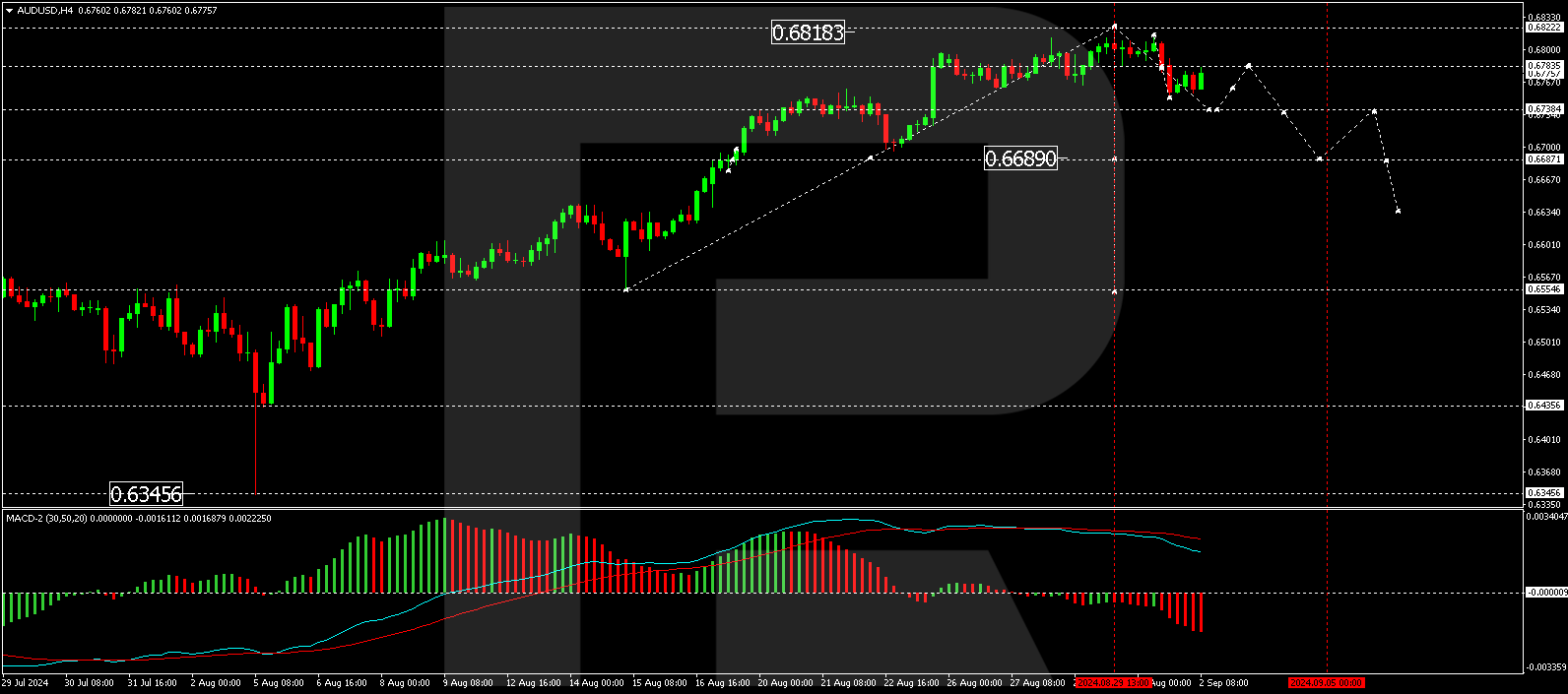
The AUD/USD is navigating the first wave of decline towards the level of 0.6743. There is an expectation that this target will be reached soon, followed by a corrective move to 0.6783 (testing from below). This would delineate the upper bounds of a consolidation range. Should the pair break downward from this range, a further decline to 0.6690 is anticipated. A breakout below this level could signal the start of a new downward trend towards 0.6640, potentially extending to 0.6555. The MACD indicator supports this bearish outlook with its high signal line directed downwards.
-638608647338843322.png)
On the H1 chart, the pair is forming a downward wave structure targeting 0.6743. After achieving this level, a rebound to 0.6783 may occur, setting the stage for the next downward phase. This scenario is corroborated by the Stochastic oscillator, with its signal line preparing to drop from below 80 to around 20, indicating potential for continued declines.
Author
Andrey Goilov
RoboForex
Higher economic education. Andrey Goilov has been working on the Forex market since 2005. A financial analyst and successful trader. Preference in trading is highly volatile instruments.

















