|

Australian data point South

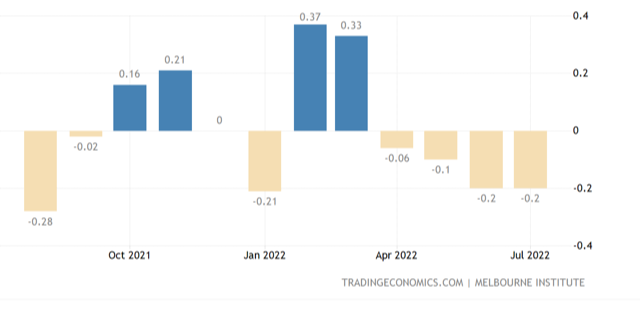
Westpac Melbourne Institute leading economic Indicator
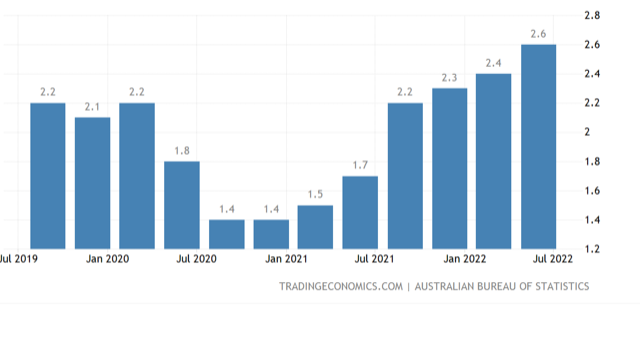
Australian Wages Hit 8 year High
Yesterday’s Australian data was decidedly concerning.

Strong evidence of a wages/inflation upward spiral, and leading economic indicators suggesting recession not far ahead.

The simultaneous nature of both these reports, and the disconnect they represent from the historical pattern of wages and inflation during periods of an over-heating economy, could not be more stark.

Time and time again we have highlighted how the low rate of employment is no longer an indicator of a strong economy. Only that immigration has collapsed. As have travellers and temporary workers.

The employment data has been the key point of those arguing the economy is strong?

Yet, this focus by many economists has completely masked the underlying reality of workers beginning to struggle to make ends meet for their families. Due to extreme energy and food prices. Misses the point that consumer behaviour risks falling off a cliff, in the not too distant future. That will be a 'already in recession’ moment.

The Westpac Melbourne Institute Leading Economic Index has been negative for 5 of the past 7 months, and steadily entrenching a contraction outlook for the past four months. Where is the strong economy indicator anywhere but in the highly mis-guided focus on employment?

Employment is no longer a valid indicator of economic activity or outlook. Economists need to learn and adjust.

Inflation, wages, and watch for consumer sentiment to turn south too. These are the factors designing our future economic outlook. Whether we like it or not.

Author

Clifford Bennett

Clifford Bennett

Independent Analyst

With over 35 years of economic and market trading experience, Clifford Bennett (aka Big Call Bennett) is an internationally renowned predictor of the global financial markets, earning titles such as the “World’s most a


More from Clifford Bennett
Share:

Editor's Picks

EUR/USD hits two-day highs near 1.1820

EUR/USD picks up pace and reaches two-day tops around 1.1820 at the end of the week. The pair’s move higher comes on the back of renewed weakness in the US Dollar amid growing talk that the Fed could deliver an interest rate cut as early as March. On the docket, the flash US Consumer Sentiment improves to 57.3 in February.

GBP/USD reclaims 1.3600 and above

GBP/USD reverses two straight days of losses, surpassing the key 1.3600 yardstick on Friday. Cable’s rebound comes as the Greenback slips away from two-week highs in response to some profit-taking mood and speculation of Fed rate cuts. In addition, hawkish comments from the BoE’s Pill are also collaborating with the quid’s improvement.

Gold climbs further, focus is back to 45,000

Gold regains upside traction and surpasses the $4,900 mark per troy ounce at the end of the week, shifting its attention to the critical $5,000 region. The move reflects a shift in risk sentiment, driving flows back towards traditional safe haven assets and supporting the yellow metal.

Crypto Today: Bitcoin, Ethereum, XRP rebound amid risk-off, $2.6 billion liquidation wave

Bitcoin edges up above $65,000 at the time of writing on Friday, as dust from the recent macro-triggered sell-off settles. The leading altcoin, Ethereum, hovers above $1,900, but resistance at $2,000 caps the upside. Meanwhile, Ripple has recorded the largest intraday jump among the three assets, up over 10% to $1.35.

Three scenarios for Japanese Yen ahead of snap election

The latest polls point to a dominant win for the ruling bloc at the upcoming Japanese snap election. The larger Sanae Takaichi’s mandate, the more investors fear faster implementation of tax cuts and spending plans. 

XRP rally extends as modest ETF inflows support recovery

Ripple is accelerating its recovery, trading above $1.36 at the time of writing on Friday, as investors adjust their positions following a turbulent week in the broader crypto market. The remittance token is up over 21% from its intraday low of $1.12.














