Aussie steady despite weak trade data

Australia’s trade surplus narrowed for a second consecutive month in August, dropping to the lowest in three months. A 3% contraction in exports was the main culprit for the deterioration while imports registered zero growth. The surplus slid to A$5.9 billion from A$7.3 billion, with analysts’ expectations at A$6.0 billion.
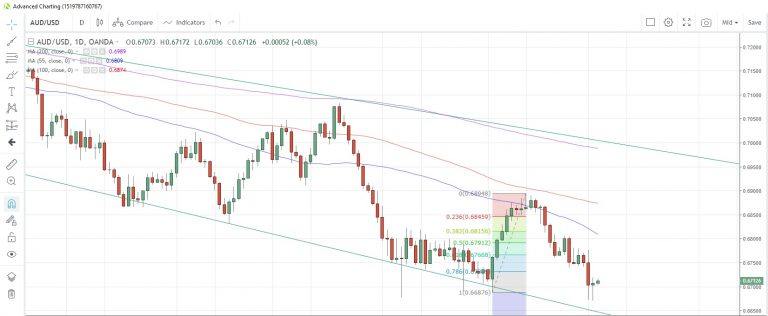
The Australian dollar was steady despite the weaker data, rising 0.03% to 0.6709 versus the US dollar and 0.01% to 71.84 versus the Japanese yen. AUD/USD looks poised for a second consecutive daily gain after touching a 10-1/2 year low yesterday.
AUD/USD Daily Chart
Source: OANDA fxTrade
BOJ needs to keep on easing
Bank of Japan Policy Board member Yukitoshi Funo said in a speech this morning that the global economy is slowing and downside risks are increasing. He noted it was vital to keep rates low to maintain a positive output gap and, if risks are seen in achieving its price target, the BOJ will need to prevent them from materializing. Easing steps include rate cuts, boosting asset purchases and further expansion of the monetary base.
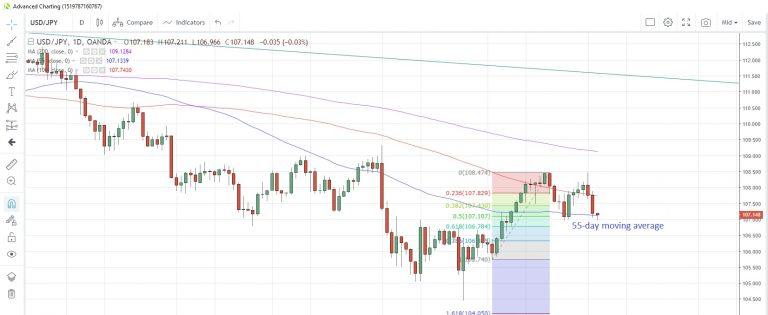
The Japanese yen showed little response to the comments, instead continuing its bid tone on the back of safe haven purchases. USD/JPY fell 0.08% to 107.10, GBP/JPY slid 0.08% to 131.72 while AUD/JPY edged 0.04% lower to 71.85. The USD/JPY 55-day moving average is at 107.13.
USD/JPY Daily Chart
Source: OANDA fxTrade
EU stands ready to extend Brexit
The UK’s Times reports that the EU is ready to bypass UK PM Johnson to grant an extension to Article 50 and the Brexit deadline. The paper notes that, under the Benn Act, the UK government is required to seek a Brexit extension to the Article 50 process if PM Johnson does not have parliamentary approval for a new agreement, or the support of MPs for a no-deal Brexit, by October 19. EU leaders are said to be on standby for an emergency Brexit summit during the last week of this month if UK Parliament does not pass anew withdrawal agreement in the next two weeks.
The pound has been relatively stable this week, with closing rates versus the US dollar in a tight 1.2295-1.2305 range so far. Today the FX pair is little changed at 1.2299. The 55-day moving average is at 1.2273 and has held on a closing basis since September 6.
Services PMIs on tap
Today it’s the turn of the services PMIs around the globe for September, with final readings from Markit for Germany, the Euro-zone, the UK and the US. In addition, we see the ISM equivalent, with estimates suggesting a dip to 55.1 from 56.4 in August. In addition we have Euro-zone retail sales for August on tap, a rebound to +0.3% m/m from -0.6% is expected, and US factory orders for the same month. Forecasts suggest a 0.2% contraction after a 1.4% expansion the previous month.
Author

Andrew Robinson
MarketPulse
A seasoned professional with more than 30 years’ experience in foreign exchange, interest rates and commodities, Andrew Robinson is a senior market analyst with OANDA, responsible for providing timely and relevant market commentar