Aussie slumps as unemployment rises


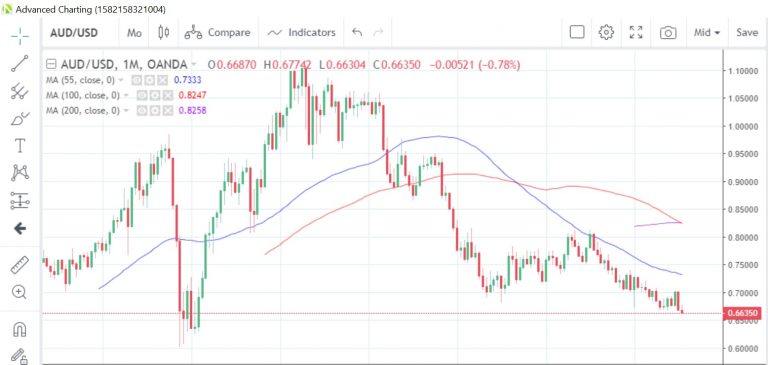
AUD/USD at 11-year low
Australia’s unemployment rate rose to 5.3% in January, up from 5.1% the previous month, and the highest reading since October last year. The uptick can be partly explained by an increase in the participation rate to 66.1%, the highest since September, from 66.0%.
The rest of the jobs report looked encouraging, with a net 13,500 jobs added in the month, more than the 10,000 economists had expected, made up of a gain of 46,200 full-time jobs countered by a loss of 32,700 part-time ones.
Investors chose to focus on the unemployment rate, given that it is a major focus for the central bank, and pushed the Aussie lower across the board, with AUD/USD touching 0.6641, the weakest since March 2009. 3-year Australian bond yields slid 5 bps after the data.
AUD/USD Monthly Chart
Source: OANDA fxTrade
China cuts Prime Rate
In a move that had been widely expected, China reduced its Loan Prime Rate (LPR) by 10 bps to 4.05%. At the same time, it trimmed 5 bps off its 5-year LDR to bring it down to 4.75%. The move comes on the back of a 10 bps cut to the MLF earlier in the week. In addition, China had announced last weekend a raft of stimulus measures to help the economy overcome the impact of CoVid-19.
Current sentiment would suggest that the market believes this will be enough to shore up the economy when faced with the virus threat, since Wall Street indices powered higher yesterday, with some hitting new record highs.
However, the South China Morning Post, citing various analysts, cautioned that the rate cut would only provide “limited relief”.
S&P sees China 2020 growth lower
Ratings agency S&P commented that it sees an economic recovery in China in Q3 and forecasts that the Chinese economy will expand 5% in the full year. It also cautioned that the CoVid-19 impact could double the amount of questionable loans in China.
USD/SGD spikes higher
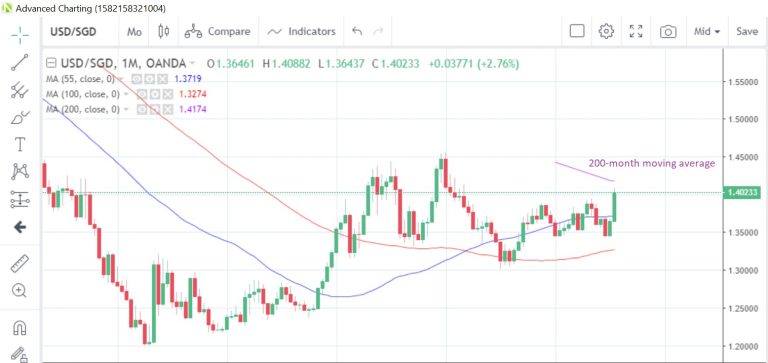
A firmer US dollar, weaker yuan and concerns about how deep the CoVid-19 threat will impact the local economy, since Singapore has very close links with China. In addition, it is the country with the second-highest number of confirmed virus cases outside China, along with Japan.
Meanwhile, ratings agency Fitch said the wider budget deficit announced earlier this week, rising to 2.1% of GDP in the fiscal year ending March 2021, is unlikely to jeopardise Singapore’s AAA rating, since it retains exceptionally strong external and fiscal balance sheets.
USD/SGD spiked higher to 1.4089 earlier this morning, the highest since May 2017 and is now at 1.4024. The 200-month moving average is at 1.4174.
USD/SGD Monthly Chart
Source: OANDA fxTrade
German consumer confidence to slide
Consumer confidence in Germany is expected to dip to 9.8 in March from 9.9 this month, according to the latest survey of economists, while producer prices are expected to rise 0.2% from a month earlier in January. UK retail sales for last month complete the European session, along with a speech from ECB’s De Guindos.
The US session features weekly jobless claims and the Philadelphia Fed manufacturing survey for February. That’s expected to fall to 12 from 17 last month. A speech from Fed’s Barkin concludes the session.
Author
Andrew Robinson
MarketPulse
A seasoned professional with more than 30 years’ experience in foreign exchange, interest rates and commodities, Andrew Robinson is a senior market analyst with OANDA, responsible for providing timely and relevant market commentar