AUD/USD Weekly Forecast: Trump’s health and the RBA in the limelight
- The RBA is having a monetary policy meeting but will probably be a non-event.
- Sentiment overshadows data in a tumultuous fundamental week.
- AUD/USD has retained its bullish long-term potential, despite a risk-off mood.

The AUD/USD pair has recovered some ground these days, as the greenback remained out of the market’s favor. Risk-appetite played against the greenback at the beginning of the week, later suffering from US political woes. As for the Aussie, gold’s comeback has provided support, as the focus shifts to the Reserve Bank of Australia announcement next week.
COVID-19 and employment
Little of interest happened in Australia last week. The most encouraging news came from the coronavirus front, as the country seems to have controlled the latest outbreak, reporting on average 20 new cases per day this week. Even more relevant, travel restrictions between the country and its neighbour New Zealand will begin to ease later this month, amid a continued decline in community transmission in both countries.
The Aussie’s advance was a result of the broad greenback’s weakness. The American currency fell despite the market’s sentiment fluctuated. Optimism led the way at the beginning of the week amid hopes the US Congress could agree on a stimulus deal, although the week has come to an end without it. House Speaker Nancy Pelosi said on Thursday that “serious” differences remain over the coronavirus relief bill, although she added that she remains optimistic.
By the end of the week, news that US President Donald Trump and wife Melania contracted COVID-19 spurred risk aversion ahead of US employment data. The Nonfarm Payroll report showed that the county added just 661K new jobs in September, quite a disappointing outcome. The unemployment rate ticked lower, to 7.9% from 8.4%, beating expectations, although it passed unnoticed, as it only indicates that fewer people are searching for work. The greenback found some support in the dismal market mood, although not enough to turn positive against its major rivals.
Slow pace of economic growth
Meanwhile, the most optimistic headlines came from China. The official NBS Manufacturing PMI surged to 51.5 in September, while the Non-Manufacturing PMI printed at 55.9, both above the final August readings and beating the market’s expectations. Growth in the Asian giant seems to be in better shape than in the rest of the world.
Australian data, on the other hand, missed expectations and pointed for a steeper economic downturn. The September AIG Performance of Manufacturing Index contracted to 46.7 in September from 49.3 in the previous month. The Commonwealth Bank index resulted at 55.4 from 55.5. Also, Retail Sales in the country fell by 4.0% in August, slightly better than previously estimated.
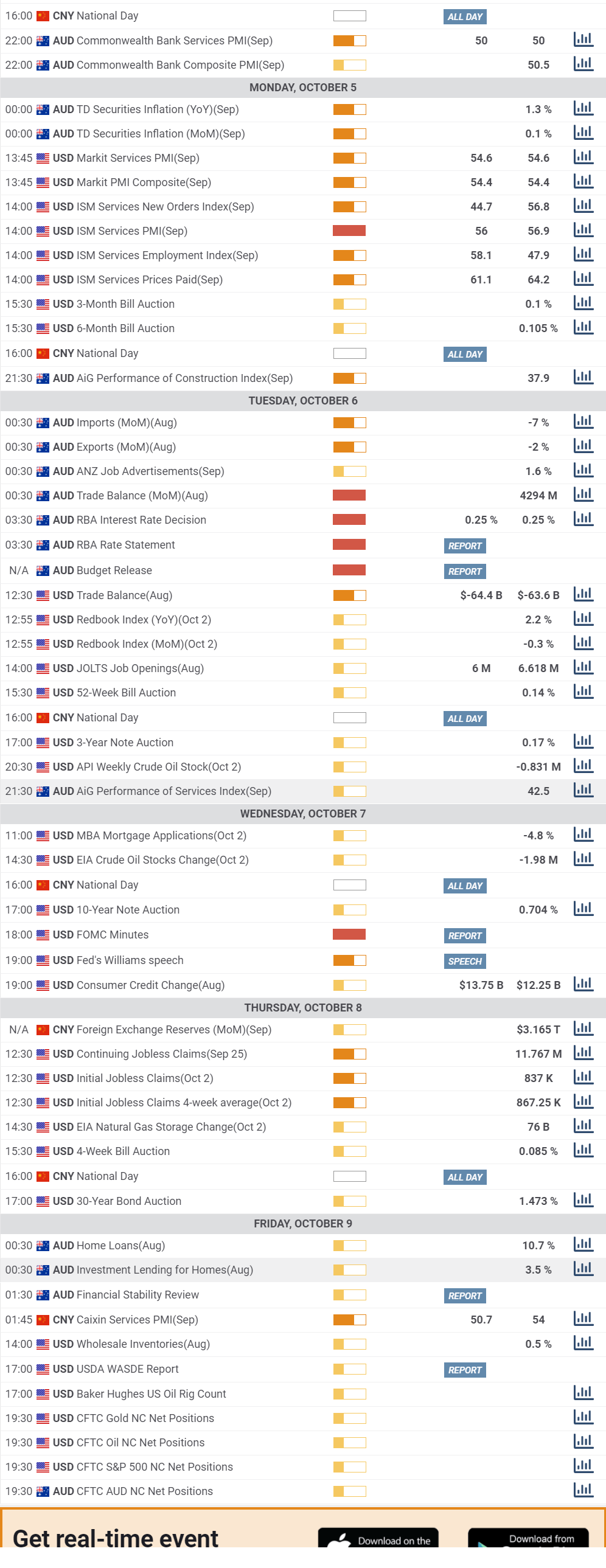
The upcoming week will be a busy one in Australia, as the country will publish updates on services output and inflation. On Tuesday, the RBA will meet to decide on the economic policy, although the market is heading into the event without expectations, as central banks have made it clear that it’s time for wait-and-see. China will be on holidays for most of the week, which means there’s not much to take care off.
As for the US, the focus will be on the FOMC Meeting Minutes, to be out next Wednesday. Expectations for this event are also limited. Instead, the attention will remain on Trump’s health, and whether the US Congress is able or not to clinch a deal.
AUD/USD Technical Outlook
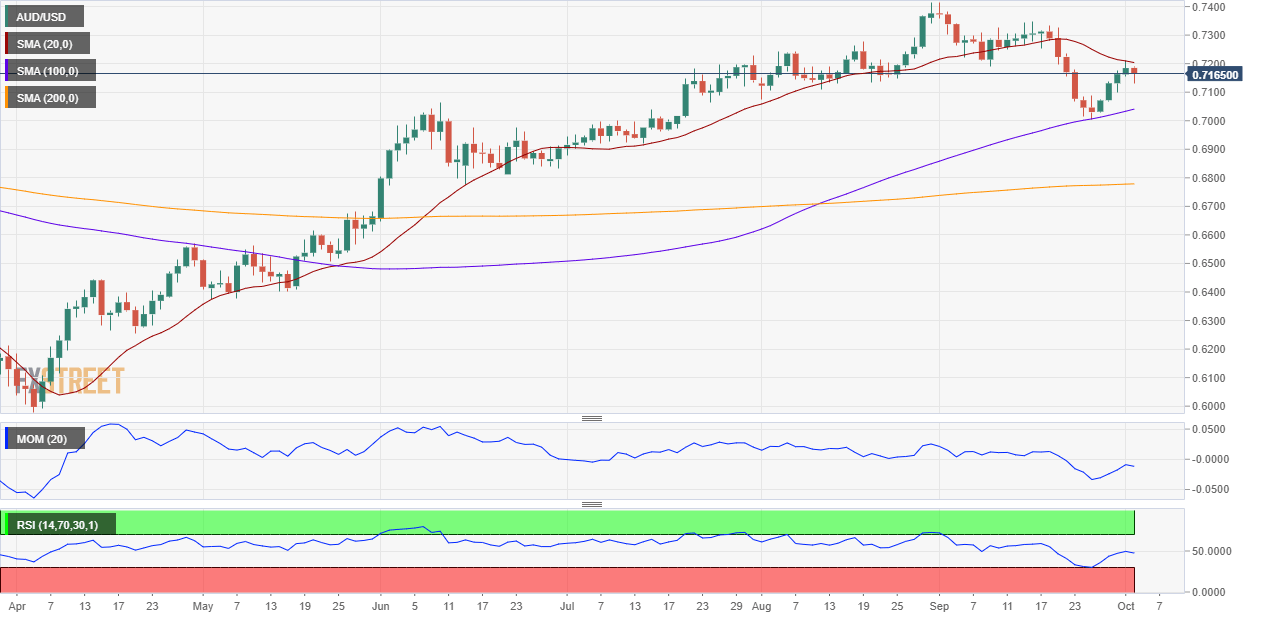
The weekly chart for the AUD/USD pair indicates that the pair has recovered its bullish potential. The pair has bounced from a bullish 20 SMA, which maintains its bullish slope above the 100 SMA. So far, the pair was unable to recover beyond a mildly bearish 200 SMA. Technical indicators, in the meantime, seem to have completed their corrective decline within positive levels, now turning higher.
In the daily chart, however, the pair is neutral-to-bearish. Technical indicators stand just below their mid-lines with modest downward slopes. A mildly bearish 20 DMA capped the upside, now around the 0.7200 level, but a bullish 100 DMA provided support, currently at 0.7040.
The pair’s bias will continue to depend on the market’s sentiment. As long as it holds above the 0.7000 figures, the bearish potential will remain limited, while a break below it exposes 0.6920. Once below this last, the next relevant level to watch is 0.6840. Resistances are located at 0.7200, and 0.7250, with gains above this last favoring an extension towards 0.7345.
AUD/USD sentiment poll
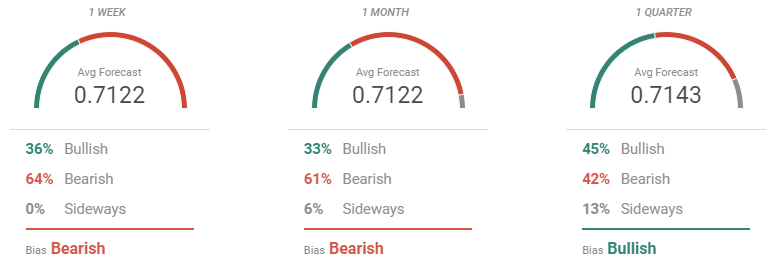
According to the FXStreet Forecast Poll pressure will remain on the Aussie. AUD/USD is expected to fall in the next few weeks, as bears stand at 64% weekly basis and at 61% in the monthly view. For the quarterly perspective, bulls stand at 45% while those betting for a decline, account 42%, pretty even. The spread of possible targets widens as time goes by, although the number of those watching for levels sub-0.7000 remains limited.
The Overview chart shows that moving averages in the three time-frame under study continue to lack clear directional strength. In the monthly view, most targets fall below the current level, although as time goes by, higher possible targets come to play.
Related Forecasts:
EUR/USD Weekly Forecast: Chaotic US developments signal wild days ahead
GBP/USD Weekly Forecast: Will Boris break the Brexit deadlock? Volatility set to explode
Author

Valeria Bednarik
FXStreet
Valeria Bednarik was born and lives in Buenos Aires, Argentina. Her passion for math and numbers pushed her into studying economics in her younger years.