Fed recap: One hike down, more to come? The Fed’s new rate path says yes

The Federal Reserve (Fed) raised its Fed Fund Target Range (FFTR) range by 25 basis points to 3.75%-4.00% in a unanimous decision, saying the move would support a timelier return to its 2% inflation goal. The accompanying September projections and Chair Kevin Warsh’s press conference delivered a clear message: the economy is resilient, financial conditions are not sufficiently restrictive and further tightening remains a realistic possibility.
A hike with a clear inflation message
The statement acknowledged that economic activity was expanding at a solid pace, domestic spending remained resilient and job gains had broadly kept pace with the workforce. Productivity growth and capital investment were also described as strong. At the same time, the Fed said inflation remained elevated and removed its earlier reference to supply shocks as a partial explanation, placing greater emphasis on the persistence of price pressures.
The decision was unanimous, but the language was notably firm. The Fed said the rate increase would help return inflation to target more quickly, while reiterating that it would deliver price stability.
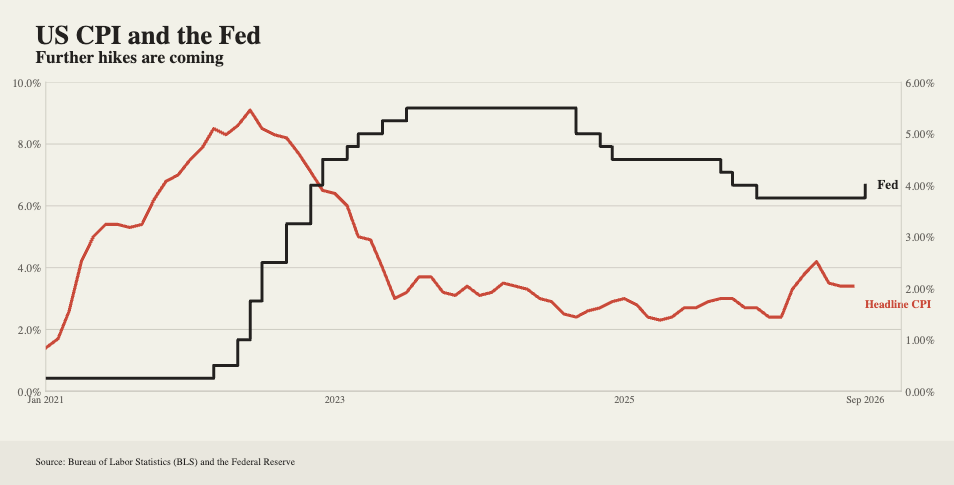
The SEP moves higher
The updated Summary of Economic Projections (SEP) reinforced the hawkish message. The median forecast for the Fed funds rate rose to 4.1% at the end of 2026 (from 3.8% in June). Twelve of the 18 officials see one more 25-bps increase this year, four expect two additional hikes, and two see no further increase.
Rate projections were also revised higher for 2027 and 2028, with the median moving to 4.1% and 3.9%, respectively. The longer-run rate estimate edged up to 3.2% (from 3.1%), suggesting that policymakers may see less need to return to the exceptionally low rates of the past decade.
In addition, growth is now expected to reach 2.3% in 2026 (from 2.2% in June), while the unemployment forecast was lowered to 4.1% (from 4.3%). Inflation forecasts moved higher: Headline PCE inflation is seen at 3.7% and core PCE at 3.4% by year-end.
Warsh: the economy can withstand tighter policy
Warsh described the decision as sober and correct, stressing that the economy had strengthened during the seven weeks since the previous meeting. The labour market remains in robust shape, with a low jobless rate, rising job openings and increasing hours worked.
His central argument was that the Fed has room to concentrate on prices because the economy is resilient. He said the view that financial conditions were not restrictive was widely shared across the FOMC and described the move as removing “a dose of accommodation”.
Warsh was unconvinced that the summer inflation data represented a meaningful improvement. He did not submit an individual dot and refused to pre-judge future decisions, but his comments made clear that the bar for further easing is high.
All in all
This was a hawkish hike, even though the Fed presented it as a measured adjustment rather than the beginning of a predetermined tightening cycle. The SEP points towards at least one further increase this year, and Warsh’s assessment of a stronger economy and insufficiently restrictive financial conditions supports that view.
Further hikes are not guaranteed. The Fed will need to see whether underlying inflation finally moves convincingly towards 2%. For now, however, the message is that policy has not yet done enough, and that the risk of another increase remains firmly alive.
Author

Pablo Piovano
FXStreet
Born and bred in Argentina, Pablo has been carrying on with his passion for FX markets and trading since his first college years.