AUD/USD Price Forecast: The upside magnet remains at 0.6300
- AUD/USD retested once again the key 0.6300 hurdle.
- The US Dollar faced renewed downside pressure despite tariff threats.
- Markets expect the RBA to reduce its interest rate at its next meeting.


On Thursday, the US Dollar (USD) faces an accelerated downward bias that sent the US Dollar Index (DXY) to the area of weekly lows in the mid-107.00s, despite another firm print of United States (US) inflation in January, this time coming from Producer Prices.
In the meantime, the Australian Dollar (AUD) managed to capitalize well on the Greenback’s pullback, leaving behind Wednesday’s retracement and retesting the 0.6399 region, the upper end of the monthly range.
Trade turbulence and tariff tensions
Recent trade disputes have seen the Australian Dollar track along with other risk-linked currencies, largely because the US Dollar had been losing steam and markets remained unsure about the latest tariff drama from Washington.
- Tariff updates: President Trump delayed a 25% tariff on Canadian and Mexican goods by one month, which initially lifted market sentiment. However, fresh tariff threats soon knocked confidence down again.
- China in the crosshairs: The US also hit Chinese imports with a 10% tariff, sparking fears that Beijing might retaliate. Since China is Australia’s biggest export destination, any countermeasures could dent demand for Australian commodities. Beijing has hinted it could challenge these tariffs at the World Trade Organization (WTO), adding to the uncertainty for resource-based economies like Australia.
Inflation, the Fed and the road ahead
Although the US Dollar has recouped some recent losses, the possibility of a deepening trade war still hangs over the market. If trade tensions heat up further, US inflation might rise, which could prompt the Federal Reserve (Fed) to maintain its restrictive stance for a longer period.
In Australia, eyes are on the Reserve Bank of Australia (RBA). Latest figures suggest inflation is cooling:
- Fourth-quarter Consumer Price Index (CPI) rose by 2.5% year-over-year, down from 2.8%
- The trimmed mean CPI—a key RBA gauge—slipped to a three-year low of 3.2%
As investors continue dialling back their bets on US rate cuts this year, market participants are almost certain the RBA will kick off its easing cycle next week.
With a 90% probability priced in, the RBA is widely expected to trim its cash rate from 4.35% to 4.10% on February 18. However, expectations for deeper cuts remain muted, with markets only forecasting 75 basis points of easing for 2025.
The big question: What happens next? If the RBA does pull the trigger on a cut, investors anticipate minimal forward guidance, leaving markets to speculate on whether this is the start of a slow, measured cycle—or just a one-off move to cushion a cooling economy.
Commodities do not offer support
Australia’s export outlook can be murky when Chinese demand is at risk. Iron ore and copper—two pillars of Australia’s economy—could face pressure if trade frictions persist. Thursday’s pullback on both these commodities also contributed to the offered stance in spot.
Technical snapshot
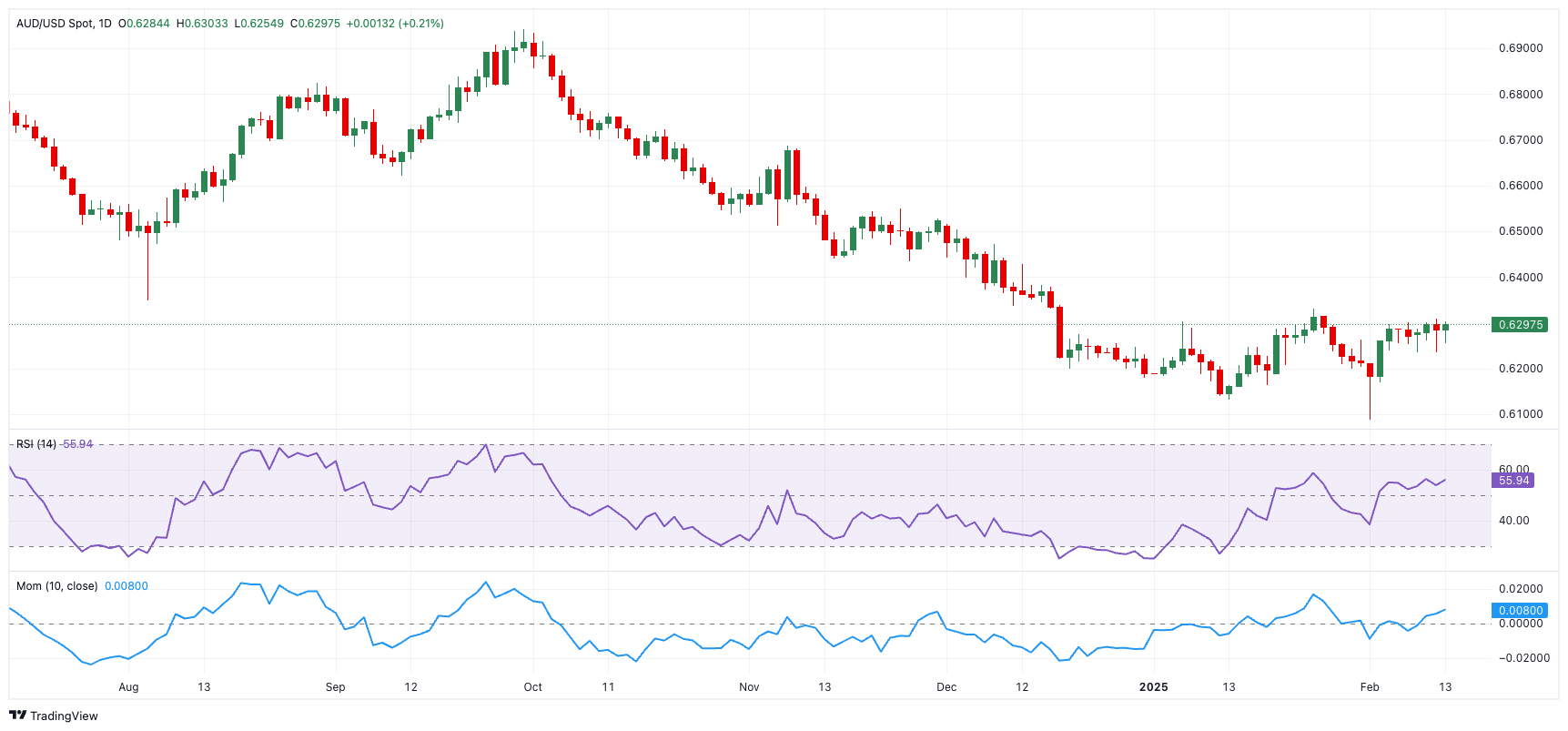
On the downside, the 0.6087 zone stands as critical support for AUD/USD—it’s the lowest level the pair has hit so far this year. A break below could open the door to the key 0.6000 region.
On the flip side, the first hurdle is the yearly peak at 0.6330, followed by the 100-day Simple Moving Average (SMA) at 0.6451, and then 0.6549 (the weekly high from November 25).
Additionally, some indicators offer mixed signals: The Relative Strength Index (RSI) remains near 55, hinting at weakening bullish momentum, while the Average Directional Index (ADX), around 18, suggests a lack of a strong trend.
AUD/USD daily chart
What’s next?
Looking ahead, traders will keep an eye on the Melbourne Institute’s Consumer Inflation Expectations set for release on February 14. Any surprises there could stir further moves in the Aussie Dollar, especially as the next RBA decision approaches.
Premium
You have reached your limit of 3 free articles for this month.
Start your subscription and get access to all our original articles.
Author
Pablo Piovano
FXStreet
Born and bred in Argentina, Pablo has been carrying on with his passion for FX markets and trading since his first college years.