AUD/USD Price Forecast: Remain at the mercy of USD price dynamics, trade-related headlines
- AUD/USD attracts some dip-buyers on Thursday amid hopes for more stimulus from China.
- A modest USD pullback from a three-week high lends additional support to the currency pair.
- Rising trade tensions caps spot prices as traders now await the US PCE Price Index on Friday.

The AUD/USD pair reverses an intraday dip and climbs back above the 0.6300 round figure during the first half of the European session on Thursday, though it lacks follow-through. The global risk sentiment gets a minor bump after China's Vice Premier Ding Xuexiang pledged stronger policy support for the world's second-largest economy, which, in turn, benefitted the China-proxy Aussie. Ding said that the government will implement more proactive macro policies this year and strive to achieve the full-year growth target.
Apart from this, a modest US Dollar (USD) pullback from a three-week top touched earlier this Thursday turns out to be another factor acting as a tailwind for the AUD/USD pair. Investors remain worried that economic growth was slowing considerably on the back of US President Donald Trump's trade policies. This, along with the Federal Reserve's (Fed) forecast for two 25-basis-points rate cuts in 2025, overshadows Wednesday's better-than-expected release of US Durable Goods Orders and undermines the buck.
The US Commerce Department reported that Durable Goods Orders rose 0.9% in February, while Core Durable Goods, which strip out the volatile transportation sector, increased by 0.7%. Adding to this, the overnight hawkish comment from a slew of influential FOMC members provided a modest lift to the USD, though bulls lack conviction amid the uncertainty over Trump's reciprocal tariffs on April 2 and their impact on the US economy. This keeps the USD bulls on the defensive and supports the AUD/USD pair.
The Australian Dollar (AUD), however, continues with its struggle to capitalize on the move higher on the back of an escalating US-China trade war and a greater chance of a rate cut by the Reserve Bank of Australia (RBA) in May. Traders might also refrain from placing aggressive bets and opt to wait for the release of the US Personal Consumption Expenditure (PCE) Price Index on Friday. The crucial inflation data should provide cues about the Fed's rate-cut path, which, in turn, will drive the USD and the AUD/USD pair.
AUD/USD daily chart
Technical Outlook
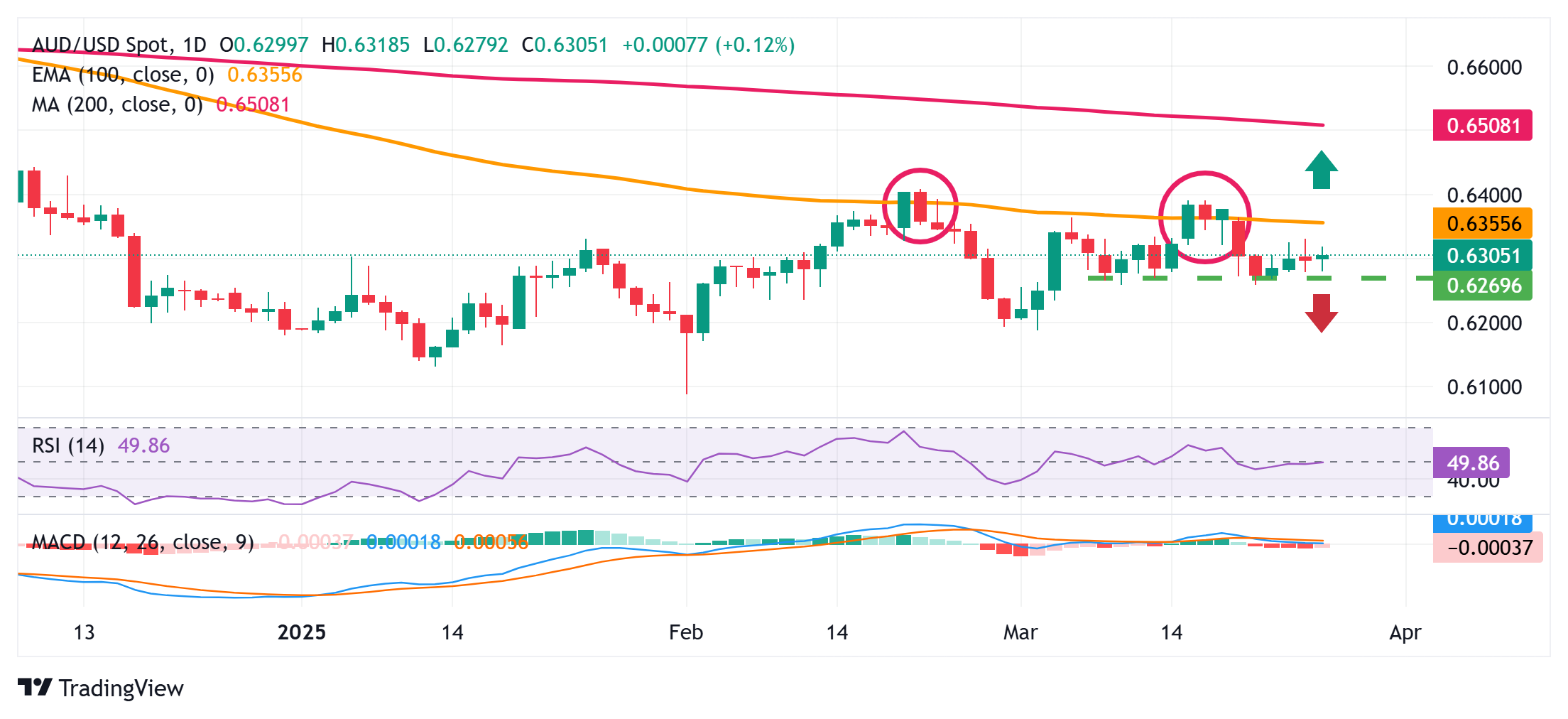
From a technical perspective, the recent repeated failures to build on strength beyond the 100-day Exponential Moving Average (EMA) and the subsequent slide warrant caution for bullish traders. Furthermore, the AUD/USD pair has been oscillating in a multi-day-old range, which, along with neutral oscillators on the daily chart, makes it prudent to wait for a sustained move in either direction before positioning for the near-term trajectory.
Meanwhile, any subsequent move up might continue to face stiff resistance near the 100-day EMA, currently pegged near the 0.6355-0.6360 region. This is followed by the year-to-date high, levels just above the 0.6400 mark touched in February, which if cleared decisively will set the stage for additional gains. The AUD/USD pair might then climb to the 200-day SMA hurdle near the 0.6440 area before aiming to reclaim the 0.6500 psychological mark.
On the flip side, the 0.6280-0.6275 zone now seems to have emerged as an immediate support, below which the AUD/USD pair could slide to the 0.6255-0.6250 support. Some follow-through selling could make spot prices vulnerable to retesting sub-0.6200 levels, of the monthly swing low. The downward trajectory could extend further towards the 0.6135 intermediate support en route to the 0.6090-0.6085 region, or a multi-year low touched in February.
Author

Haresh Menghani
FXStreet
Haresh Menghani is a detail-oriented professional with 10+ years of extensive experience in analysing the global financial markets.