AUD/USD Price Forecast: Next target now sits at 0.6500
- AUD/USD advanced further and came closer to the 0.6500 barrier.
- The US Dollar remained on the back foot, adding to Friday’s drop.
- PM Albanese and the Labour Party won the elections over the weekend.


The Australian Dollar (AUD) maintained its upside bias on Monday, extending gains against the US Dollar (USD) for a second straight session. That said, AUD/USD advanced to just pips away from the key 0.6500 hurdle in quite an auspicious beginning of the week, helped by the weaker Greenback and signs of easing trade tensions between Washington and Beijing.
The generalised firm risk sentiment also underpinned the bullish performance of the Aussie, while keeping the US Dollar under persistent downside pressure.
Australia’s China link remains a vulnerability
Despite a thaw in US-China relations, markets remain wary of how quickly improved diplomacy will translate into economic upside—particularly for Australia, whose trade exposure to China remains substantial.
Indeed, any sign of softening demand or political strain out of Beijing can weigh heavily on AUD, regardless of developments elsewhere.
Central banks hold steady, but outlooks diverge
Both the Federal Reserve (Fed) and Reserve Bank of Australia (RBA) left interest rates unchanged at their latest meetings. But policy messaging diverged subtly.
Fed Chair Jerome Powell stuck to a cautious, data-driven script, reiterating the Fed's resolve to bring inflation to target before easing. Meanwhile, RBA Governor Michele Bullock cited elevated inflation and a tight labour market in justifying the hold at 4.10%.
Australia’s recent inflation print offered little relief: headline and trimmed mean CPI both came in slightly above expectations, keeping the door open for further delays to any easing cycle.
Markets still fully price in a 25 basis point cut at the RBA’s May 20 meeting—but expectations for a larger move have faded. Over the next 12 months, traders anticipate up to 125 basis points of total easing.
Back to the Fed, investors largely anticipate the central bank to keep its Fed Funds Target Range (FFTR) unchanged at 4.25%-4.50% at its upcoming meeting.
Speculators lighten up on bearish Aussie bets
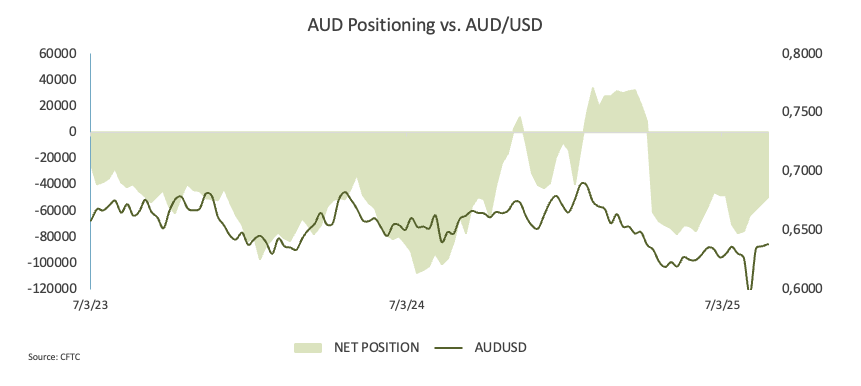
Fresh CFTC data suggests sentiment toward the Aussie may be stabilising. Net short positions among non-commercial traders fell to seven-week lows to approximately 50K contracts as of April 29, on the back of a downtick in open interest rose—a potential sign that positioning may be bottoming out.
Light data week ahead in Oz
The domestic calendar will include the release of Building Permits and Private House Approvals on May 6, followed by the Ai Group Industry Index, which will round out the docket on May 7.
Technical view
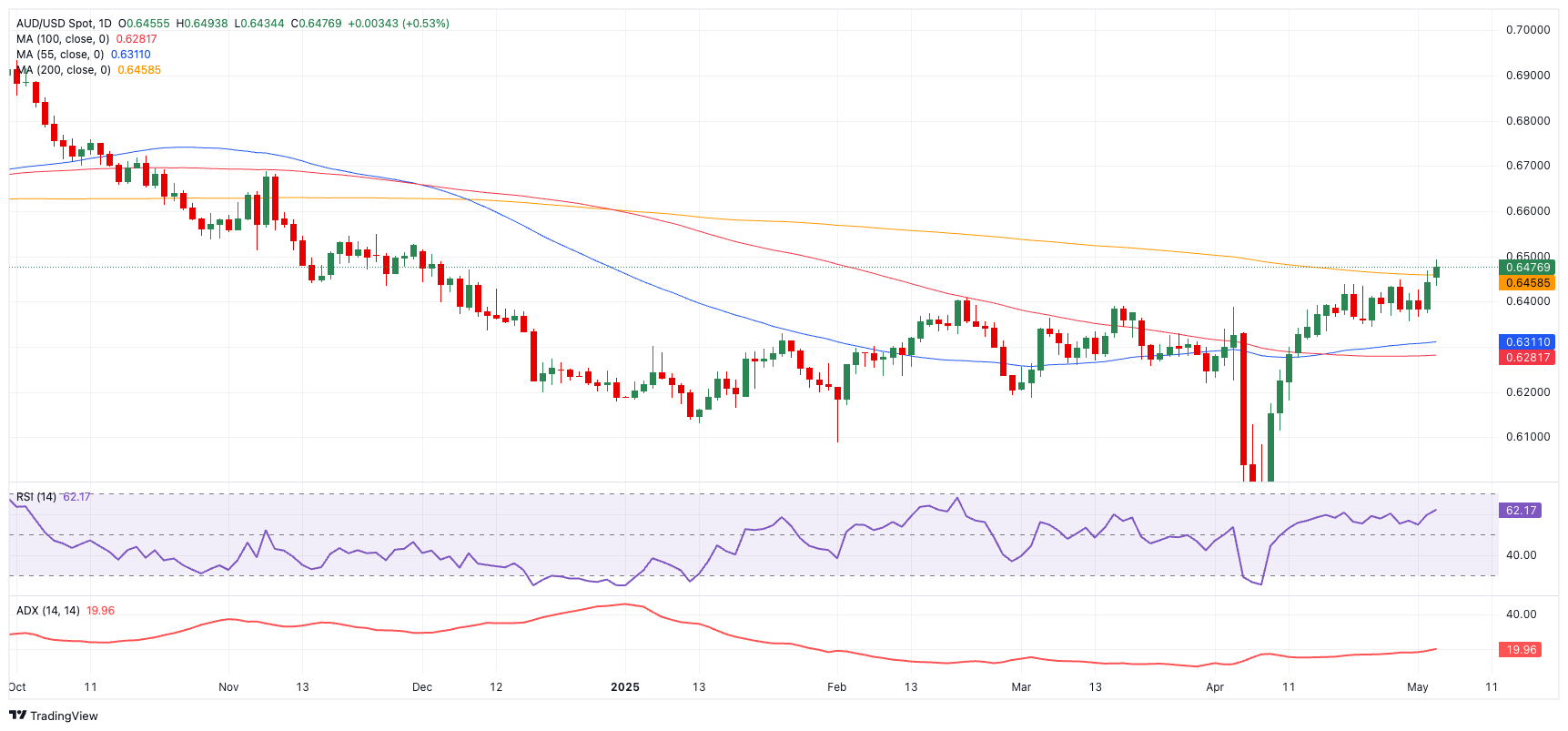
AUD/USD managed to surpass its 200-day simple moving average (SMA) at 0.6460, while a decisive break above it could open a path toward the November 2024 high of 0.6687 and to a more constructive outlook as well.
On the downside, transitory support is seen at the 55-day and 100-day SMAs (0.6309 and 0.6283, respectively). A break below those levels could expose the pair to deeper losses, potentially toward the 2025 bottom of 0.5913 or even the pandemic-era trough at 0.5506.
Momentum signals are tilted to the bullish side: the Relative Strength Index (RSI) above 62 shows scope for further upside, but a gradual strengthening of the Average Directional Index (ADX) around 21 suggests the pair’s recovery continues to gather impulse.
AUD/USD daily chart
Outlook: Volatility ahead, but risks titled to the downside
With global trade still in flux and inflation proving sticky at home, the Australian Dollar faces a tough backdrop. Unless local data convincingly beats expectations—or Chinese growth surprises to the upside—AUD/USD may struggle to sustain rallies in the near term.
Author
Pablo Piovano
FXStreet
Born and bred in Argentina, Pablo has been carrying on with his passion for FX markets and trading since his first college years.