AUD/USD Price Forecast: Next on the upside comes the 200-day SMA
- AUD/USD advanced to 2025 peaks and approached the 0.6400 level.
- The US Dollar sold off as investors digested the latest tariff headlines.
- Australia’s jobs report came in stronger than initial estimates in January.


The US Dollar (USD) reversed two consecutive days of gains on Thursday, sending the Dollar Index (DXY) back to the area south of the 107.00 support amid some alleviated concerns surrounding tariffs and despite steady effervescence on the geopolitical landscape.
Over in Australia, the Aussie Dollar (AUD) accelerated its gains against the Greenback, sending AUD/USD to the 0.6380-0.6390 band for the first time since December, helped at the same time by a solid labour market report in Oz.
Tariffs and trade tensions
Trade tensions are still a major driver in the currency markets. The Australian Dollar, along with other risk-friendly currencies, had been on a roll thanks to the US Dollar’s softer patch and uncertainty around new United States (US) tariff plans.
President Donald Trump provided a brief boost to market sentiment by postponing a planned 25% tariff on Canadian and Mexican goods for one month in early February. However, that optimism quickly faded when new tariff threats appeared. The US also slapped a 10% tariff on Chinese imports, raising concerns about possible retaliation from China.
Because China is Australia’s biggest export market, any further escalation could weaken demand for Australian commodities. China has even suggested it might challenge the US at the World Trade Organization (WTO), adding another layer of uncertainty for resource-exporting nations like Australia.
Monetary policy at a crossroads: The RBA, inflation and the Fed
Even though the US Dollar has recovered somewhat, investors remain on edge about potential flare-ups in trade disputes. If these conflicts heat up, they could push inflation higher, which in turn might keep the Federal Reserve (Fed) leaning toward tighter monetary policy for longer.
In Australia, the Reserve Bank of Australia (RBA) recently cut its policy rate by 25 basis points to 4.10%—a move the market had widely expected. The RBA stressed this doesn’t mark the start of a bigger easing cycle. Underlying inflation is projected to hover a bit above the target at 2.7% and robust labour data prompted a reduction in the unemployment forecast to 4.2%.
At her press conference, RBA Governor Michele Bullock underscored that the rate cut doesn’t automatically signal more cuts ahead. Future decisions will hinge on developments in the labour market.
For context, Australia’s job market beat expectations in January, adding 44K positions—mostly full-time—and pushing the Unemployment Rate to 4.1%, still below the RBA’s 4.2% forecast. The strong data reinforced the bank’s cautious approach to any further rate cuts.
Deputy Governor Andrew Hauser echoed Governor Bullock’s scepticism about the market’s optimism for quick rate reductions, with futures currently implying under 50 basis points of cuts over the next year.
Commodities lend a helping hand
Australia’s economy is deeply tied to its commodity exports, so any drop in Chinese demand could ripple through the country’s growth outlook. On Thursday, however, copper prices resumed their weekly recovery, while iron ore prices trimmed their recent uptrend somewhat.
Technical view: Key levels
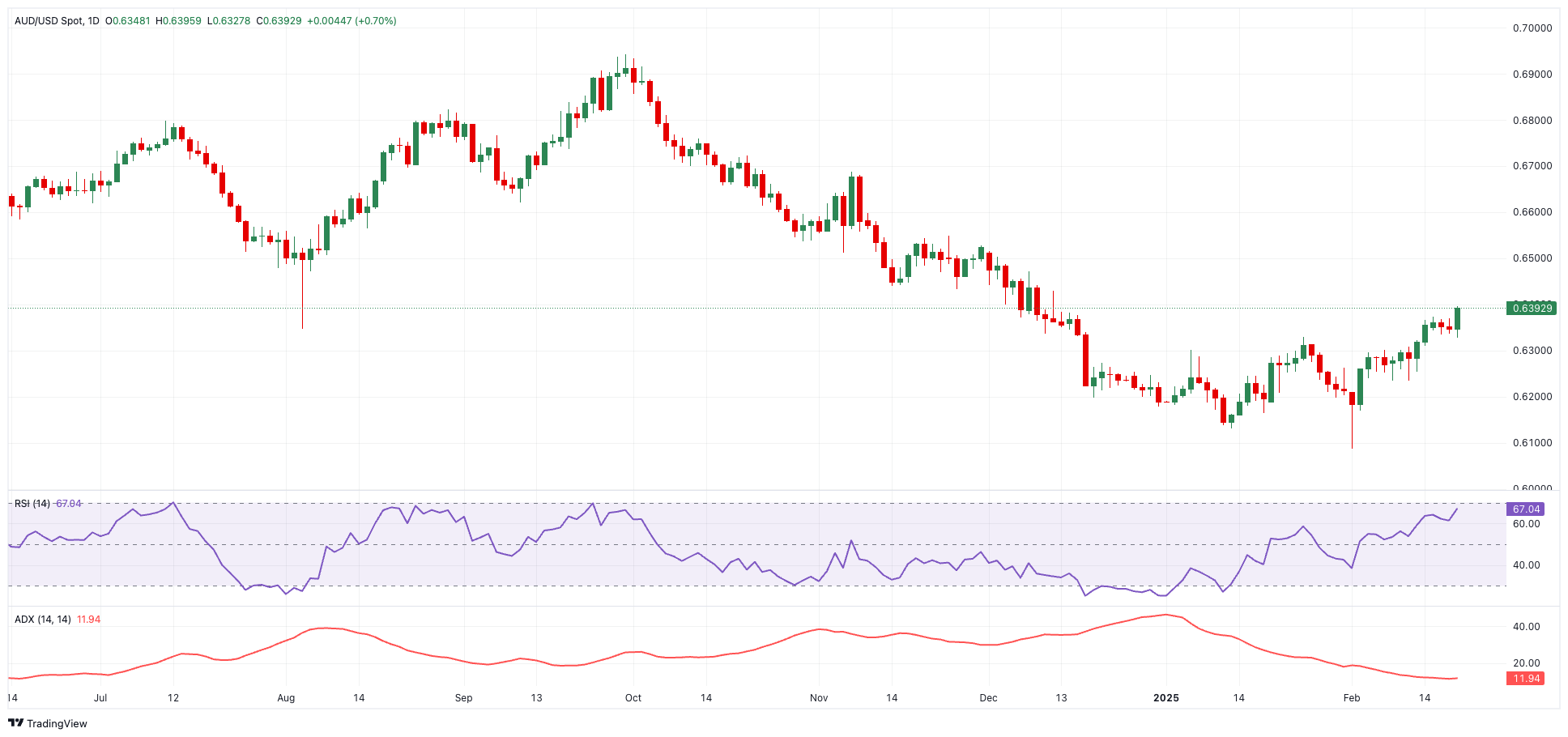
On the upside, the first hurdle is the 2025 high of 0.6395 (February 20). The next level to watch is the 100-day Simple Moving Average (SMA) at 0.6425, followed by the weekly top at 0.6549 (November 25), and finally the 200-day SMA at 0.6553.
On the downside, the initial support is the 55-day SMA at 0.6276, followed by the 2025 bottom at 0.6087, and then the psychologically important 0.6000 mark.
Indicators are giving mixed signals. The Relative Strength Index (RSI) surpasses the 63 level, hinting at a firm bullish tilt, while the Average Directional Index (ADX) near 13 suggests the overall trend is still fairly weak.
AUD/USD daily chart
Next tap on the docket
Moving forward, the RBA’s Monthly CPI Indicator will grab attention on February 26, seconded by Construction Done figures. On February 27 will come the always relevant quarterly prints of Private Capital Expenditure (Q4), while Housing Credit and Private Sector Credit numbers will close next week’s calendar.
Premium
You have reached your limit of 3 free articles for this month.
Start your subscription and get access to all our original articles.
Author
Pablo Piovano
FXStreet
Born and bred in Argentina, Pablo has been carrying on with his passion for FX markets and trading since his first college years.

















