AUD/USD Price Forecast: Next on the upside comes 0.6600
- AUD/USD added to the positive start to the week and rose to multi-day highs.
- The US Dollar dropped further following the continuation of the downside bias.
- The RBA Minutes left the door open to extra easing in the next meetings.


The Australian Dollar (AUD) maintained its bullish momentum for the third consecutive day on Tuesday, lifting AUD/USD further north of the key 0.6500 mark on Tuesday, riding a wave of US Dollar weakness.
Jobs miss keeps rate‑cut talk alive
Last week’s labour market data offered little encouragement. Unemployment edged up to 4.3%, while the economy added a paltry 2K jobs. Participation nudged to 67.1%, and consumer inflation expectations cooled to 4.7% in July from 5.0 % a month earlier.
Those numbers help explain the Reserve Bank of Australia’s (RBA) surprise decision earlier this month to leave its cash rate at 3.85%. Six board members voted to wait; three wanted an immediate 25‑bp cut. Governor Michele Bullock brushed off the split as a matter of “timing, not direction” and hinted that a softer second‑quarter CPI print would clear the runway for easing.
The RBA Minutes from the July 8 policy meeting indicated that further easing is anticipated in the future. It was noted that all members reached a consensus regarding the outlook, indicating that underlying inflation was expected to decline further in year-ended terms, which would justify some additional reduction in interest rates over time.
The Minutes indicated that a minority of members believed that the “downside risks to the economic outlook” provided justification for lowering the cash rate target at this meeting. A majority of members expressed the view that lowering the cash rate for a third time within four meetings would not align with what they described as “a cautious and gradual” approach to easing monetary policy.
Furthermore, the RBA is likely to resume easing at its August 12 gathering, as futures markets fully anticipate a 25 basis point cut in August, along with a total easing of 75 basis points over the next 12 months.
China’s two‑speed recovery
Australia's largest trading partner continues to present a mixed picture.
Chinese GDP grew 1.1% in Q2 (5.2% YoY), factory output is humming at almost 7 %, yet retail sales are stuck below 5% as households stockpile savings. A chunky June trade surplus of $114.8 bn underlines an economy coasting rather than sprinting.
In addition, and as expected, the People’s Bank of China PboC) left its one‑ and five‑year Loan Prime Rates (LPRs) unchanged at 3.00 % and 3.50 %, respectively.
Diverging policy paths
While the RBA and the Fed have both paused, the similarities end there. Washington frets fresh tariffs could reignite inflation, and a tick‑up in June CPI suggests that risk is real. Any renewed price pressure on either side of the Pacific could quickly reopen the policy gap.
Speculators turn their backs
CFTC data show sentiment has soured: net shorts ballooned to roughly 75K contracts in the week to 15 July, even as total open interest slid to a four‑week low near 150.5K contracts.
Charts at a glance
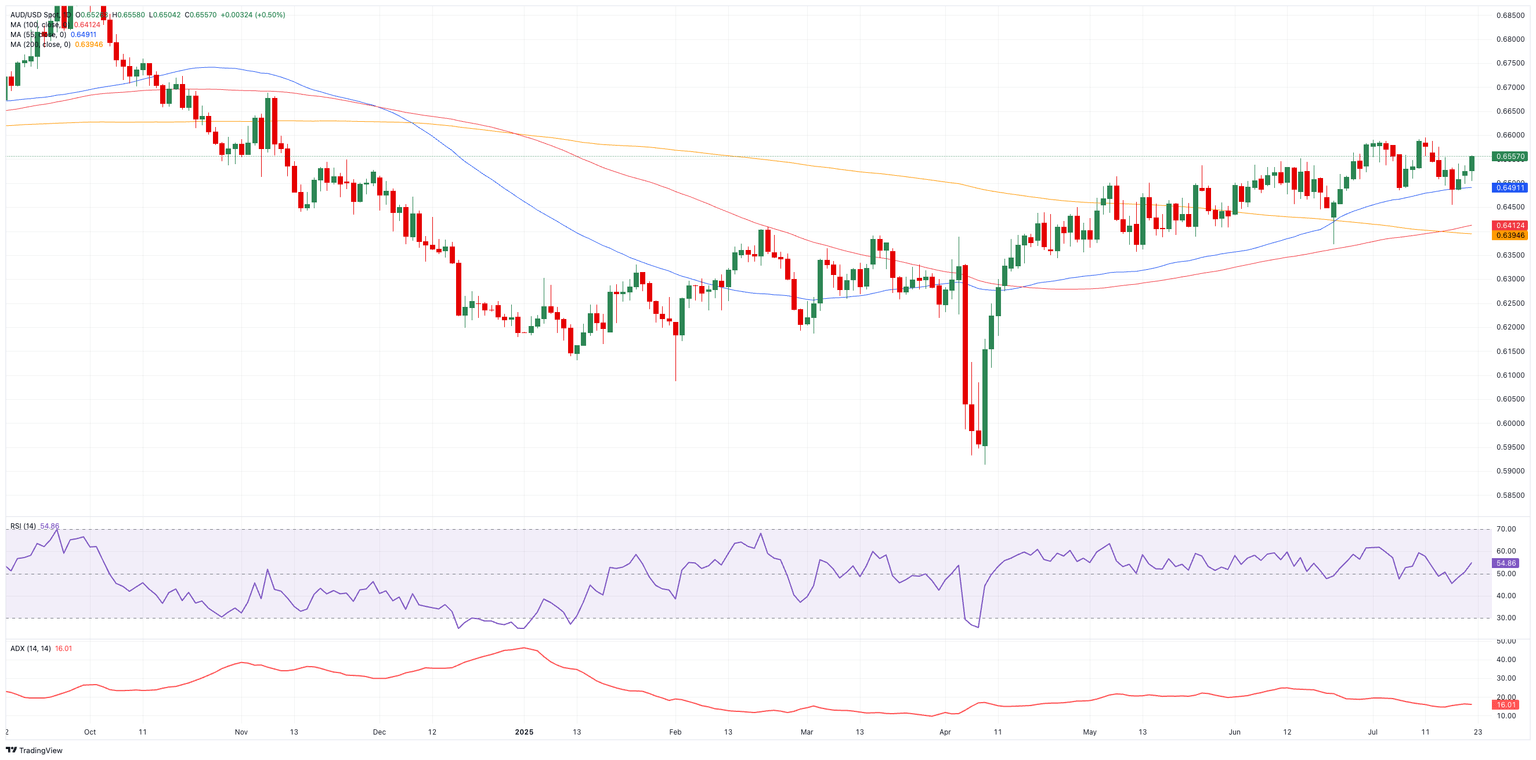
Upside hurdles sit at 0.6590 (2025 peak), then 0.6687 (November 7, 2024), and, beyond that, the psychological 0.7000 level.
On the other hand, support rests at 0.6454 (July low) and the 200‑day SMA at 0.6398.
The momentum appears to have increased: the Relative Strength Index (RSI) is nearing the 55 level, while the Average Directional Index (ADX) hovers around 16, indicating a trend that lacks conviction.
AUD/USD daily chart
Bottom line
The Aussie appears range-bound until Beijing provides a clearer growth signal or trade tensions introduce a new challenge. The RBA is signalling gentle nudges, not bold shifts, which leaves traders hunting for the next catalyst.
Interest rates FAQs
Interest rates are charged by financial institutions on loans to borrowers and are paid as interest to savers and depositors. They are influenced by base lending rates, which are set by central banks in response to changes in the economy. Central banks normally have a mandate to ensure price stability, which in most cases means targeting a core inflation rate of around 2%. If inflation falls below target the central bank may cut base lending rates, with a view to stimulating lending and boosting the economy. If inflation rises substantially above 2% it normally results in the central bank raising base lending rates in an attempt to lower inflation.
Higher interest rates generally help strengthen a country’s currency as they make it a more attractive place for global investors to park their money.
Higher interest rates overall weigh on the price of Gold because they increase the opportunity cost of holding Gold instead of investing in an interest-bearing asset or placing cash in the bank. If interest rates are high that usually pushes up the price of the US Dollar (USD), and since Gold is priced in Dollars, this has the effect of lowering the price of Gold.
The Fed funds rate is the overnight rate at which US banks lend to each other. It is the oft-quoted headline rate set by the Federal Reserve at its FOMC meetings. It is set as a range, for example 4.75%-5.00%, though the upper limit (in that case 5.00%) is the quoted figure. Market expectations for future Fed funds rate are tracked by the CME FedWatch tool, which shapes how many financial markets behave in anticipation of future Federal Reserve monetary policy decisions.
Premium
You have reached your limit of 3 free articles for this month.
Start your subscription and get access to all our original articles.
Author
Pablo Piovano
FXStreet
Born and bred in Argentina, Pablo has been carrying on with his passion for FX markets and trading since his first college years.