AUD/USD Price Forecast: Further losses are likely below the 200-day SMA
- AUD/USD rose marginally, although it faltered just ahead of 0.6400.
- The US Dollar traded in an inconclusive range amid tariff concerns.
- The RBA’s inflation gauge is due next on the Australian docket.

In quite a dull start to the new trading week, the US Dollar (USD) alternated gains with losses in the lower end of its recent range, prompting the US Dollar Index (DXY) to hit new multi-week lows before staging a lacklustre rebound.
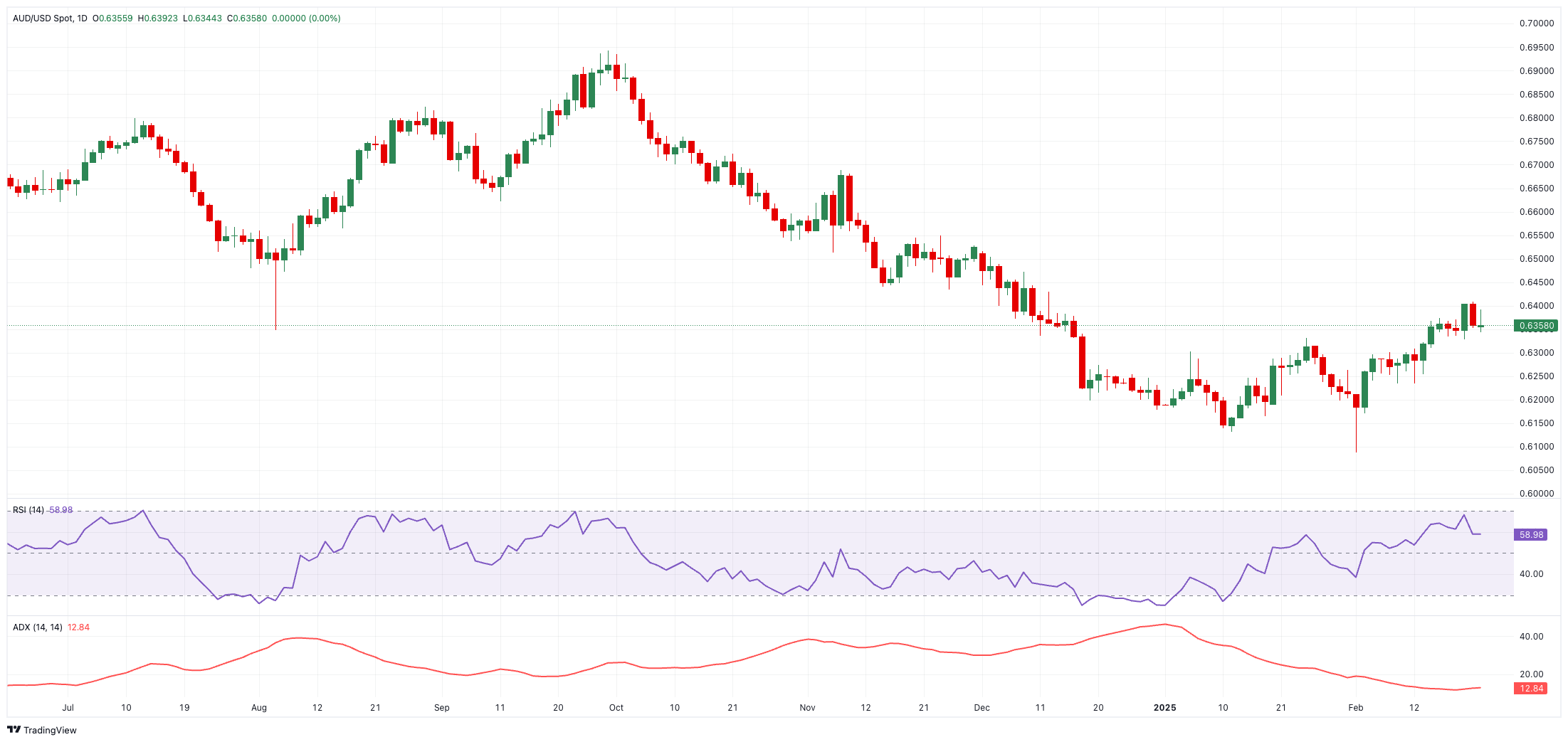
Meanwhile, the Australian Dollar sped higher against the Greenback, encouraging AUD/USD to revisit the vicinity of the 0.6400 region, where it ran out of steam, leaving spot marginally up for the day.
Confronting protectionism: The ongoing tariff saga
Trade tensions continue to influence currency markets. Currencies considered “risk-friendly,” such as the Aussie Dollar, have been riding the US Dollar’s weaker patch and the uncertainty surrounding new US tariff plans.
Early in February, President Trump briefly lifted market sentiment by delaying a planned 25% tariff on Canadian and Mexican goods for a month. However, that optimism faded quickly when the US introduced fresh tariff threats, including a 10% tariff on Chinese imports—raising the prospect of Chinese retaliation.
Because China is Australia’s largest export market, any escalation in tariffs could undermine demand for Australian commodities.
A pivotal moment for rates: RBA, inflation, and the Fed
Despite the US Dollar’s lack of drection, investors remain wary of further flare-ups in trade disputes, which could spark higher inflation and keep the Federal Reserve (Fed) leaning toward tighter policy for longer.
In Australia, the Reserve Bank of Australia (RBA) recently trimmed its policy rate by 25 basis points to 4.10%, a move that was widely expected. However, the RBA emphasized this wasn’t the start of a broader easing cycle.
Underlying inflation in Oz is projected to hover above target at around 2.7%, while stronger labour data prompted the RBA to revise its unemployment forecast down to 4.2%.
At her usual press conference, RBA Governor Michele Bullock made it clear that this rate cut does not automatically mean more cuts are coming. Future decisions will hinge on how the labour market evolves.
Indeed, Australia’s job market outperformed expectations in January, adding 44,000 positions—mostly full-time—and bringing the Unemployment Rate to 4.1%, just under the RBA’s 4.2% projection. This robust data supports the bank’s cautious stance on additional rate cuts.
Later, Deputy Governor Andrew Hauser also expressed doubt about market expectations of rapid rate reductions, pointing out that futures are pricing in fewer than 50 basis points of cuts over the next year.
Commodities remain cautious
Australia’s economic fortunes are closely tied to commodity exports, so any slowdown in Chinese demand could ripple through growth forecasts. On Monday, copper prices added to the previous day’s pullback, while maintaining the sideline theme in the upper end of the range so far, while iron ore prices maintained its range bound theme unchanged, also near yearly peaks.
Chart watch: Critical price points
On the upside, the first hurdle is the 2025 high of 0.6408 (February 21). Beyond that, watch the 100-day Simple Moving Average (SMA) at 0.6415, and the weekly top of 0.6549 (November 25), which appears reinforced by the 200-day SMA.
Bears, on the other hand, meet provisional support at the 55-day SMA at 0.6273, followed by the 2025 bottom of 0.6087 and the psychological 0.6000 level.
Technical indicators are mixed: while the Relative Strength Index (RSI) near 60 signals a bullish tilt, the Average Directional Index (ADX) around 13 suggests the overall trend remains relatively weak.
What’s Next?
Looking ahead, the RBA’s Monthly CPI Indicator (due February 26) will be in the spotlight, along with Construction Done figures. On February 27, the quarterly Private Capital Expenditure (Q4) data will be released, followed by Housing Credit and Private Sector Credit numbers to round out the week.
Author

Pablo Piovano
FXStreet
Born and bred in Argentina, Pablo has been carrying on with his passion for FX markets and trading since his first college years.

















