AUD/USD Price Forecast: Further gains appear in the pipeline
- AUD/USD could not sustain an earlier breakout of 0.6800.
- The Dollar’s rebound weighed on the Aussie Dollar and the risk complex.
- The RBA’s Monthly CPI Indicator surpassed consensus in July.

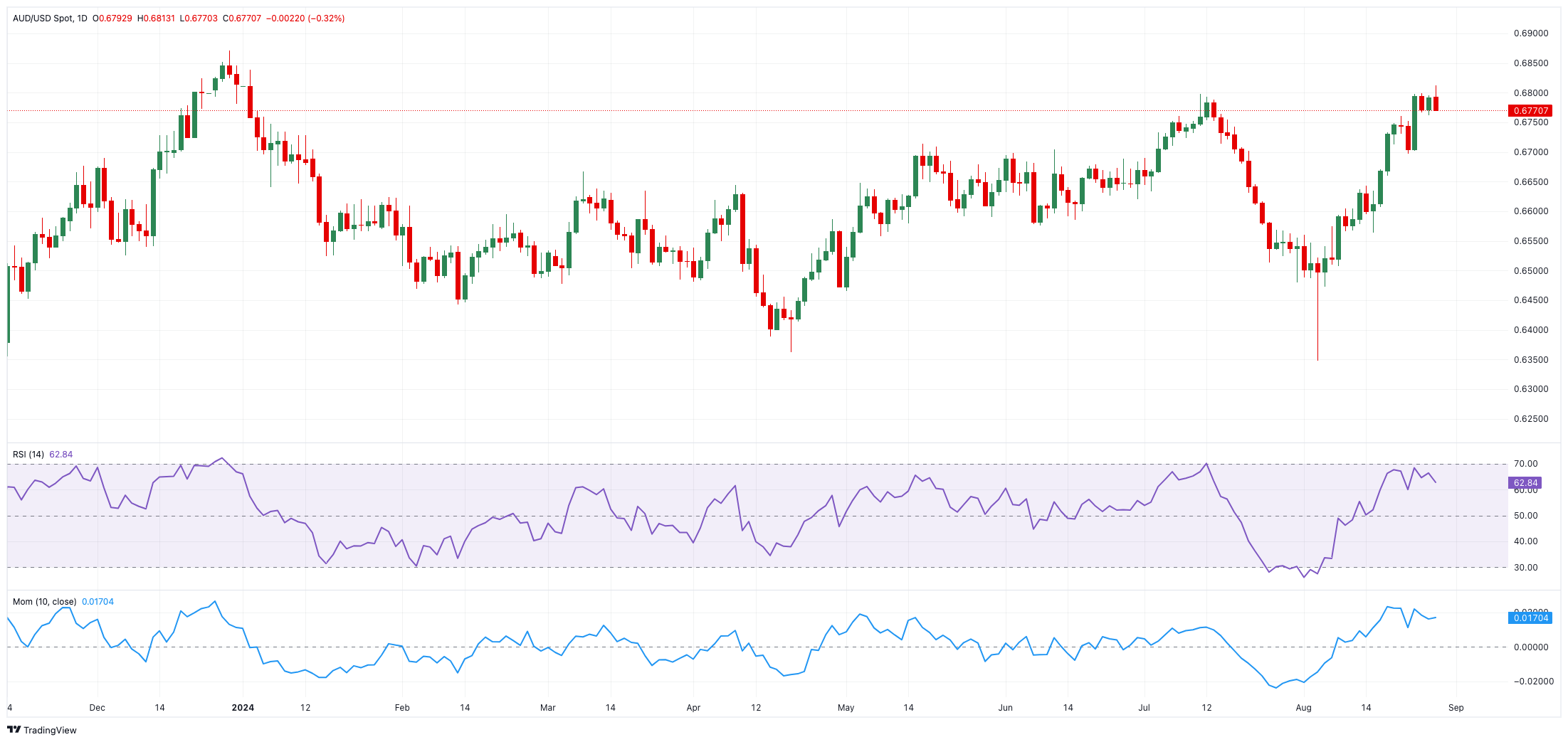
On Wednesday, AUD/USD finally broke above the key 0.6800 the figure for the first time since early January, flirting with yearly highs at the same time. That bull run, however, dissipated soon afterwards in response to the intense rebound in the US Dollar (USD).
Currently, the pair's upward momentum remains strong, supported by a recent breakthrough above the 200-day SMA at 0.6610, which has shifted the short-term outlook for AUD/USD to a bullish stance.
The ongoing monthly recovery in AUD has been largely driven by the weakening Greenback and a broader improvement in risk-related assets. Despite the pair's three-week rally, the 0.6800 region still emerges as a tough barrier.
Additionally, the Australian dollar derived extra weakness from the knee-jerk in copper prices, which faded recent multi-week highs vs. a slight increase in iron ore prices.
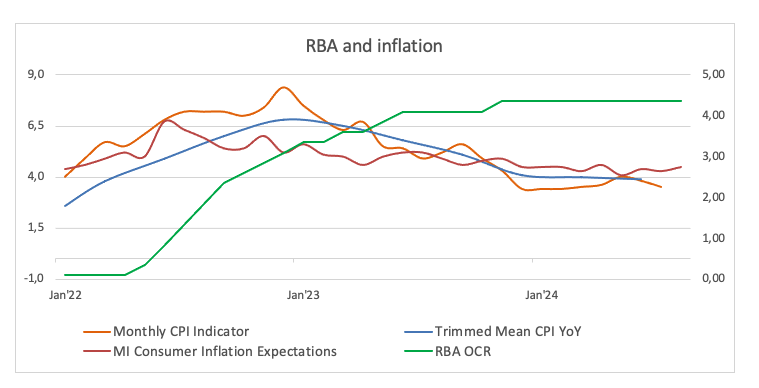
Recent monetary policy developments have also favoured the multi-week advance in the Australian Dollar. The Reserve Bank of Australia (RBA) recently kept the official cash rate (OCR) at 4.35%, choosing caution with no immediate plans to ease policy due to ongoing domestic inflation pressures. Both the trimmed mean and headline CPI inflation are now projected to reach the 2-3% target range by late 2026, later than previously expected.
In a subsequent address, Governor Michelle Bullock reaffirmed the RBA's readiness to raise interest rates if necessary to manage inflation, maintaining a hawkish stance amid high underlying inflation. She emphasized the bank's vigilance regarding inflation risks following the decision to keep rates steady. Core inflation, which was 3.9% in the last quarter, is anticipated to fall within the 2-3% target range by late 2025.
The positive sentiment surrounding the AUD has been further bolstered by the hawkish tone in the RBA Minutes released last week, where members debated whether to increase the cash rate target or leave it unchanged. The case for an increase was driven by persistent underlying inflation and the need to counteract market expectations of multiple rate cuts later in 2024. Ultimately, the members concluded that maintaining the current cash rate target was the best course of action. They also noted that a near-term rate cut is unlikely, though future rate adjustments remain possible.
Overall, the RBA is expected to be the last among the G10 central banks to start cutting interest rates. So far, the swaps market continues to see around 90% probability of a rate cut by the RBA by year end, although this decision remains uncertain, as it will heavily depend on forthcoming data.
Nevertheless, the potential for rate cuts by the Fed in the near term, contrasted with the RBA's likely extended restrictive stance, should support a stronger AUD/USD in the coming months.
However, the Australian Dollar's gains may be constrained by a slow recovery in the Chinese economy. China continues to grapple with post-pandemic challenges such as deflation and insufficient stimulus. Concerns about demand from China, the world's second-largest economy, were heightened following the Politburo meeting, which, despite promises of support, did not introduce any specific new stimulus measures.
Meanwhile, the latest CFTC report for the week ending August 20 indicates that speculators remain largely net-short on the AUD, although they have reduced their positions to three-week lows. Net shorts have dominated since Q2 2021, with only a brief two-week break so far this year.
On the Australian docket, the RBA’s Monthly CPI Indicator (weighted mean) rose by 3.5% in July, down from June’s 3.8% increase.
AUD/USD daily chart
AUD/USD short-term technical outlook
Further gains are expected to drive the AUD/USD to its August high of 0.6812 (August 28), ahead of the December 2023 top of 0.6871 (December 28), and the 0.7000 milestone.
Occasional bearish attempts, on the other hand, may result in an initial decline to the temporary 55-day SMA of 0.6654, before the key 200-day SMA of 0.6610 and the 2024 bottom of 0.6347 (August 5).
The four-hour chart depicts the reappearance of some consolidation. However, the immediate resistance level is 0.6812, ahead of 0.6871. On the other hand, the 55-SMA at 0.6730 comes first, seconded by 0.6697, and the 200-SMA at 0.6638. The RSI receded to around 53.
Author

Pablo Piovano
FXStreet
Born and bred in Argentina, Pablo has been carrying on with his passion for FX markets and trading since his first college years.