AUD/USD Price Forecast: Bulls remain on the sidelines amid US-China trade war fears
- AUD/USD attracts fresh sellers amid US-China trade war fears and modest USD strength.
- Bets that the RBA will cut rates this month undermine the Aussie amid a softer risk tone.
- A sustained move beyond the 0.6230-0.6235 confluence will negate the negative outlook.


The AUD/USD pair struggles to capitalize on the previous day's goodish recovery move from sub-0.6100 levels, or the lowest level since April 2024, and attracts some sellers on Tuesday. US President Donald Trump agreed to delay 25% trade tariffs against Canada and Mexico by 30 days, though a 10% duty on imports from China is still set to take effect from Tuesday. Moreover, Trump's intention to impose a 10% universal tariff keeps investors on the edge, which is evident from a generally weaker tone around the equity markets. This, in turn, assists the safe-haven US Dollar (USD) to regain positive traction after the previous day's turnaround from the vicinity of over a two-year peak and weighs on the perceived riskier Australian Dollar (AUD).
Meanwhile, speculations that Trump's trade tariffs could push up inflation and give the Federal Reserve (Fed) less impetus to cut interest rates further, which triggers a modest bounce in the US Treasury bond yields and further underpins the USD. The view was echoed by comments from Chicago Fed President Austan Goolsbee, who warned that uncertainty over Trump’s policies could delay the central bank’s plans to cut interest rates. Separately, Atlanta Fed President Raphael Bostic noted on Monday that although the US labor market remains surprisingly resilient, tariff threats throw a wrench in outlook expectations. Apart from this, bets that the Reserve Bank of Australia (RBA) could consider a rate cut in February weighs on the Aussie and the AUD/USD pair.
Meanwhile, Fed governor Michelle Bowman said on Friday that rate cuts are still expected this year but added that future moves should be cautious and gradual, with time to assess data. This holds back the USD bulls from placing aggressive bets and offers some support to the AUD/USD pair. Traders now look forward to the US economic docket – featuring the release of JOLTS Job Openings and Factory Orders data. This, along with speeches by influential FOMC members and Trump's tariff headlines, will drive the USD demand and provide some meaningful impetus to the AUD/USD pair. The market focus, however, will remain glued to the closely-watched US monthly employment details – popularly known as the Nonfarm Payrolls (NFP) report on Friday.
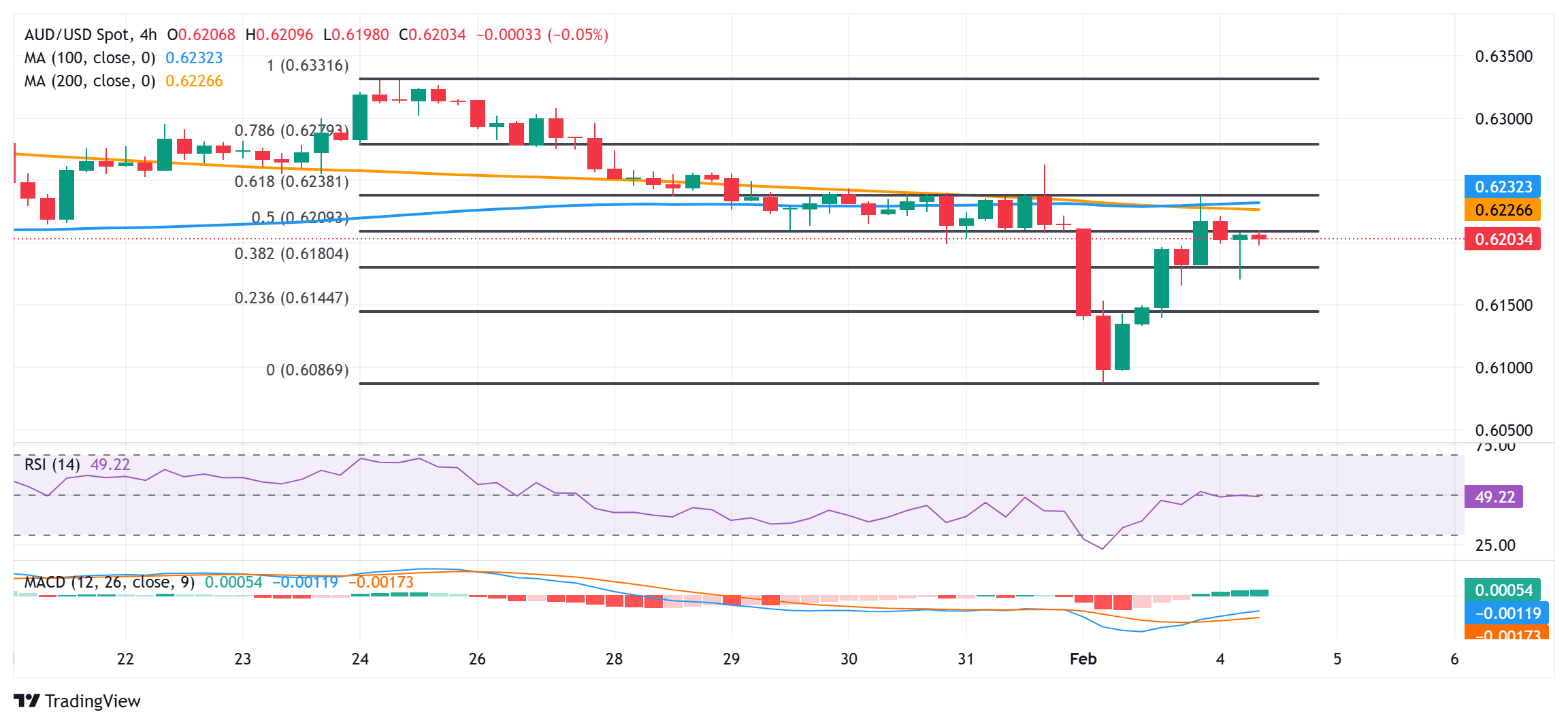
AUD/USD 4-hour chart
Technical Outlook
From a technical perspective, the overnight recovery move falters near a resistance marked by the 50% Fibonacci retracement level of the recent downfall from the January swing high. The said hurdle is pegged near the 0.6230-0.6235 area, which coincides with the 100- and the 200-period Simple Moving Averages (SMAs) on the 4-hour chart, which, in turn, should act as a key pivotal point. A sustained strength beyond might trigger a short-covering rally and lift the AUD/USD pair further towards the 0.6300 mark en route to the 0.6330 area (January 24 peak).
On the flip side, the Asian session low, around the 0.6170 area, now seems to act as immediate support, below which the AUD/USD pair could accelerate the fall back towards the 0.6100 mark. Acceptance below the latter will be seen as a fresh trigger for bearish traders and pave the way for a decline toward testing levels below the 0.6000 psychological mark, or the April 2020 swing low.
Premium
You have reached your limit of 3 free articles for this month.
Start your subscription and get access to all our original articles.
Author
Haresh Menghani
FXStreet
Haresh Menghani is a detail-oriented professional with 10+ years of extensive experience in analysing the global financial markets.

















