AUD/USD Price Forecast: Attention now shifts to the labour market
- AUD/USD traded with an inconclusive bias in the mid-0.6300s.
- The US Dollar rose marginally amid tariff narrative and geopolitics.
- Australia’s wages metrics lost some impulse in Q4.


The US Dollar (USD) rose marginally and added to Tuesday’s rebound, encouraging the Dollar Index (DXY) to flirt with four-day highs in the 107.20-107.25 band on Wednesday, a move that was accompanied by the resumption of the downward bias in US yields along with tariff concerns and geopolitical effervescence.
At the same time, the Australian Dollar exchanged gains with losses against the Greenback, leaving AUD/USD orbiting around the upper end of the recent range near the 0.6350 region.
Tariffs and trade tensions
Trade tensions remain a key factor driving currencies right now. The Aussie Dollar—and other risk-friendly currencies—had been riding higher on the back of the US Dollar’s soft patch and concerns about Washington’s new tariff plans.
President Trump briefly lifted market spirits by delaying a 25% tariff on Canadian and Mexican goods for a month earlier in February. However, that optimism faded quickly as new tariff threats emerged. The US also imposed a 10% tariff on Chinese imports, sparking worries about possible retaliation from China.
Because China is Australia’s biggest export market, any back-and-forth escalation could weaken demand for Australian commodities. China has even hinted it might challenge the US at the WTO, creating more uncertainty for countries like Australia that rely heavily on resource exports.
Inflation, the Fed, and where we go from here
Although the US Dollar rebounded a bit, investors are still on edge about potential flare-ups in trade tensions. If trade conflicts worsen, inflation could rise, which might prompt the Federal Reserve (Fed) to keep monetary policy tighter for a longer period.
Back in Australia, the Reserve Bank of Australia (RBA) recently trimmed its policy rate by 25 basis points to 4.10%, a widely expected move. However, the RBA made it clear this was not the start of a larger easing cycle. Underlying inflation is forecast to stay slightly above target at 2.7%, and thanks to strong labour data, the unemployment rate forecast was lowered to 4.2%.
At her press conference, RBA Governor Michele Bullock emphasized that this rate cut does not necessarily mean more are on the way. Future decisions will hinge on how the labour market evolves.
For context, Australia’s Q4 wage growth slowed, with the Wage Price Index rising 0.7% QoQ—below expectations and the previous quarter’s pace. On a yearly basis, wages grew by 3.2%, aligning with forecasts. The RBA is closely monitoring labour market developments, and tomorrow’s January labour force survey will play a key role in shaping future policy, as the market anticipates about 75 basis points of further easing over the next year.
Commodities offer modest help
Australia’s economic prospects are closely tied to its commodity exports. If Chinese demand slows, it could have a significant knock-on effect. On Wednesday, both iron ore and copper prices—major drivers of Australia’s economy—managed to resume their upward impulse, which help the Aussie Dollar to stay afloat.
Technical picture: Levels that matter
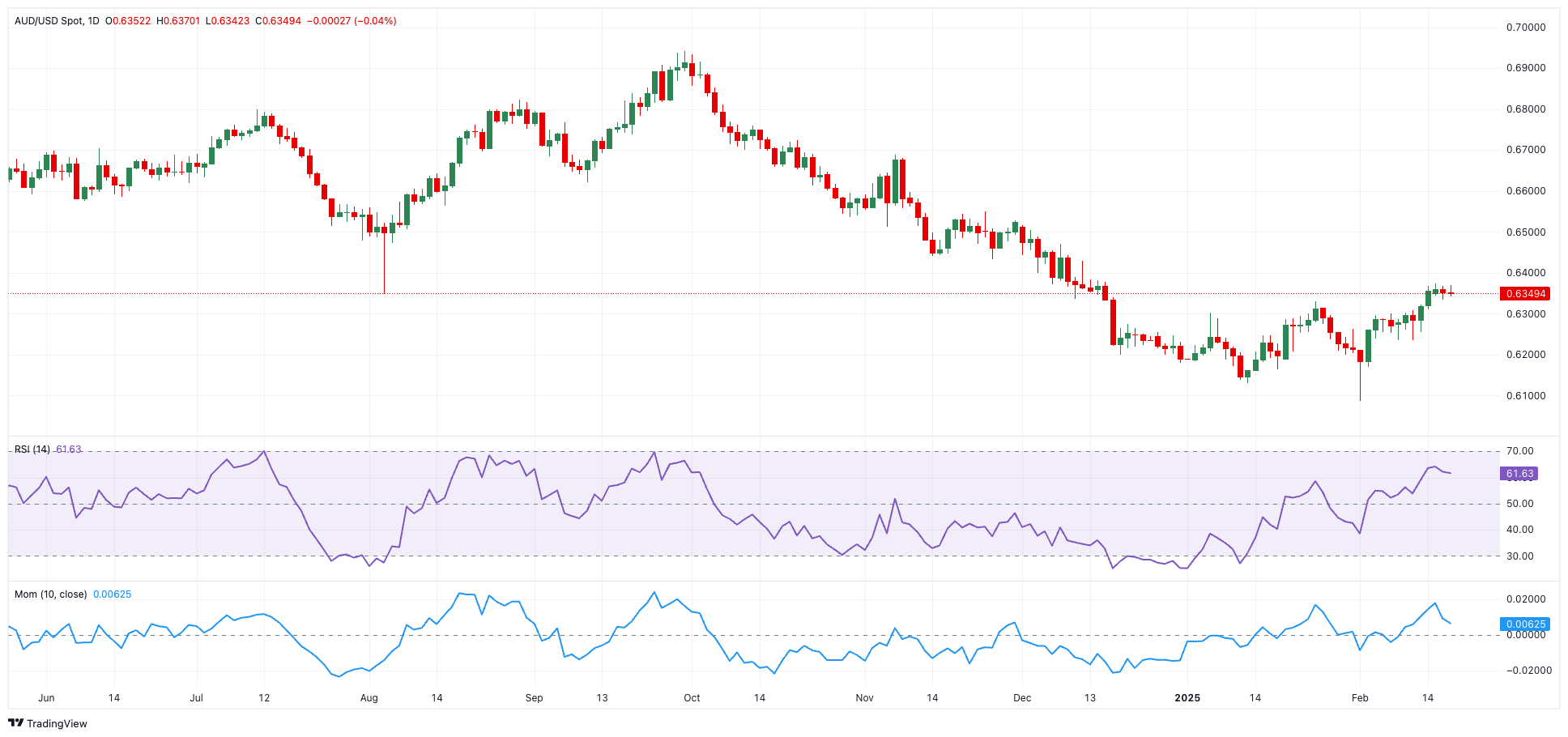
On the upside, the first hurdle is the 2025 high of 0.6373, reached on February 17. Next comes the interim 100-day Simple Moving Average (SMA) at 0.6430, followed by the November 25 top at 0.6549, and then the 200-day SMA at 0.6554.
On the downside, the 55-day SMA at 0.6278 serves as temporary support, ahead of the 2025 bottom at 0.6087, and then the psychologically significant 0.6000 mark.
Technical indicators are mixed: the Relative Strength Index (RSI) sits around 63, suggesting some bullish momentum, but the Average Directional Index (ADX) near 13 points to a relatively weak overall trend.
AUDUSD daily chart
What’s next?
The publication of the labour market report is expected to take centre stage in Oz on February 20.
Premium
You have reached your limit of 3 free articles for this month.
Start your subscription and get access to all our original articles.
Author
Pablo Piovano
FXStreet
Born and bred in Argentina, Pablo has been carrying on with his passion for FX markets and trading since his first college years.