AUD/USD Price Forecast: A drop to the March low is not ruled out
- AUD/USD built on weekly losses and revisited the 0.6270 region.
- The US Dollar extended its post-Fed upside impulse to weekly highs.
- The Australian labour market report came in on the weak side.


The Australian Dollar (AUD) stayed on the back foot for a third straight session on Thursday, with AUD/USD extending the weekly pullback to the 0.6370 region, coincident with the provisional 55-day SMA.
Meanwhile, the US Dollar (USD) gained further traction helped by speculation that the Fed might keep its restrictive stance for longer following the latest FOMC event and Chair Powell’s comments. Against that, the US Dollar Index (DXY) added to Wednesday’s recovery and rose to multi-day peaks north of the 104.00 level.
Trade tensions under the microscope
Ongoing uncertainty over US trade policy continues to unsettle investors, who fear potential retaliatory measures from US trading partners. The threat of a broader trade war is weighing on risk-sensitive currencies, including the Aussie. As Australia relies heavily on exporting commodities to China, any slowdown in its top trading partner—especially if triggered by US tariffs—could take a toll on the Australian economy.
Central banks and the inflation conundrum
Worries about trade-fueled inflation nudging the Federal Reserve (Fed) toward a more prolonged tightening cycle are clashing with mounting concerns over a US economic slowdown.
The FOMC delivered a "mixed hold" on Wednesday, keeping the Fed funds target rate unchanged at 4.25-4.50%, as widely expected. In a unanimous decision, the Committee noted that uncertainty remains elevated, prompting a slight tweak in its statement.
Fed Chair Powell reiterated his March 7 guidance, stating, "We do not need to be in a hurry, and are well positioned to wait for greater clarity." He also explained that while the updated Fed funds rate projections remain unchanged, the details now lean toward less easing.
The FOMC further revised its outlook by lowering its real GDP growth forecast and raising its inflation expectations. Powell attributed much of the inflation uptick to tariffs, remarking that they "tend to bring growth down and they tend to bring inflation up."
Across the Pacific, the Reserve Bank of Australia (RBA) trimmed its benchmark rate by 25 basis points in February to 4.10%. Governor Michele Bullock emphasized that any further adjustments will depend on inflation data, while Deputy Governor Andrew Hauser cautioned against assuming a rapid series of cuts. Still, many analysts expect the RBA could roll out up to 75 basis points of additional easing if trade tensions intensify.
Recent RBA minutes showed policymakers debating between holding rates steady or opting for a smaller cut. Ultimately, they chose a 25-basis-point reduction but stressed that this does not guarantee a broader easing cycle. Officials also highlighted that Australia’s peak rate remains relatively low by global standards, partly due to a resilient domestic labour market.
On the latter, the Employment Change shrank by 52.8K individuals in February, reversing the previous month’s gain, while the Unemployment Rate held steady at 4.1%
AUD/USD Technical Outlook
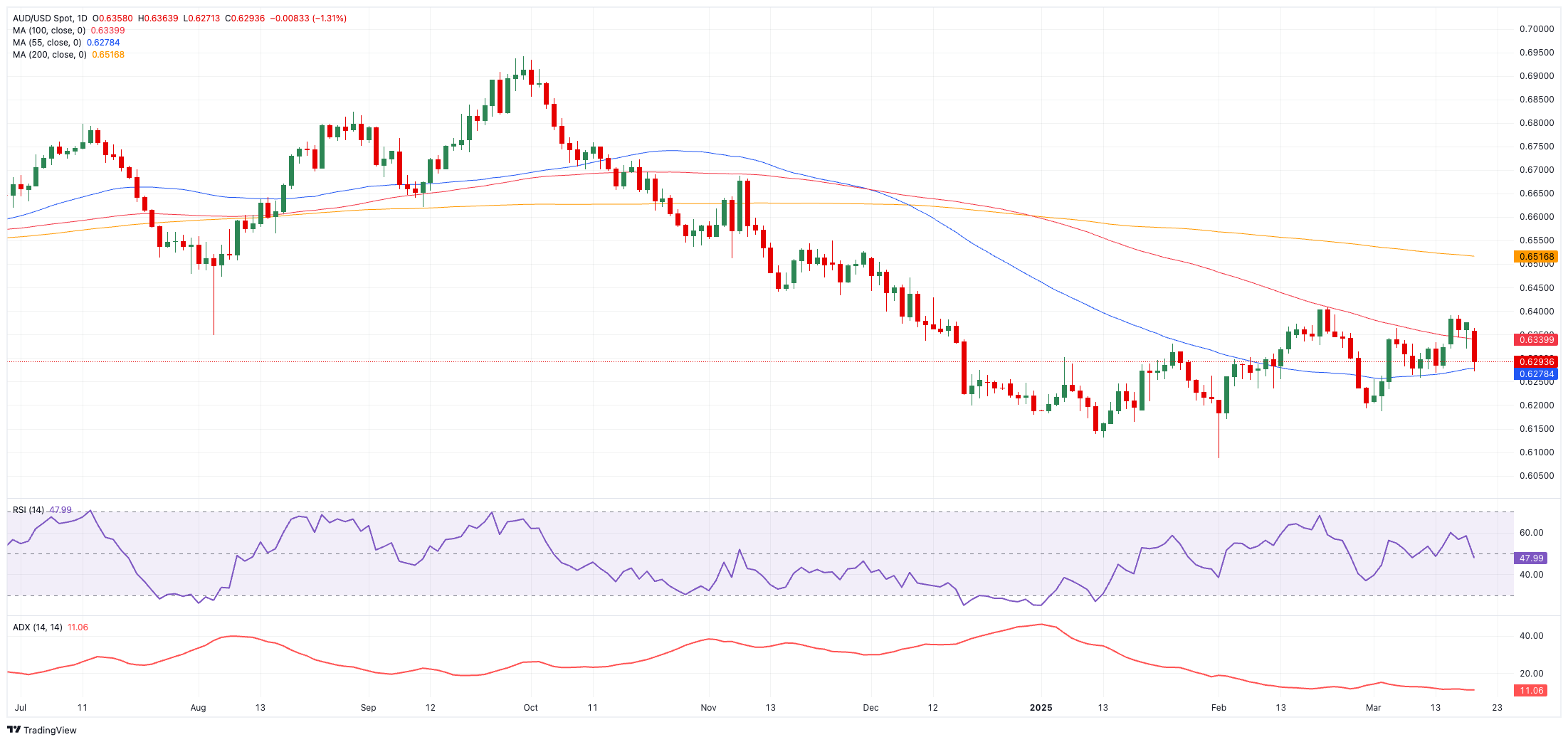
A decisive break above the 2025 peak at 0.6408 (February 21) could open the door toward the 200-day Simple Moving Average (SMA) at 0.6520, with the November 2024 high at 0.6687 (November 7) looming beyond.
On the flip side, immediate support lies at the March low of 0.6186 (March 4). A deeper pullback could test the 2025 trough at 0.6087, with the psychologically significant 0.6000 mark just below.
Momentum indicators paint a mixed picture: the Relative Strength Index (RSI) has slipped below 48, pointing to waning bullish pressure, while the Average Directional Index (ADX) hovering around 11 suggests a generally weak trend overall.
AUD/USD daily chart
Premium
You have reached your limit of 3 free articles for this month.
Start your subscription and get access to all our original articles.
Author
Pablo Piovano
FXStreet
Born and bred in Argentina, Pablo has been carrying on with his passion for FX markets and trading since his first college years.