|

AUD/USD outlook: Dips after less hawkish RBA, but larger bulls remain intact

AUD/USD

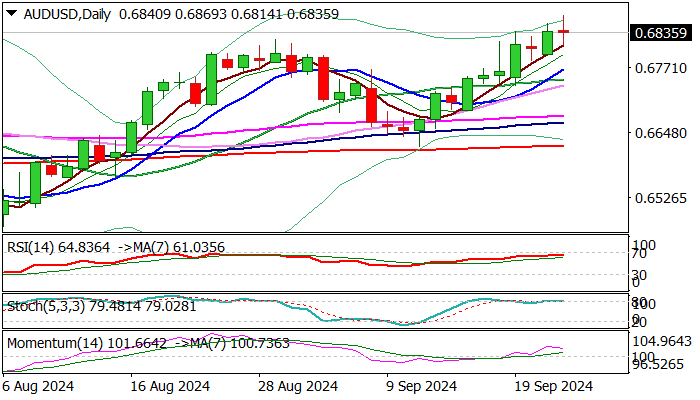
AUDUSD eased from new multi-month high on Tuesday after the Reserve Bank of Australia kept rates unchanged in today’s policy meeting, but comments from Governor Bullock were less hawkish than expected and sidelined expectations for possible policy tightening.

The pullback was so far shallow, as Aussie is underpinned by higher commodity prices and diverging Fed/RBA monetary policies, suggesting that larger bulls are just taking a breather.

Strong positive momentum on daily chart and formation of daily Tenkan/Kijun-sen contributes to bullish scenario however, overbought conditions warn that the price action may hold in prolonged consolidation.

Initial supports lay at 0.6814/0.6790 zone, ahead of more significant supports at 0.6774/66 (Fibo 38.2% of 0.6622/0.6869 / rising 10DMA) which should keep the downside protected and maintain bullish structure.

Res: 0.6869; 0.6900; 0.6948; 0.6961.
Sup: 0.6814; 0.6790; 0.6766; 0.6745.
Chart

Interested in AUD/USD technicals? Check out the key levels

    1. R3 0.6921
    2. R2 0.6887
    3. R1 0.6863
  1. PP 0.6829
    1. S1 0.6805
    2. S2 0.6771
    3. S3 0.6747

Author

Slobodan Drvenica

Slobodan Drvenica

Windsor Brokers

Industry veteran with over 22 years’ experience, Slobodan Drvenica joined Windsor Brokers in 1995 when he was an active trader for more than 10 years, managing the trading desk and own account departments.


More from Slobodan Drvenica
Share:

Editor's Picks

AUD/USD renews two-month lows near 0.6950 after Australian CPI data

AUD/USD is renewing two-month lows near 0.6950 in the Asian session on Wednesday, as below-expectations August Australian underlying CPI data pours cold water on expectations for further RBA interest rate hikes. Chinese PMI data also fail to inspire the Australian Dollar, despite a pause in the US Dollar advance.

USD/JPY trades below 157.50 as Japan's weak data and bullish USD lend support

USD/JPY extends its consolidative price move during the Asian session on Wednesday, trading below mid-157.00s. Hawkish BoJ expectations, along with intervention risks, underpin the Japanese Yen, though dismal domestic data cap gains. Meanwhile, rising Fed rate hike bets and oil-driven inflation fears push US bond yields to fresh multi-year highs. Moreover, the US-Iran standoff supports a bullish US Dollar and acts as a tailwind for the currency pair.

Gold consolidates below $4,200 as bullish USD and Fed hike bets offset softer bond yields

Gold struggles to capitalize on the previous day's recovery from an eight-week low, consolidating below $4,200 during the Asian session on Wednesday. The overnight slide in oil prices eased the US Treasury bond rout, supporting the bullion. However, Fed rate-hike bets and inflationary concerns keep bond yields near multi-year highs. Moreover, geopolitical uncertainties underpin the safe-haven US Dollar, which, in turn, caps the commodity.

Ethereum sees profit-taking near $2,700 ahead of key US economic data
Ethereum (ETH) has shown signs of profit-taking near $2,700 over the past few days, with rising exchange deposits and a slowdown in exchange-traded fund (ETF) inflows ahead of US inflation and labor market data releases. The top altcoin's Exchange Reserves, which track the total amount of a crypto asset held across exchange wallets, have increased by roughly 125K ETH since Friday.
Silver is more volatile than Gold ahead of PCE and NFP. This chart shows the positioning gap
The market’s attention is focused on American data this week, but there’s something only those with a trained eye may be looking at: Gold and Silver positioning gap. Financial markets are moving on fears, mostly related to persistently high energy prices driven by the Middle East war. Sure, the US Dollar (USD) is strong, but at what cost?
Silver is more volatile than Gold ahead of PCE and NFP. This chart shows the positioning gap
The market’s attention is focused on American data this week, but there’s something only those with a trained eye may be looking at: Gold and Silver positioning gap. Financial markets are moving on fears, mostly related to persistently high energy prices driven by the Middle East war. Sure, the US Dollar (USD) is strong, but at what cost?