|

AUD/USD maintains bearish trend ahead of key Australian jobs data

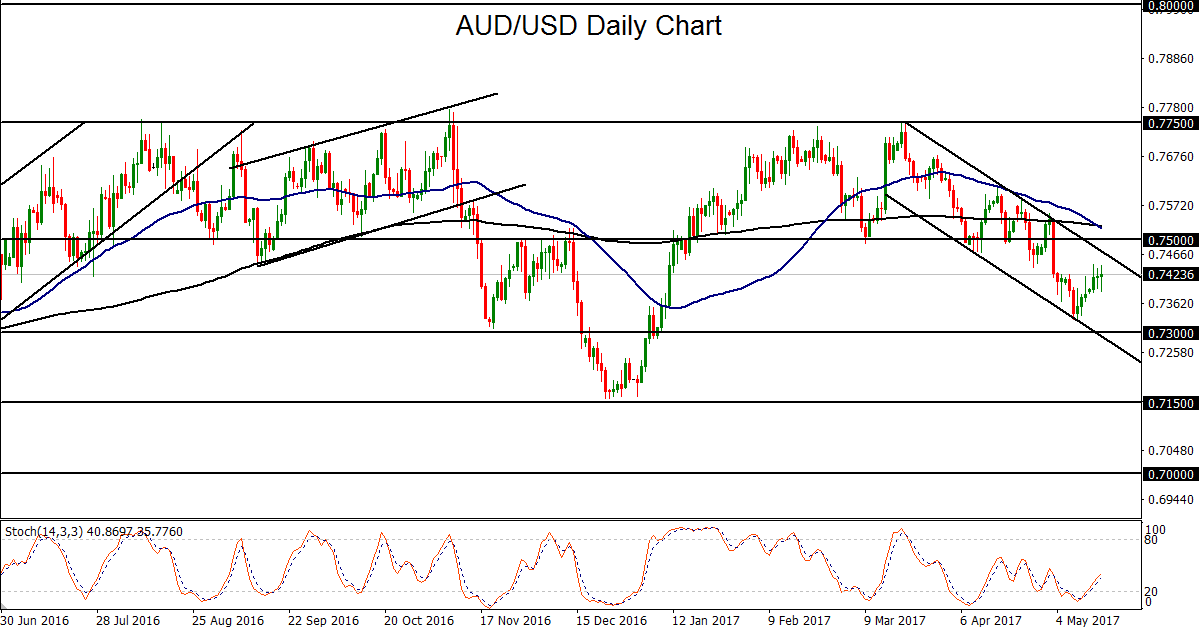
Despite the sharp drop in the US dollar this week, the plunge was significantly more pronounced against the euro, Swiss franc and yen, than it was against the Australian dollar. Though AUD/USD did rise within the past week as the US dollar fell, this relatively mild boost exists within a clearly-defined downtrend channel that, if it remains intact, points to further potential downside for the currency pair. Key economic data likely to move the Australian dollar will occur on Thursday in Canberra, when the Australian jobs report for April will be released.

Last month, employment change data for March showed a much better-than-expected 60.9K jobs added against a 20K forecast, which helped prompt a short-term boost for the Australian dollar. This time around, expectations for April are exceptionally low at only around 4.5K additional jobs expected. The unemployment rate is expected to remain steady at 5.9%.

From a price perspective, despite pronounced weakness in the US dollar recently, AUD/USD remains within a clear bearish trajectory that has been in place for the past two months, since the 0.7750-area year-to-date highs back in March. This two-month slide for the currency pair is outlined by the noted parallel downtrend channel. Supporting this bearish technical bias are key moving averages – the 50-day MA has just tentatively crossed below the 200-day, potentially signifying more technical weakness.

In the event that AUD/USD remains pressured within the descending channel in the aftermath of the impending Australian jobs report, a continuation of the downtrend should once again target its recent downside objective at the key 0.7300 support level. On any data-driven boost for AUD/USD, however, a break above the channel should be met by major resistance around the 0.7500 level.
Author

James Chen, CMT

James Chen, CMT

Investopedia

James Chen, Chartered Market Technician (CMT), has been a financial market trader and analyst for nearly two decades.


More from James Chen, CMT
Share:

Editor's Picks

EUR/USD remains offered below 1.1800, looks at US data

EUR/USD is still trading on the defensive in the latter part of Thursday’s session, while the US Dollar maintains its bid bias as investors now gear up for Friday’s key release of the PCE data, advanced Q4 GDP prints and flash PMIs.
 

GBP/USD bounces off monthly lows near 1.3430

GBP/USD is sliding in tandem with its risk-sensitive peers, drifting back towards the 1.3430 area, its lowest levels in the month. The move reflects a firmer Greenback, supported by another round of solid US data and a somewhat divided FOMC Minutes.

Gold eyes next breakout on US GDP, PCE inflation data

Gold sticks to recent gains around the $5,000-mark early Friday, biding time before the high-impact US macro events. The focus is now on the US fourth-quarter Gross Domestic Product, core Personal Consumption Expenditures Price Index and the Supreme Court’s ruling on President Donald Trump’s tariffs.

Ethereum: Active addresses halt growth as US selling pressure eases

Ethereum network growth has declined after two months of explosive increase. US selling pressure has eased following an improvement in the Coinbase Premium Index. ETH extends its range-bound move below the $2,107 resistance and above $1,740 .

Hawkish Fed minutes and a market finding its footing

It was green across the board for US Stock market indexes at the close on Wednesday, with most S&P 500 names ending higher, adding 38 points (0.6%) to 6,881 overall. At the GICS sector level, energy led gains, followed by technology and consumer discretionary, while utilities and real estate posted the largest losses.

Injective token surges over 13% following the approval of the mainnet upgrade proposal

Injective price rallies over 13% on Thursday after the network confirmed the approval of its IIP-619 proposal. The green light for the mainnet upgrade has boosted traders’ sentiment, as the upgrade aims to scale Injective’s real-time Ethereum Virtual Machine architecture and enhance its capabilities to support next-generation payments.