AUD/USD Forex Signal

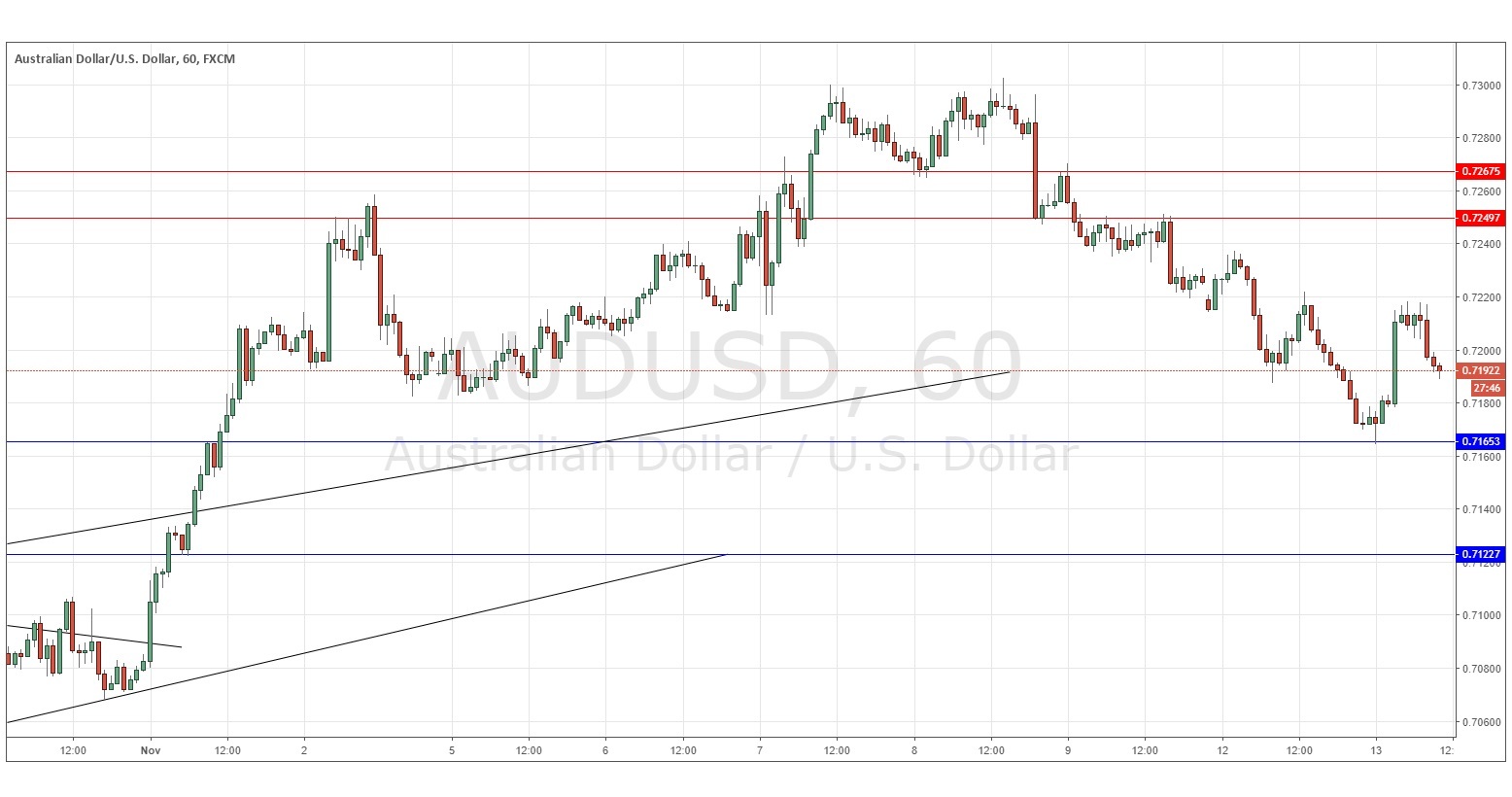
Yesterday’s signals produced an excellent, profitable long trade from the bullish pin candle which rejected the support level identified at 0.7165 to the pip. It would make sense to have taken profits on this trade by now.
Today’s AUD/USD Signals
Risk 0.75%.
Trades may only be entered prior to 5pm Tokyo time, over the next 24-hour period.
Long Trades
-
Long entry following some bullish price action on the H1 time frame immediately upon the next touch of 0.7165 or 0.7123.
-
Place the stop loss 1 pip below the local swing low.
-
Adjust the stop loss to break even once the trade is 20 pips in profit.
-
Remove 50% of the position as profit when the trade is 20 pips in profit and leave the remainder of the position to ride.
Short Trades
-
Short entry following some bearish price action on the H1 time frame immediately upon the next touch of 0.7250 or 0.7268.
-
Place the stop loss 1 pip above the local swing high.
-
Adjust the stop loss to break even once the trade is 20 pips in profit.
-
Remove 50% of the position as profit when the trade is 20 pips in profit and leave the remainder of the position to ride.
The best method to identify a classic “price action reversal” is for an hourly candle to close, such as a pin bar, a doji, an outside or even just an engulfing candle with a higher close. You can exploit these levels or zones by watching the price action that occurs at the given levels.
AUD/USD Analysis
I wrote yesterday that I thought that a test of the support level at 0.7165 would tell us a lot. If that level holds, the bulls could have another shot at driving the price up to new highs.
The level did hold, and the bulls managed to drive the price up to just under 0.7220 before the price began to fall again.
The Australian Dollar is not really in focus any more, and it simply looks very difficult to forecast the probable next directional movement, so I again have no directional bias. I just note that if either of the nearby levels hold, they will form a double top or bottom with medium-term technical significance.
There is nothing important due today concerning either the AUD or the USD.
Author

Adam Lemon
DailyForex.com
Adam is a Forex trader who has worked within financial markets for over 12 years, including 6 years with Merrill Lynch. He is certified in Fund Management and Investment Management by the U.K. Chartered Institute for Securities & Investment.














