AUD/USD Forecast: Sellers remain in control of the sentiment
- AUD/USD traded on the defensive and broke below 0.6500.
- Further weakness could drag spot to the 2024 lows.
- Retail Sales in Australia increased 1.1% MoM in January.

AUD/USD added to Wednesday’s decline and breached the key support at 0.6500 on the back of the firmer note in the US Dollar (DXY) on Thursday.
Further loss of traction in the pair came amidst the increasing pick up in upside momentum in the Greenback, particularly after US inflation figures gauged by the PCE showed that disinflationary pressure remains well in place in the US economy, although comments from Fed officials continued to signal a potential rate reduction in June.
In the meantime, the Aussie dollar suffered another slump in iron ore prices, which retreated sharply to levels last seen in late August near the $110 mark per tonne, always on the back of omnipresent concerns surrounding the still-absent economic rebound in China.
Although potential stimulus measures in China may offer temporary support for a rebound, it is the sustained recovery news from the country that holds greater significance in providing stronger support to the Australian dollar and potentially initiating a more significant upward trend in AUD/USD. A revival in the Chinese economy is also expected to align with an uptick in commodity prices, which would further contribute to a stronger Australian currency.
Regarding the Reserve Bank of Australia (RBA), it is hoped that the central bank's cautious approach should help alleviate substantial downward pressure on the AUD. The RBA is seen as one of the latest major central banks to initiate interest rate cuts, which contributes to this expectation.
A look at the data releases Down Under show the Housing Credit expanded by 0.4% MoM in January, and preliminary Retail Sales rose by 1.1% on a monthly basis also in January.
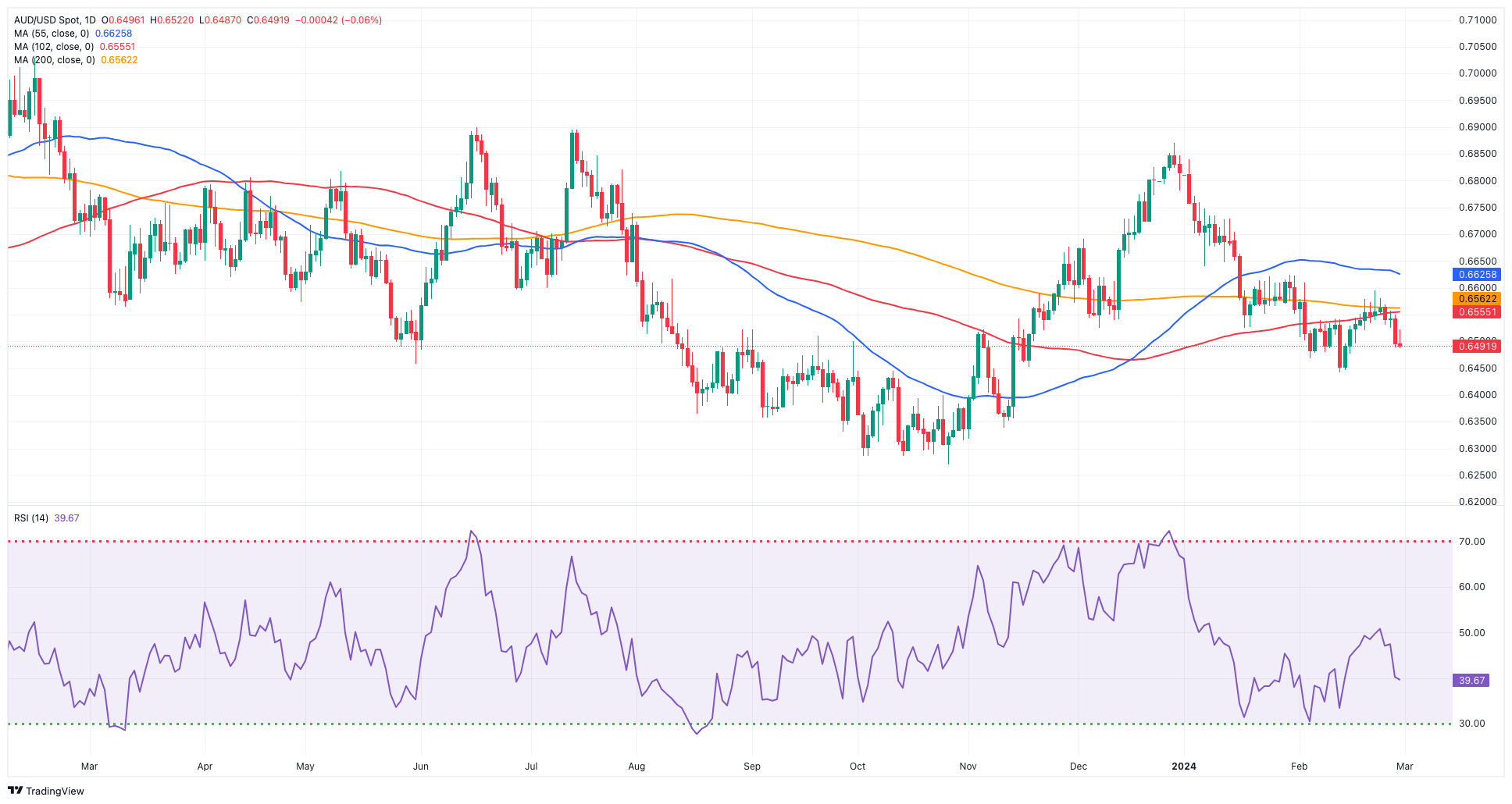
AUD/USD daily chart
AUD/USD short-term technical outlook
If sellers continue pushing stronger, AUD/USD initially confronts conflict near its 2024 bottom of 0.6452 (February 13). Breaking below this level might lead to a possible visit to the 2023 low of 0.6270 (October 26), followed by the round level of 0.6200 and the 2022 low of 0.6169 (October 13).
On the upside, after clearing the weekly top of 0.6595 (February 22), the pair may retest the temporary 55-day SMA at 0.6623, which coincides with the late-January highs (January 30). A break above this range might lead to the December 2023 peak of 0.6871 (December 28), followed by the July 2023 high of 0.6894 (July 14) and the June 2023 top of 0.6899 (June 16), all before the important 0.7000 barrier.
It is worth noting that the AUD/USD's downward bias should be minimized once it clears the crucial 200-day SMA at 0.6559 convincingly.
According to the 4-hour chart, further retracements appear in place for the time being. The initial support level is 0.6442, followed by 0.6347 and 0.6338. On the other side, the 200-SMA aligns at 0.6554 before 0.6595 and 0.6611. Furthermore, the MACD fell below zero, and the RSI dropped to the proximity of 37.
Author

Pablo Piovano
FXStreet
Born and bred in Argentina, Pablo has been carrying on with his passion for FX markets and trading since his first college years.















