|

AUD/USD Forecast: Increased bearish potential in the short-term

AUD/USD Current Price: 0.7280

  • Australia will publish this Monday the AIG Performance of Services Index for August.
  • US employment data and falling equities put the pair under pressure on Friday.
  • AUD/USD corrective decline could continue this Monday, but bulls retain control.
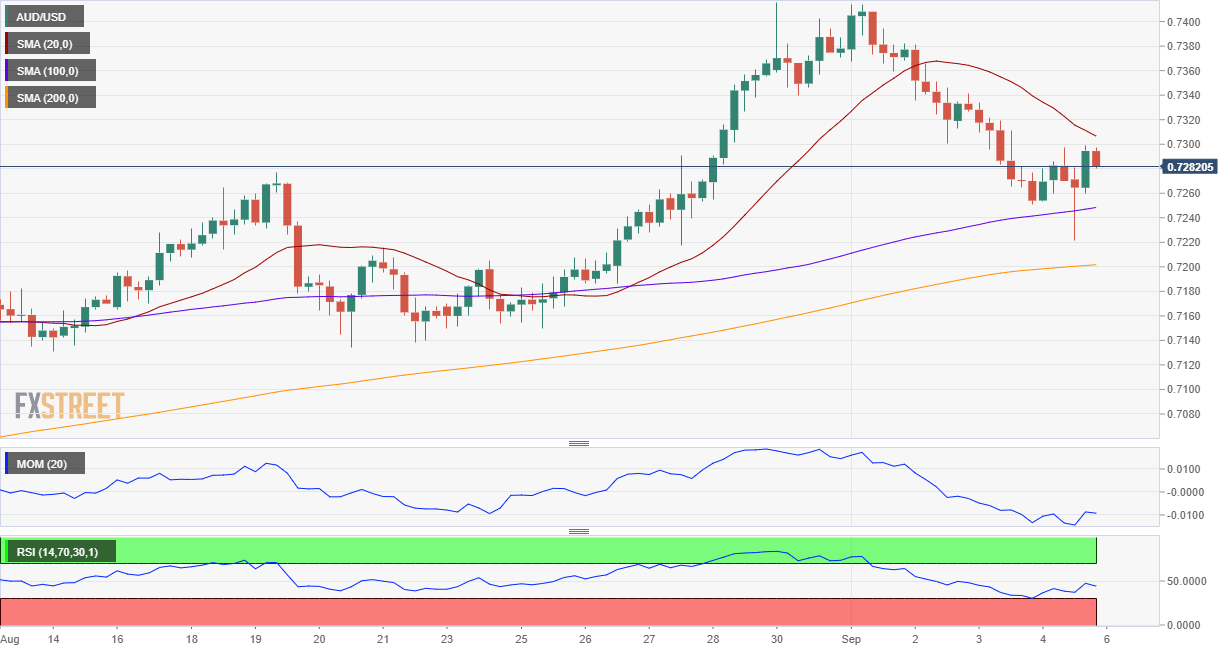
The Australian dollar edged lower against its American rival last week but held not far from the multi-year high set at 0.7413. In fact, the pair closed Friday unchanged in the 0.7280 price zone, despite generally encouraging US employment data and another bad day in Wall Street. The Aussie came under selling pressure at the beginning of the day, as July Retail Sales in the country were downwardly revised to 3.2% from a preliminary estimate of 3.3%.

At the beginning of the new week, Australia will publish the AIG Performance of Services Index for August, previously at 44. China, on the other hand, will release the August Trade Balance, seen posting a surplus of $50.5B.

AUD/USD short-term technical outlook

The daily chart for the AUD/USD pair shows that it bounced from its 20 DMA, while the 100 DMA advances above the 200 DMA, both far below the shorter one. Technical indicators corrected from overbought readings but lost bearish potential within positive levels. In the 4-hour chart, technical indicators recovered from oversold readings, but remain within negative levels with limited bullish strength. The 20 SMA, in the meantime, heads lower above the current level, increasing the risk of a bearish extension ahead.

 Support levels: 0.7265 0.7220 0.7170

Resistance levels: 0.7305 0.7340 0.7380  

View Live Chart for the AUD/USD

Author

Valeria Bednarik

Valeria Bednarik was born and lives in Buenos Aires, Argentina. Her passion for math and numbers pushed her into studying economics in her younger years.


More from Valeria Bednarik
Share:

Editor's Picks

GBP/USD advaces beyond 1.3450 after BoE decision, US Q2 GDP

GBP/USD gains positive momentum on Thursday, surpassing 1.3450 and trading at fresh multi-week highs. The Bank of England decided to maintain the benchmark rate unchanged at 3.75%. The MPC voted 6-3 to keep rates on hold, with the 3 dissenters favoring a rate hike. US Q2 GDP missing expectations helped the pair advance, while renewed US Dollar weakness across the FX board pushed the pair further up ahead of the monthly close.

EUR/USD confortable around 1.1530, highest in six weeks

The EUR/USD pair trades around 1.1530 in the American session on Thursday, reaching fresh six-week highs. The US Dollar is in sell-off mode, with multiple factors weighing on the American currency. Not only did the Federal Reserve vote divided to keep rates on hold on Wednesday, creating doubts about a September hike, but US Q2 GDP missed expectations. A suspected JPY intervention adds pressure on the Greenback.

Gold recovers the $4,100 level as US Dollar weakens further

Gold trades just above $4,100 amid a US Dollar sell-off. The Greenback enjoyed some near-term demand following Wednesday's post-FOMC downfall, but was unable to retain its gains. The preliminary estimate of the US Q2 GDP showed the economy grew at an annual rate of 1.5%, missing the market's expectations of 2.1%.

Ripple Price Forecast: XRP builds recovery momentum as whales increase exposure
Ripple (XRP) rises toward the pivotal $1.10 resistance on Thursday, marking three consecutive days of gains. This neutral-to-slightly bullish outlook follows the Federal Reserve (Fed) decision to leave interest rates unchanged in the 3.50%-3.75% range.
The FOMC: Rates left on hold; dollar falls as Warsh fails to vote for hike
The Fed kept interest rates on hold today, defying a 30% chance in the Fed Funds Futures market that rates would rise. The Committee voted 9-3 to keep rates on hold, with governors Kashkari, Hammack and Logan all voting to hike rates due to concerns about inflation. The immediate market reaction has been a sharp drop in the USD on a broad basis.
9-3: Is the Federal Reserve’s vote tally Warsh's new forward guidance?
The rate did not move. Neither did the statement, and that’s the more interesting fact. Set the July 29 Federal Open Market Committee (FOMC) statement beside the one issued on June 17, and the two documents are identical apart from a single verb and a paragraph at the bottom naming three dissenters.