|

AUD/USD Forecast: Bullish case supported by firmer gold

AUD/USD Current Price: 0.7240

  • Australian housing data beat expectations in August, providing support to AUD/USD.
  • The market sold-off the greenback on renewed hopes for a US coronavirus aid package.
  • AUD/USD is trading at fresh 2-week highs and technically bullish.
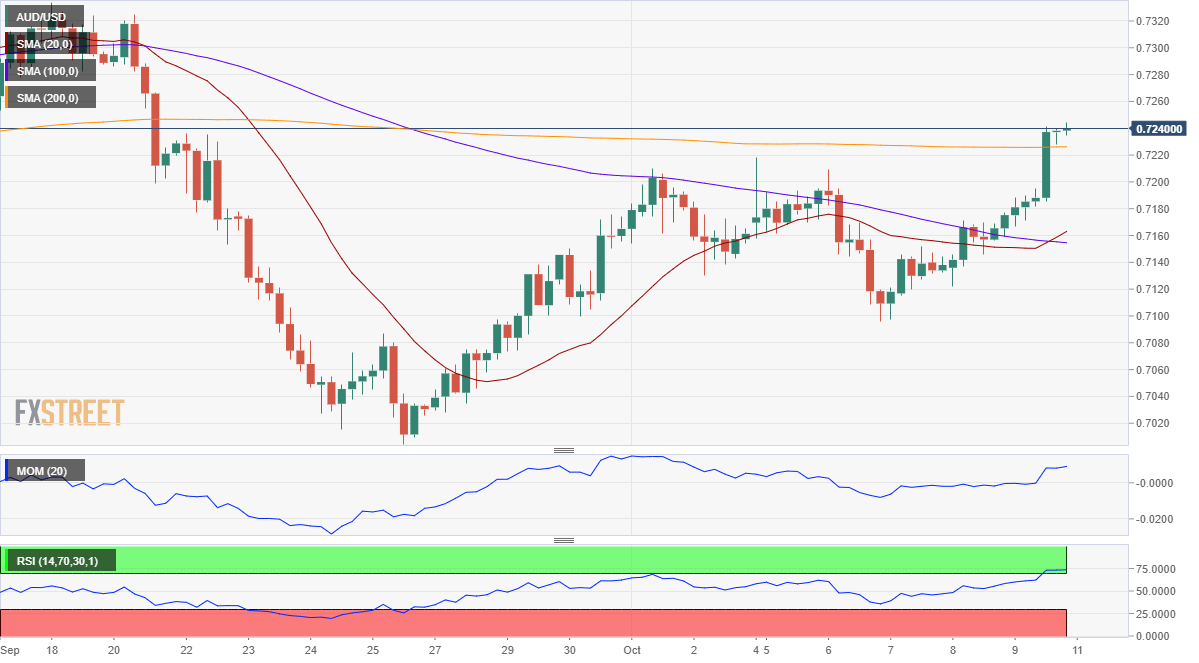
The Aussie benefited from risk appetite on Friday, with AUD/USD ending a second consecutive week with gains at 0.7240. Hopes for a US coronavirus stimulus package boosted equities, which in turn, underpinned the commodity-linked currency. Soaring gold prices provided additional support, as the bright metal closed the week around $1,930 a troy ounce, a level last seen on September 21.

Australian data released at the end of the week was upbeat, as Home Loans were up 13.6% in August, while Investment Lending for Hokes was up 9.2% in the same month. The country won’t release macroeconomic data this Monday.

AUD/USD short-term technical outlook

The AUD/USD pair is offering a bullish stance in its daily chart, as technical indicators are crossing their midlines into positive territory, while the pair settled above all of its moving averages, although the 20 DMA maintains a bearish slope. In the 4-hour chart, the bullish potential is stronger, as the pair settled above all of its moving averages, while technical indicators stand within overbought readings, barely losing its strength upwards.

Support levels: 0.7210 0.7170 0.7130

Resistance levels: 0.7250 0.7290 0.7330

View Live Chart for the AUD/USD

Author

Valeria Bednarik

Valeria Bednarik was born and lives in Buenos Aires, Argentina. Her passion for math and numbers pushed her into studying economics in her younger years.


More from Valeria Bednarik
Share:

Editor's Picks

GBP/USD remains slightly bid near 1.3300

GBP/USD now advances marginally and manages to dispute the 1.3300 region on Tuesday. Indeed, Cable regains some balance on the back of the lacklustre performance of the Greenback, all preceding the Fed’s meeting on Wednesday and the BoE’s gathering on Thursday.

EUR/USD recedes from tops, back below 1.1400

EUR/USD manages to set aside part of the recent weakness and clinches decent gains on Tuesday. Indeed, spot keeps the trade below the 1.1400 mark amid acceptable losses in the US Dollar, all following rising optimism of a US-Iran deal and steady caution prior to the FOMC gathering on Wednesday.

Gold holds above $4,000; looks to FOMC for fresh impetus amid US-Iran tensions

Gold is seen consolidating above $4,000 as traders opt to wait for the crucial FOMC decision due later this Wednesday for more cues about the Fed's future policy path. The outlook, in turn, will influence the US Dollar and provide some meaningful impetus to the non-yielding bullion. In the meantime, the risk of resumption of US-Iran hostilities continues to underpin the USD's reserve-currency status, acting as a headwind for bullion.

Australia CPI could boost Aussie if inflation arrives above 4%

The Australian Bureau of Statistics will publish the June Consumer Price Index on Wednesday at 01:30 GMT. The report is expected to show that inflation rose 4% from a year earlier, matching the May reading. The monthly CPI is foreseen at 0.2% following the -0.7% print from May. The ABS will also release the Trimmed Mean CPI, the Reserve Bank of Australia’s favorite inflation gauge.

Indian Rupee outlook: Downtrend set to persist – Just at a slower pace

The Indian Rupee just endured its most brutal six-month stretch in years, battered by a perfect storm of global shocks. From United States-India trade uncertainty to surging Oil prices and the significant outflow of Foreign Institutional Investment from the Indian stock market, every event brought nothing but pain for the Indian currency.

US Dollar mid-year outlook: Exceptional currency, exceptional risks?
The US Dollar enters the second half of 2026 in a markedly different position from a year ago. The King currency has recovered, reflecting persistent US inflation, changing expectations for Fed policy, geopolitical tensions and renewed demand for defensive assets.