AUD/USD Forecast: Aussie weakens ahead of first-tier Asian figures

AUD/USD Current Price: 0.7055
- US Dollar strengthens as the market mood sours.
- Australian Retail Sales and Chinese PMIs coming up next.
- AUD/USD near-term technical readings hint at a test of the 0.7000 threshold.
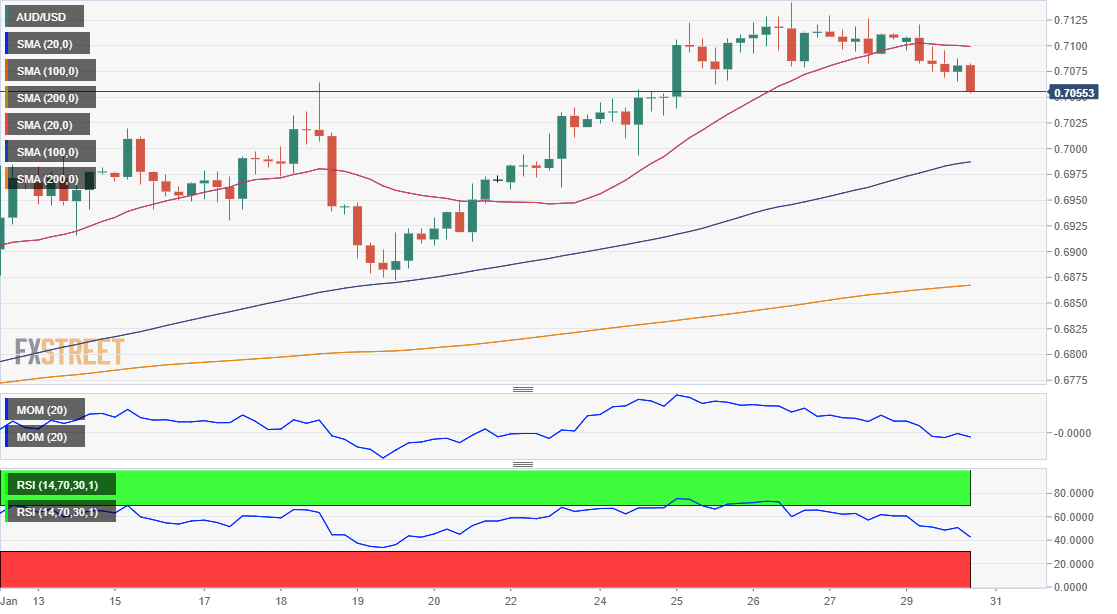
The AUD/USD pair edged lower at the beginning of the week, ending Monday at around 0.7050. The pair eased from an early high of 0.7119 as the market mood soured as the day went by. The US Dollar appreciated on the back of upbeat US data released last week and the soft tone of global indexes. Also, US Treasury yields ticked higher, posting modest gains but reaching fresh multi-week highs.
Australia will open its macroeconomic calendar on Tuesday with the release of December Retail Sales, foreseen down by 0.3% in the month. The country will also publish Private Sector Credit for the same month, while China will unveil the NBS Manufacturing and Non-Manufacturing PMIs. The first is expected to improve from 47 in November to 49.7, while services output is foreseen jumping from 41.6 to 51. Encouraging Chinese figures may boost the market sentiment to the detriment of the US Dollar.
AUD/USD short-term technical outlook
The AUD/USD pair posted a lower low and a lower high for a second consecutive day, somehow hinting at further slides ahead. Still, technical readings in the daily chart fall short of supporting a steeper decline, but reflect the ongoing corrective slide. Technical indicators retreated from overbought territory, but the RSI holds at around 63, while the Momentum turned flat well above its midline. Furthermore, the 20 SMA maintains its firmly bullish slope at around 0.6950, reflecting buyers’ strength.
In the near term, and according to the 4-hour chart, technical readings suggest sellers may try to break the 0.7000 threshold. The pair develops below a now flat 20 SMA, although the longer moving averages maintain their bullish slope far below the current level. Technical indicators, on the other hand, keep heading south within negative levels, standing at fresh one-week lows and without signs of bearish exhaustion.
Support levels: 0.7030 0.6995 0.6960
Resistance levels: 0.7100 0.7145 0.7190
Author

Valeria Bednarik
FXStreet
Valeria Bednarik was born and lives in Buenos Aires, Argentina. Her passion for math and numbers pushed her into studying economics in her younger years.
















