AUD/USD analysis: intraday recovery means nothing to the dominant bearish trend

AUD/USD Current price: 0.7197
- AUD/USD gains daily basis, but lower low and failure to clear 0.7200 keeps the risk skewed to the downside.
- Australian trade balance to be out next, focus on trade with China.
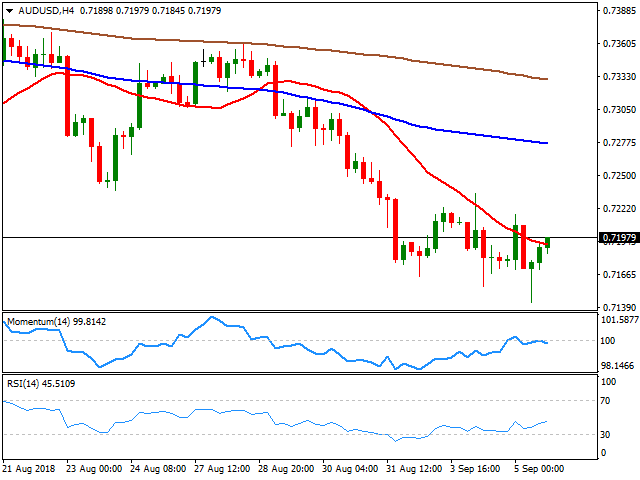
An advance in the Dow Jones and decreasing dollar's demand helped the Aussie to enter positive territory against the greenback by the end of the day after the pair reached a fresh over two years' low of 0.7143 on the back of risk aversion earlier in the day. The Australian currency fell despite better-than-expected local data, as the country informed a quarterly growth of 0.9%, beating expectations of 0.7% and slightly below the previous 1.0%. Yearly growth in the three months to June surpassed the 2.8% forecasted and the previous 3.1%, printing a solid 3.4%. The faster rate of expansion was attributed to stronger domestic spending. Chinese news were not that encouraging, as the August Caixin Services PMI fell to 51.5 in August, down from 52.8 in July. Australia will unveil its July Trade Balance during the upcoming session, expected to post a surplus of 1,40M after July's 1,87M. Export and Import levels, particularly those from and to China, will likely set Aussie's tone for the rest of the day. Despite advancing, the AUD/USD pair has posted a lower low and a lower high daily basis, indicating that bears are still in control of the pair. In the shorter term, and according to the 4 hours chart, the upside seems limited, as the pair is unable to break above a bearish 20 SMA, currently hovering around it, while the Momentum indicator retreats modestly from its 100 level and the RSI hovers around 44. The Aussie is still vulnerable, and a break below 0.7150, could put the pair back under selling pressure.
Support levels: 0.7150 0.7120 0.7095
Resistance levels: 0.7235 0.7270 0.7300
Author

Valeria Bednarik
FXStreet
Valeria Bednarik was born and lives in Buenos Aires, Argentina. Her passion for math and numbers pushed her into studying economics in her younger years.