|

AUD/USD analysis: increasing risk of a bullish breakout

AUD/USD Current price: 0.7205

  • Equities rally, rather than data, underpins the Aussie.
  • AUD/USD keeps pressuring a relevant Fibonacci resistance at around 0.7225.
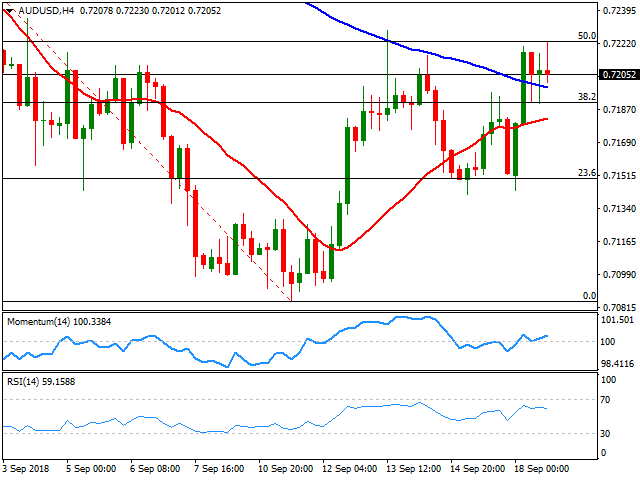
The AUD/USD pair posted a nice comeback this Tuesday, settling above the 0.7200 figure and close to a key mid-term resistance. The pair started the day with a soft tone, falling to 0.7143 after US President Trump confirmed a new batch of tariffs on Chinese goods to become effective next September 24. The pair, however, bounced sharply, advancing alongside with equities, despite the RBA Meeting's Minutes showed that policymakers are concerned about trade tensions that pose a "material risk" to the economy. The pair saw a short-lived knee-jerk when China escalated the war by also announcing tariffs, but the positive momentum of Wall Street helped it recover the ground lost. The Australian Westpac Leading Index for August will be out early Asia, previously at 0.01%.

The pair tested a couple of times the resistance at 0.7225, the 50% retracement of its latest daily slide, but so far remain unable to break above it. A bullish breakout will depend on market mood, rather than on data, as a continued advance in equities, and commodities will likely keep the Aussie supported. Technical readings in the 4 hours chart support additional gains, as the price settled above its 20 and 100 SMA, with the longer one still heading lower and above the shortest one, while technical indicators remain within positive levels, the Momentum advancing to fresh weekly highs and the RSI currently stable at around 60.

Support levels: 0.7190 0.7165 0.7130   

Resistance levels: 0.7225 0.7260  0.7300

View Live Chart for the AUD/USD

Author

Valeria Bednarik

Valeria Bednarik was born and lives in Buenos Aires, Argentina. Her passion for math and numbers pushed her into studying economics in her younger years.


More from Valeria Bednarik
Share:

Editor's Picks

AUD/USD falls from 0.7050 amid Iran uncertainty

AUD/USD is back in the red, falling from 0.7050 in the Asian session on Friday, reversing the previous day's goodish rebound from a nearly two-month low amid a modest US Dollar uptick. Iran downplayed Trump's claim that a deal has been approved and said that key issues, including the Strait of Hormuz and frozen funds, remain unresolved. This keeps a lid on optimism, which, along with Fed rate-hike bets, revives USD demand and weighs on the pair.

USD/JPY recovers above 160.00 as Mideast woes persist ahead of BoJ

USD/JPY recovers ground above 160.00 in the Asian session on Friday. Economic risks due to uncertainty in the Middle East undermine the Japanese Yen, while lifting the safe-haven US Dollar (USD) amid the US-Iran standoff. This acts as a tailwind for the pair, though fears of intervention could limit deeper JPY losses and cap the pair's rebound ahead of the BoJ meeting next week.

Gold: Downside risks remain intact amid a Bear Cross

Gold returns to the red in Asia on Friday, following a temporary short-covering rally above $4,200 seen a day ago. The bright metal is set to book a second consecutive weekly loss, having tested the year-to-date lows near the $4,000 threshold earlier in the week.

Crypto Today: Bitcoin, Ethereum, XRP rebound broadens despite continued US-Iran strikes

Bitcoin steadies its recovery on Thursday, edging higher toward $63,000 despite incessant capital outflows. Meanwhile, altcoins, including Ethereum and Ripple, exhibit subtle rebound signs, trading above $1,650 and $1.12, respectively.

U.S. economic outlook: The Warsh era starts with a great debate

Warsh is starting his tenure at the Fed during a transition of sorts. Given the prior FOMC statement and the countless Fed speakers we’ve heard from since then, it seems Fed officials are in the midst of shifting toward a more neutral policy stance.

4.2% headline, 0.2% core: Why the Fed's next hike may be targeting the wrong problem

May's CPI put headline inflation at 4.2% on the year, up from 3.8% in April and the hottest reading since April 2023, while core prices rose just 0.2% on the month, undershooting the 0.3% consensus and halving April's pace.