|

AUD/USD analysis: at two-year lows and poised to extend decline

AUD/USD Current price: 0.7074

  • Positive Australian data fell short of supporting the Aussie.
  • Weak equities and a strong dollar combined to tear the AUD down.
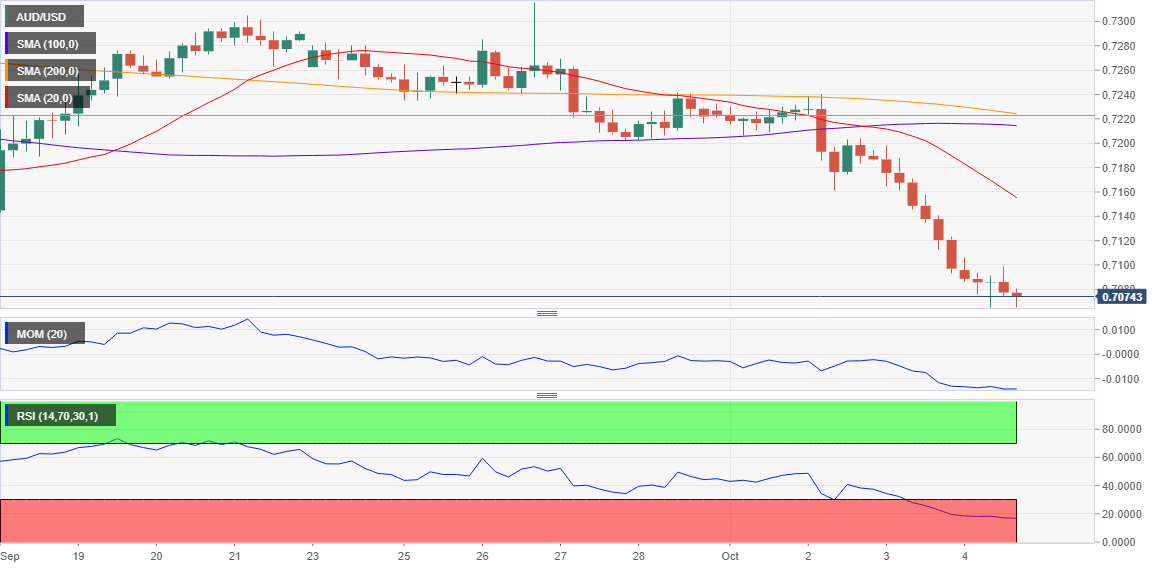
The AUD/USD pair plunged to 0.7065, its lowest since February 2016, with the Aussie still among the weakest currencies of the FX board, falling despite solid local data released at the beginning of the day. According to the official report, Australian trade surplus beat expectations by printing A$1.6B in August, the eighth consecutive monthly surplus. Moreover, export grew 15.3% from a year earlier, while exports and imports with China hit fresh record highs in the year to August. Nevertheless, the strength of the greenback and the sour tone of equities kept the pair on the negative side, all through the day. Australia will release the AIG Performance of Construction Index for September, HIA New Home Sales for August and Retail Sales,  seen up 0.2% in August. 

 The pair attempted to recover ground but was capped by sellers around the 0.7100 figure, and despite oversold, the risk remains skewed to the downside, given that in the 4 hours chart, the pair extended further below all of its moving averages, with the 20 SMA maintaining an almost vertical slope but some 100 pips above the current level. The Momentum indicator bounced from extreme levels, but its upward strength has already eased, while the RSI maintains its downward slope, now at around 20. The pair could correct higher at the end of the week, should equities recover ground on the back of a strong US employment report, which could bring some relief to equities.

Support levels: 0.7085 0.7050 0.7010

Resistance levels: 0.7170 0.7200 0.7225      

View Live Chart for the AUD/USD

Author

Valeria Bednarik

Valeria Bednarik was born and lives in Buenos Aires, Argentina. Her passion for math and numbers pushed her into studying economics in her younger years.


More from Valeria Bednarik
Share:

Markets move fast. We move first.

Orange Juice Newsletter brings you expert driven insights - not headlines. Every day on your inbox.

By subscribing you agree to our Terms and conditions.

Editor's Picks

EUR/USD falls toward 1.1700 on broad USD recovery

EUR/USD turns south and declines toward 1.1700 on Wednesday. The US Dollar gathers recovery momentum and forces the pair to stay on the back foor, as traders look to USD short-covering ahead of US inflation report on Thursday. However, the downside could be capped by hawkish ECB expectations. 

GBP/USD trades deep in red below 1.3350 after soft UK inflation data

GBP/USD stays under strong selling pressure midweek and trades below 1.3350. The UK annual headline and core CPI rose by 3.2% each, missing estimates of 3.5% and 3.4%, respectively, reaffirming dovish BoE expectations and smashing the Pound Sterling across the board ahead of Thurday's BoE policy announcements. 

Gold clings to moderate daily gains above $4,300

Following Tuesday's volatile action, Gold regains its traction on Wednesday and trades in positive territory above $4,300. While the buildup in the USD recovery momentum caps XAU/USD's upside, the cautious market stance helps the pair hold its ground.

Bitcoin risks deeper correction as ETF outflows mount, derivative traders stay on the sidelines

Bitcoin (BTC) remains under pressure, trading below $87,000 on Wednesday, nearing a key support level. A decisive daily close below this zone could open the door to a deeper correction.

Monetary policy: Three central banks, three decisions, the same caution

While the Fed eased its monetary policy on 10 December for the third consecutive FOMC meeting, without making any guarantees about future action, the BoE, the ECB and the BoJ are holding their respective meetings this week. 

AAVE slips below $186 as bearish signals outweigh the SEC investigation closure

Aave (AAVE) price continues its decline, trading below $186 at the time of writing on Wednesday after a rejection at the key resistance zone. Derivatives positioning and momentum indicators suggest that bearish forces still dominate in the near term.