Asia wrap: The strait, the spike, and the silicon bottleneck

The spike
A quick reality check. We are operating inside moving goalposts. What looks definitive now may be revised by the next trading session. And the fact that screens have steadied after the opening air pockets should not be mistaken for resolution
And let's start with the pre-Monday open trading assumptions that were being discussed across trading desks in Singapore.
- The oil market is likely to see a price jump of 10%-15% when it reopens, with Brent crude potentially reaching $80-plus a barrel.
- The situation is fluid, but so far the biggest market fear of the targeting of energy infrastructure and the enforced closure of tanker routes has not happened.
- Despite fears of an oil shock, the global economy may not be severely impacted due to factors such as the US shale revolution and the decent supply of oil currently available.
On Saturday, everyone was an AI expert. By Sunday night, they were crude shipping specialists, squinting at free Marine Traffic websites like they were Bloomberg terminals in 2008. Red dots are piling up at the mouth of the Strait of Hormuz. Tankers are idling. Insurance desks are pulling coverage faster than risk managers after a fat finger event.
When history speeds up, expertise becomes a social media hobby.
Let’s start where markets start. Not with outrage. Not with ideology. With flow.
Ayatollah Khamenei is dead. Forty years of rule were decapitated in the blink of a weekend. Retaliation followed, and American lives were lost. This is not another drone flare-up that fades by Tuesday. This is a regime-level shock injected into a market that was already twitching, from “the economy is strong” to “we are all becoming unemployed.”
Brent did what he should have done. It leaped more than 12 percent, printed north of $80, and then settled lower, up 6%. That is not apocalyptic panic. That is insurance repricing.
The only question that matters in the first 72 hours after a geopolitical shock is brutally simple. Does oil keep moving higher?
Geopolitical shocks are not binary events. They scatter across a spectrum of market outcomes. The outlier everyone still whispers about is 1973, when the Yom Kippur conflict metastasized into a deliberate oil embargo and a sustained supply strangulation. That was not a volatility spike. It was a structural energy shock that reset inflation, rates, and equity valuations for years.
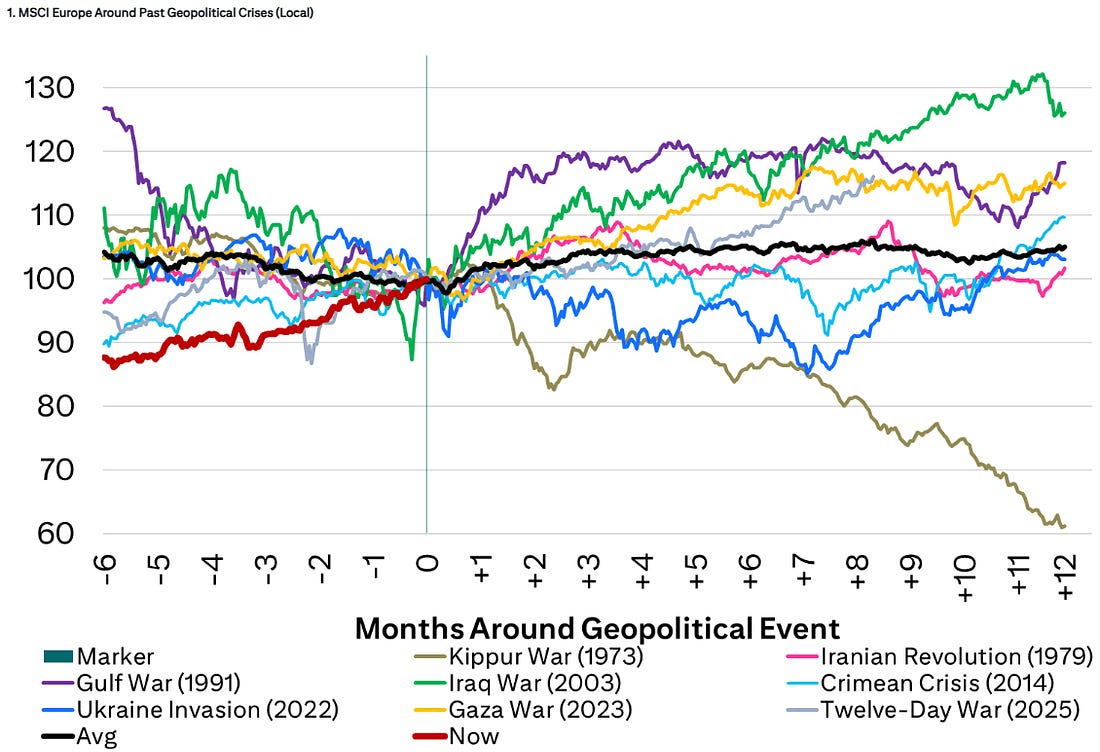
Most other Middle East eruptions never crossed the Rubicon. They rattled pipelines, threatened shipping lanes, and injected fear into screens, but once physical flows normalized, capital rotated back in. In market terms, the difference is simple. If barrels keep moving, panic fades. If barrels stop, the market mood changes dramatically
So for traders, this is less about political clickbait war headlines. It's simply about barrels.
Three paths sit on this oil trader’s blotter. ( And I’ll try to keep the repetition for prior notes to a minimum)
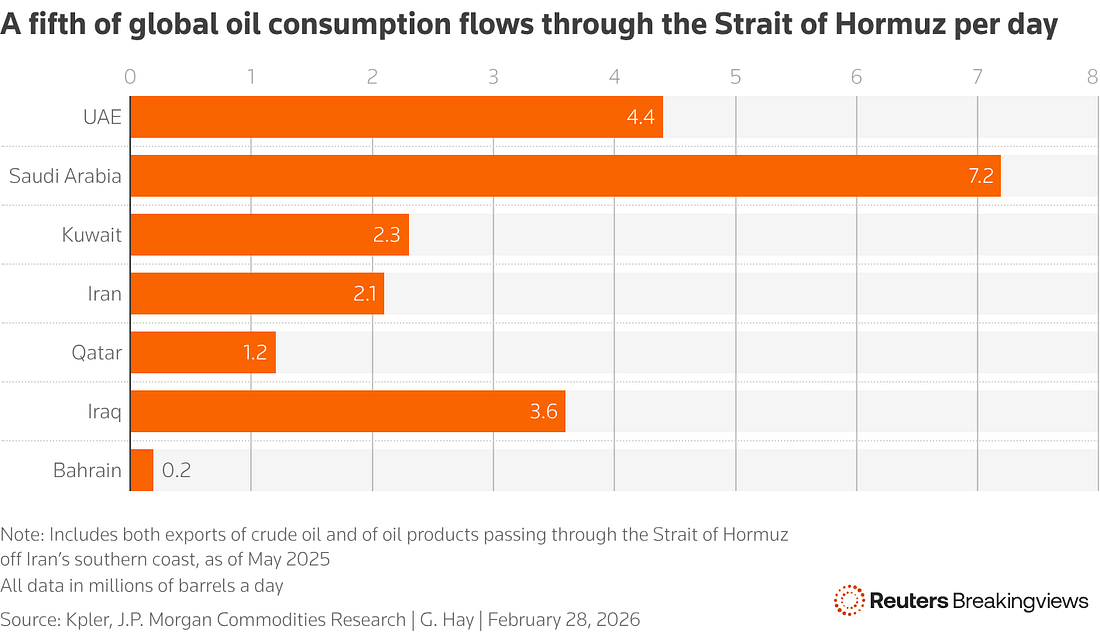
The tail event is a genuine Hormuz closure. 20% of global oil exports are squeezed. LNG and fertilizer flows pinched. That is a scenario where Brent does not flirt with $80. It sprints toward $125. Risk assets do not wobble. They reset lower in a violent fashion.
The clean unwind is a rapid regime stabilization and de-escalation. Insurance restored. Tankers resume. Oil retraces toward $60. The spike becomes a memory and dip buyers look prescient.
The middle path is the one markets are quietly pricing. The Strait is not formally closed. Tehran says it has no intention of doing so. Yet commercial shipping pauses anyway. Not because of missiles. Because underwriters yank war risk cover within hours. The binding constraint is not a naval blockade. It is the insurance market.
When coverage disappears, supply is impaired even if the waterway is technically open.
That justifies $80 oil without requiring an apocalypse.
Saudi trading on Sunday delivered a powerful tell. Aramco rallied on higher crude, yet the broader Saudi index fell hard. When the crown jewel rises, but the kingdom sinks, you are looking at a market hedging tail risk, not celebrating windfall revenue. Oil strength in isolation does not immunize equities from geopolitical drag.
The longer live fire continues and the wider it spreads, the higher the equity risk premium drifts. Not explosively. Methodically. Markets are not pricing the end of the world. They are charging more for uncertainty.
Now layer in positioning.
US equities have gone nowhere for months. They are expensive on valuation but not frothy on momentum. Gold has already been whispering anxiety for weeks. Asset allocators, overseeing trillions, report their strongest optimism in five years, anchored in earnings recovery and faith that inflation has been beaten.
That faith is fragile.
An oil spike is not just a commodity story. It is a macro thesis stress test. If crude sustains above $80 and pushes higher, the disinflation narrative cracks. Lower rate dreams get postponed. A new Federal Reserve chair steps into office in two months and immediately faces a credibility exam. Markets love to test fresh central bankers.
There is another consensus lurking in plain sight. Almost everyone expects a weaker dollar. A soft greenback has greased the wheels of emerging market performance and global risk appetite. The first reaction to the Iranian escalation was dollar strength via higher oil prices. If that persists, crowded short dollar assumptions get wrong-footed quickly. When everyone leans one way, it takes only a mild shove to trigger an imbalance.
And then there is the other obsession.
AI.
While tankers queue in the Gulf, hyperscalers continue to pour billions into data centers. Investors demand proof of return. Power grids groan under projected load. Building generation capacity is slow, regulated, and capital-intensive. The real AI scarcity may not be chips. It may be electrons.
The next great AI proxy might not be a semiconductor. It might be a utility.
Wireless infrastructure is another quiet constraint. Scaling advanced AI over networks not purpose-built for it is like bolting a jet engine onto a bicycle frame. 5G was not designed for distributed intelligence at the edge. 6G, expected closer to 2030, promises intelligence woven into the network itself. China is positioning aggressively, pairing robotics, autonomous systems, and rare earth leverage into a cohesive industrial strategy.
Meanwhile, space-based connectivity is moving from science fiction to a capital markets pitch deck. Starlink’s explosive growth and chatter about a trillion-dollar valuation signal something profound. The market is beginning to price communications infrastructure as the spine of the next technological era. Aerospace and defence inflows have doubled in six months. Performance explains the enthusiasm.
Yet here is the sobering reality. AI adoption is not a straight line. It is a buildout constrained by power, spectrum, regulation, and geopolitics. The silicon revolution needs space. It also needs stability.
So we sit at an intersection.
A fifth of the world’s seaborne oil flows through a narrow corridor now shadowed by war risk clauses. Asset allocators are optimistic. Inflation is assumed to be conquered. The dollar was expected to drift lower. AI is treated as destiny.
Markets can juggle many narratives at once. But they demand coherence.
If oil flows resume smoothly and retaliation cools, the spike becomes a footnote, and earnings momentum reclaims centre stage. If insurance paralysis lingers and crude grinds higher, the inflation genie peeks out of the bottle. If the dollar refuses to weaken, emerging-market exuberance fades. If AI infrastructure hits physical shipping bottlenecks, multiples compress in a hurry.
This is not a moment for ideology. It is a moment for calibration.
The Strait is the valve. Insurance is the wrench. Oil is the pressure gauge.
And the market, as always, is not forecasting the future. It is auctioning probabilities in real time.
Author
Stephen Innes
SPI Asset Management
With more than 25 years of experience, Stephen has a deep-seated knowledge of G10 and Asian currency markets as well as precious metal and oil markets.