Are Democrats to blame for the decline in US Retail Sales?


The latest US sales data for May suggests that the US consumer is fatigued as we head into the summer months. Core retail sales that adjust for vehicle sales contracted by 0.1% last month, and there were downside revisions to the April data. So, what is going on with the mighty US consumer?
US consumer confidence slides
To get an answer to this, we need to look at last week’s University of Michigan Consumer Confidence report for June. The overall reading was 65.6, down from 69.1 in May, and the index of consumer expectations also fell to 67.6 from 68.8. Overall, while consumer sentiment was changed little in June compared to May, the assessment of personal finances fell due to rising concerns over high prices and weakening incomes. Inflation expectations remained steady at 3.3%, and long-term inflation expectations inched up to 3.1% from 3% in May.
This was a shock for the markets as economists surveyed before the release expected consumer confidence to rise. While this hasn’t had a meaningful impact on the US stock market’s performance, which rose to its 30th record high close of the year on Monday, it may explain why the rally is so narrow, with only 46% of US stocks rising above their 50-day moving average, and some 10 stocks accounting for over 60% of the S&P 500’s gain so far this year.
Democrats see consumer confidence drop sharply
After a spate of stronger than expected US economic data, including payrolls for May, there is something else going on that is weighing on US consumer sentiment: politics. The June survey of consumers by the University of Michigan has seen a sharp decline in consumer sentiment among Democratic voters. Democrats saw their confidence levels fall to 84.5 from 91.3 in May, at the start of the year their confidence level was 101.7. Republican voters have also seen their confidence levels fall since January, but by a much smaller margin. For example, in January, Republican consumer confidence was 56.3, it is 52.6 now. Democrat voters’ consumer confidence levels are now at their lowest levels since November 2023.
Why the Presidential election could drive growth from here
The decline in confidence is strange, since the Presidential election polls have not significantly shifted in recent months, and both candidates are neck and neck. President Trump is ahead by 0.7 points, with President Biden expected to pull in 40.2%, vs. President Trump at 40.9%. Perhaps Democrats are losing confidence in their guy winning the November election because 1, Trump’s conviction on multiple charges of falsifying business records has not dented his popularity and he raised more than $35mn in online donations following his conviction. 2, There has been a huge amount of speculation in the press in recent weeks about President Biden’s health and his fitness to run for another term, after he appeared to freeze and get confused during several public appearances.
Are Democrats losing faith in their ability to win the November election?
Consumer confidence tends to be drawn along party lines in the US, so when the Republicans are in power consumer confidence among republican voters tends to rise, and when Democrats are in power, they tend to be more confident. Thus, the sharp decline in consumer confidence among Democrat voters could be a sign that they are losing hope in President Biden and his ability to win another term in office. The recent decline in retail sales suggests that this lack of confidence could hurt the real economy in the US in the lead up to the election, if it continues to lead to subdued spending by Democrat voters. Ironically, a weakening economy before the November election caused by a subdued Democrat consumer, could make things even tougher for President Biden in this election.
Main Street vs Wall Street
From a market perspective, this is unlikely to dent sentiment towards the main S&P 500 index, and it is unlikely to dent the rally in tech stocks. However, a weakening US consumer could mean that the rally does not broaden out much beyond tech. It may also trigger a widening of the divergence between Main Street and Wall Street. This can be seen in the lagging performance of the equal weighted S&P 500, which strips out the impact from the mega tech firms, vs, the non-equal weighted S&P 500 that is dominated by tech, as you can see below.
Equal-weighted S&P 500 (orange line) and S&P 500, normalized to show how they move together over the last five years
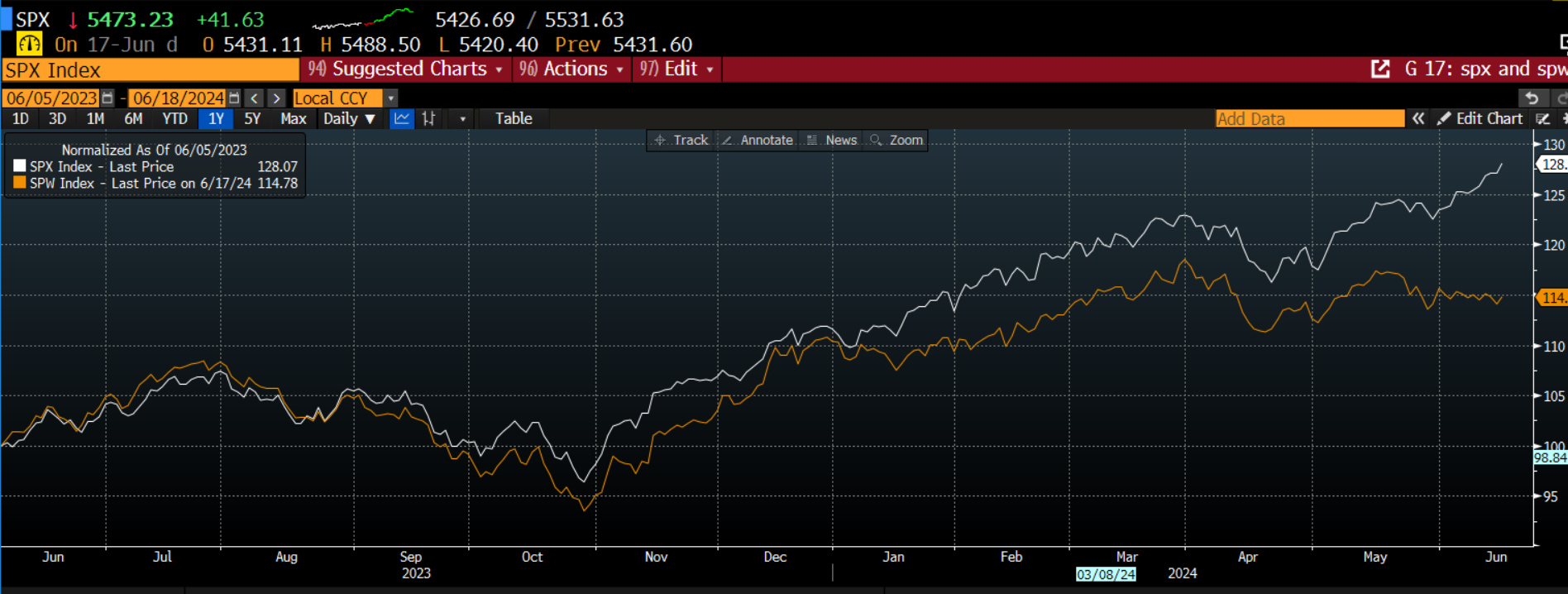
Source: XTB and Bloomberg
Author
Kathleen Brooks
XTB UK
Kathleen has nearly 15 years’ experience working with some of the leading retail trading and investment companies in the City of London.