Anticipating the week ahead: Insights into economic indicators and market dynamics


As traders brace themselves for the upcoming week, a multitude of events and themes are poised to unfold, potentially shaping market sentiment and influencing trading dynamics across the global financial landscape. From significant holidays to critical economic data releases, investors remain on high alert, closely monitoring developments that could reverberate through currency valuations and policy expectations.
Highlights:
- Chinese New Year and Singapore public holiday
- US CPI and inflation expectations
- Australian employment data
- Technical trends and currency pairs
Dive with me into this comprehensive breakdown of what lies ahead and the potential implications for various asset classes:
Economic indicators and key events
Against the backdrop of cultural observances and economic data releases, market participants navigate through a terrain fraught with possibilities:
1. Chinese New Year and Singapore public holiday
The celebration of Chinese New Year marks the beginning of a week of public holidays in China, coinciding with Singapore's public holiday on Monday. These festivities are anticipated to exert a moderating influence on trading activity in these regions, potentially affecting liquidity and volatility in the markets. Traders must exercise caution amidst reduced participation during this holiday period.
2. US CPI and inflation expectations
A focal point of the week revolves around the release of key US inflation data, including the Consumer Price Index (CPI) and inflation expectations. Both CPI and Personal Consumption Expenditure (PCE) reports hold immense significance for investors, with CPI figures garnering particular attention due to their profound impact on monetary policy decisions. Traders keenly scrutinize any deviations from expected inflation levels, anticipating potential shifts in the strength of the US dollar and Federal Reserve interest rate decisions.
However, a crucial factor influencing CPI figures is inflation expectations, with one measure from the NY Fed set to be released on Monday. The chart provided illustrates the NY Fed's 1 and 3-year CPI expectations alongside the Michigan 1-year inflation expectations and CPI year-on-year itself. A brief examination reveals that all these metrics are experiencing downward trends, sparking speculation that the Fed may consider rate cuts. The challenge lies in the fact that none of these indicators are close to the Fed's 2% inflation target. If consumers don't anticipate CPI reaching 2% in the next 12 months, there's a possibility that CPI won't either.
Should there be an unexpected rise in CPI expectations prior to the CPI report, it could reinforce the US dollar further and put pressure on other currencies as traders continue to reduce their expectations of a rate cut in the first half of the year. Conversely, a decline in CPI expectations might cause the US dollar to retrace its steps before the CPI report, potentially accelerating its decline if inflation figures turn out softer than anticipated.
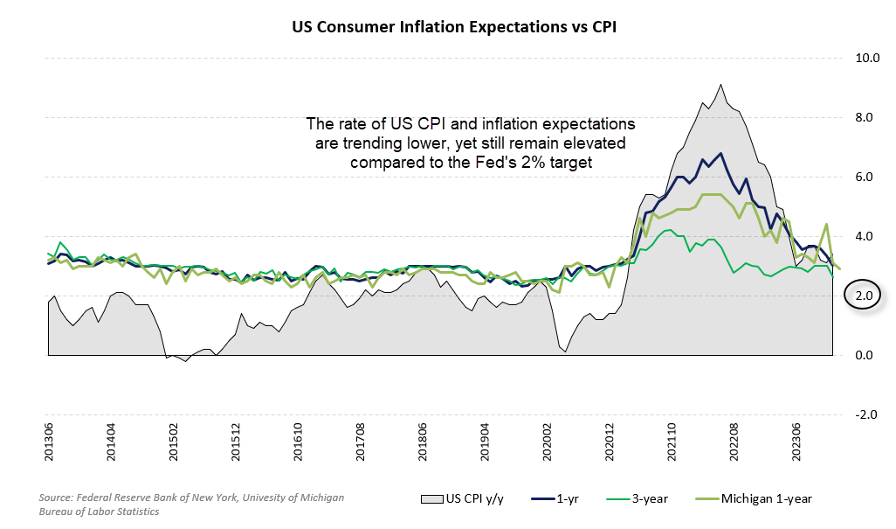
Source: Federal Reserve Bank of New York
3. Australian employment data
Australia's employment figures come under scrutiny following December's unexpected reduction of 106,000 full-time jobs. Analysts are eager to discern whether this decline represents a temporary anomaly or signals a broader trend in the labor market. The outcome of this data release may significantly influence expectations regarding Reserve Bank of Australia (RBA) monetary policy, potentially impacting the Australian dollar's valuation against major counterparts.
4. UK data dump
In the United Kingdom, a deluge of economic data is set to be unveiled, spanning Consumer Price Index (CPI), Gross Domestic Product (GDP), trade balance, and retail sales figures. These indicators carry substantial weight in shaping market perceptions of Bank of England (BOE) policy expectations and the broader economic outlook. Traders will meticulously analyze the data for any surprises or deviations from consensus forecasts, which could catalyze volatility in currency markets.
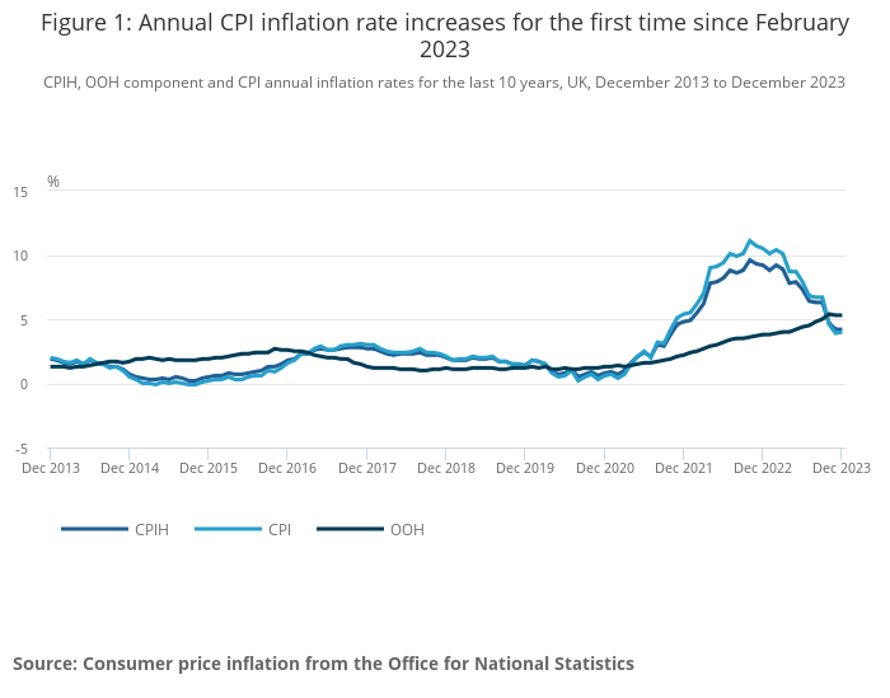
Source: https://www.ons.gov.uk/
5. New Zealand data releases
In New Zealand, attention is riveted on key data points such as food inflation, credit card statistics, and visitor arrivals. Notably, the revision of Reserve Bank of New Zealand (RBNZ) Official Cash Rate (OCR) forecasts by ANZ, which anticipates two 25 basis point hikes, could influence investor sentiment and expectations regarding future monetary policy decisions. These revisions may significantly impact the New Zealand dollar's performance in currency markets.
Market analysis: Technical trends and currency pairs
1. US Dollar Index
Last week, the US Dollar Index displayed mixed signals, reflecting nuanced market sentiment. While the candlestick closed above its open, resembling a small bearish pin bar, the weekly close indicated an upward trajectory compared to prices from 3 and 6 months ago, suggesting a bullish long-term trend. However, the direction remains uncertain, hinging significantly on the upcoming release of US CPI (inflation) data.
The US Dollar Index, often seen as a barometer of global economic health, faces a pivotal moment with the impending CPI data release. A drop in inflation could trigger concerns about economic growth, potentially prompting a selloff in the dollar. Conversely, persistently high inflation may fuel speculation of a rate cut by the Federal Reserve, bolstering the dollar's momentum in the short term.
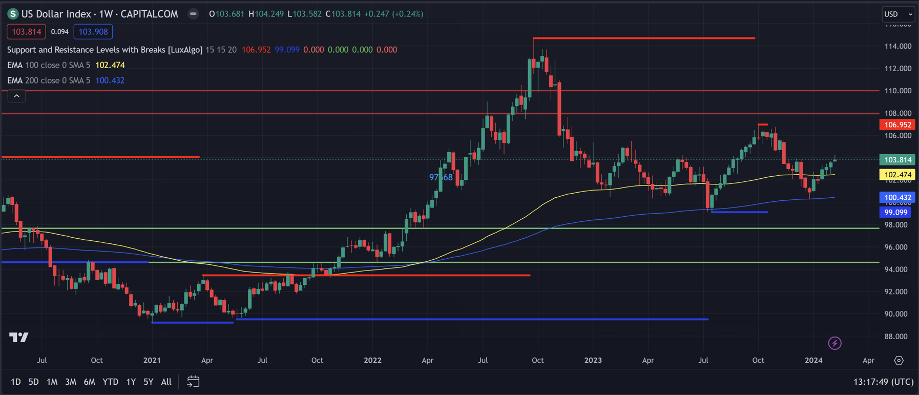
Source: TradingView
Let's examine the dynamics of ICE US Dollar Futures. First, let's clarify the components involved:
ICE US Dollar Index Futures: These are financial contracts traded on the Intercontinental Exchange (ICE) that enable investors to speculate on or hedge against changes in the value of the US dollar relative to a basket of other major currencies.
Asset Manager Short Positions: This term refers to the positions taken by asset managers who anticipate a decrease in the value of the US dollar. Short positions involve selling assets that the investor does not currently own, with the expectation of repurchasing them at a lower price in the future.
WoW: This acronym represents "Week-over-Week," indicating the change in asset manager short positions in US Dollar Index futures contracts compared to the previous week.
According to the US Commodity Futures Trading Commission statement, the current level of asset manager short positions in US Dollar Index futures contracts stands at -197.00. This suggests that asset managers, collectively, hold net short positions in these contracts. The notation "N/A from last week" indicates that there is no available data for comparison with the previous week. Additionally, the figure has decreased from 1002.00, the level of short positions held by asset managers one year ago. There is no specific change reported from the previous week due to the unavailability of data.
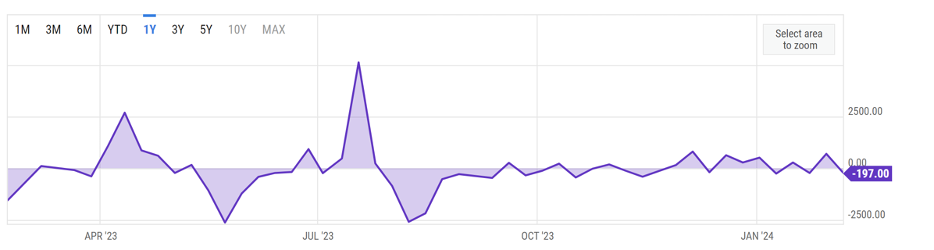
Source: https://ycharts.com
2. NASDAQ 100 and S&P 500 indices
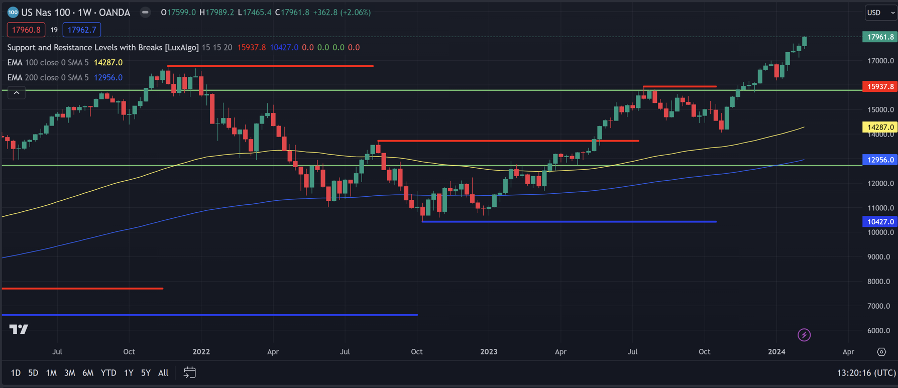
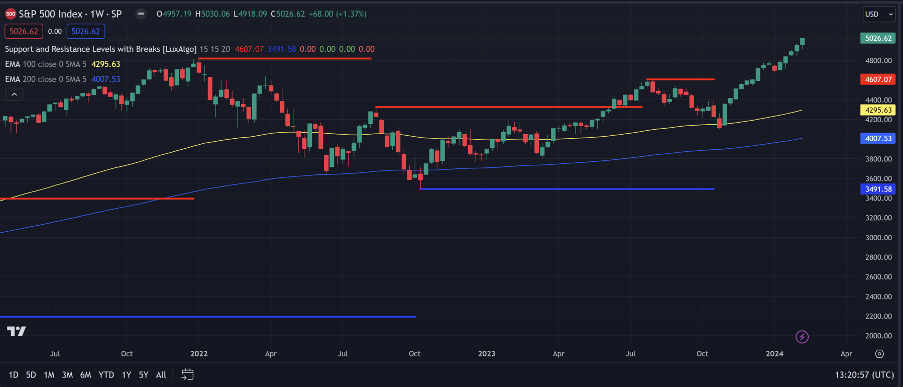
Both the NASDAQ 100 and S&P 500 Indices surged to new record highs, buoyed by bullish sentiments in US stock markets. Despite rising short-term US treasury yields and Dollar values, foreign investment inflows into the US market signal confidence in the US economy relative to its counterparts. The technical outlook remains bullish, with historical data indicating promising advances following fresh all-time highs.
Source: TradingView
The remarkable performance of the NASDAQ 100 and S&P 500 Indices underscores the resilience of US equities amidst a backdrop of rising interest rates and inflation concerns. The influx of foreign capital underscores the perceived strength of the US market, further supported by robust corporate earnings and optimistic economic forecasts. However, investors remain wary of potential headwinds, including geopolitical tensions and policy uncertainties.
Source: TradingView
3. Currency pair analysis: GBP/USD and EUR/JPY
In the GBP/USD pair, the $1.2641 resistance level held firm, underscoring its significance as both support and resistance. Conversely, the EUR/JPY pair witnessed the ¥158.98 level acting as robust support, culminating in a decisive bounce during key market sessions. These currency pairs reflect the efficacy of technical analysis in identifying entry points and managing risk amidst market fluctuations.
The GBP/USD and EUR/JPY pairs offer intriguing insights into the interplay of technical levels and market sentiment. The rejection of key resistance levels underscores the influence of market psychology and investor behavior in currency markets. Traders navigating these pairs must remain vigilant for potential breakout opportunities, leveraging technical indicators and fundamental analysis to navigate evolving market conditions.
In conclusion, as traders navigate the week ahead, volatility and uncertainty may characterize market conditions, driven by economic data releases, policy developments, and cultural observances. Vigilance and adaptability will be paramount as market participants seek to capitalize on emerging opportunities while mitigating risks in an ever-evolving financial landscape. Adapting to shifting market dynamics requires a judicious blend of technical analysis, fundamental insights, and astute risk management strategies.
Author
Faouz Rejeb
Independent Analyst
Transitioning from my distinction as the Best Crypto Analyst in 2022, I actively serve as a distinguished Marketing Brand Manager and acclaimed independent Market Analyst.