Amazon ( AMZN Stock), the pandemic and black Friday

Undoubtedly, the changes that the Covid-19 pandemic has brought have managed to permeate different aspects of our day-to-day life, which has led us as a society to think of a “ new normal”, such as the transfer of our environments from work to home and also the accelerated adoption of online commerce, two changes that will probably have the opportunity to remain present after a possible cure for both the pandemic and the social and economic struggle we are going through, that is why the big tech world and banking are looking for ways to do business together.
This inevitable alliance occurs from two perspectives, one that makes banks see the edge of having to choose between whether to be seen as technology companies or as financial companies and the idea that this union could result in the largest banks controlling the technology industry as a result of the massive growth of payment systems in recent years and the only thing that is expected is an approach to a regulatory plan that dictates the rules of the game.
Payment systems linked to the forms that some technology companies have based how they charge for their services, have created a gap for financial companies to see an opportunity to develop “a new style of mobile bank account” or different formats such as the Venmo system from PayPal that includes peer-to-peer payment services to pay rent or split bills; making it clear that the next Modern Corporation is based on the intellectual capital that allows for expansion at zero or almost zero marginal costs through technological platforms and networks.
One of the companies preparing for a busy end of the year is Amazon, which is preparing for the Christmas season, with Black Friday just around the corner, but the most anticipated news for this company in the long term is the launch of Amazon Pharmacy, announced a few days ago, which will give US customers the ability to order prescriptions for home delivery and free two-day shipping for Amazon Prime members.
Overall figures for Amazon in the third quarter beat expectations, with the company coming in at $ 12.37 a share on revenue of $ 96.15 billion, compared to analysts’ estimates at $ 7.41 a share and $ 92.7 billion respectively, which increased the top line by 37% compared to the previous year.
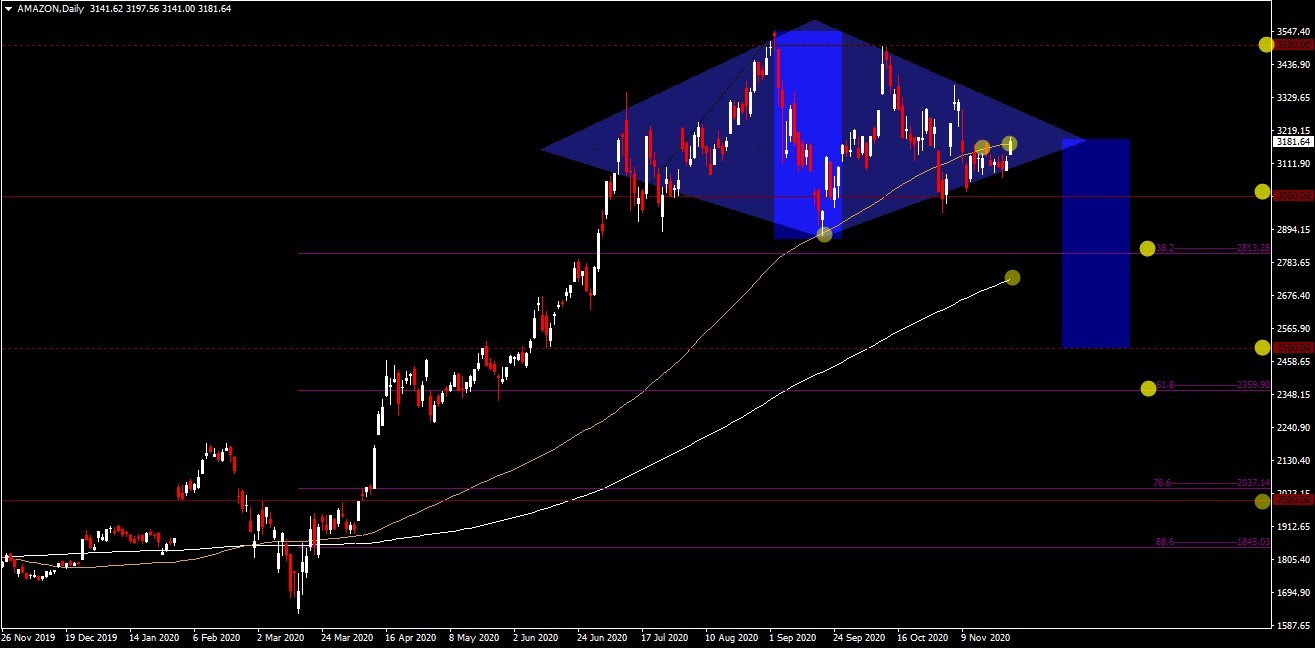
Amazon registers a diamond pattern that began in July and gave a high failure with the first at $3,547 on September 2 and the second high at $3,500 without being able to overcome it; on Monday it had a sinking of 0.03% to $3,098.39 , and currently it is at $3,181.64, retesting the 100-day SMA. If the asset moves below $3,000, it could find Support at the 38.6% Fibonacci retracement and the 200-DMA at $2,813.28 and at the $2,500.

















