|

Albert Edwards “Fed is a Slave to the S&P 500”: Would Kevin Warsh Change That?

Society General’s Albert Edwards was at the Bank Credit Analyst annual conference in New York last week.

Also in attendance were Larry Summers, Paul Volcker, and potentially the next Fed Chair, ex Fed-Governor Kevin Warsh.

Edwards’ email comments on Warsh and Summers ring a bell with me.
fed

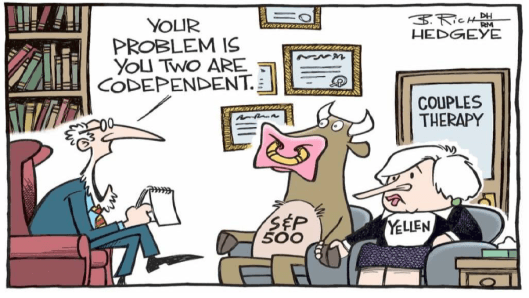
I was the first speaker and afterward I enjoyed listening to every other speaker at the two-day event. Most notable of the outside economics speakers were Paul Volker, Larry Summers, and most significantly for me, ex Fed-Governor Kevin Warsh. Much to my own regret, I had never familiarised myself with the views of Governor Warsh, who was at the Fed from 2006-11, and played a key role in navigating the Fed through the crisis. He got a rousing reception from the BCA audience as he talked a lot of sense – in particular on how the Yellen Fed has lost its way and current policy is deeply flawed. He explained that the Fed has been “captured” by a groupthink of academics led by the ‘Secular Stagnation’ ideas of his friend, Larry Summers. Rather than admitting they are wrong, this group, who failed to predict the current economic malaise, have constructed this theory to explain why ever more stimulus is required. In particular, Warsh warned that the Fed had become the slave of the S&P.

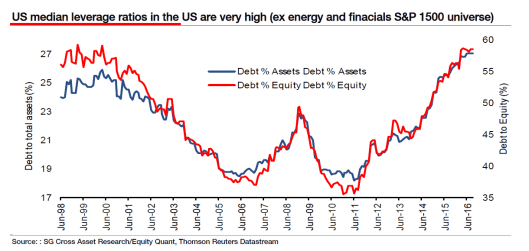
Summers’ relaxed view on the debt build-up, particularly visible in the corporate sector, is in sharp contrast with our own view that this looks set to wreck the US economy.

The problem with Summers’ analysis in my view is that it is the higher debt that is being used to push up asset values (via share buybacks), just as it did during the housing bubble in 2005-7. And by pushing asset values well beyond fundamentals you build debt structures on false asset values, which only become apparent when the asset bubble bursts. And am I in any way reassured that the Fed sees no bubbles? No, I am not. These dudes will never identify an asset bubble – at least before the event!

Median Leverage Ratios
US

Here we are once again, only this time higher.

Author

Mike “Mish” Shedlock's

Mike “Mish” Shedlock's

Sitka Pacific Capital Management,Llc

More from Mike “Mish” Shedlock's
Share:

Markets move fast. We move first.

Orange Juice Newsletter brings you expert driven insights - not headlines. Every day on your inbox.

By subscribing you agree to our Terms and conditions.

Editor's Picks

EUR/USD: Bulls pray for a dovish Fed

EUR/USD has finally taken a breather after a pretty energetic climb. The pair broke above 1.1680 in the second half of the week, reaching its highest levels in around two months before running into some selling pressure. Even so, it has gained almost two cents from the late-November dip just below 1.1500 the figure.

GBP/USD trims gains, recedes toward 1.3320

GBP/USD is struggling to keep its daily advance, coming under fresh pressure and retreating to the 1.3320 zone following a mild bullish attempt in the Greenback. Even though US consumer sentiment surprised to the upside, the US Dollar isn’t getting much love, as traders are far more interested in what the Fed will say next week.

Gold: Bullish momentum fades despite broad USD weakness

After rising more than 3.5% in the previous week, Gold has entered a consolidation phase and fluctuated at around $4,200. The Federal Reserve’s interest rate decision and revised Summary of Economic Projections, also known as the dot plot, could trigger the next directional move in XAU/USD. 

Week ahead: Rate cut or market shock? The Fed decides

Fed rate cut widely expected; dot plot and overall meeting rhetoric also matter. Risk appetite is supported by Fed rate cut expectations; cryptos show signs of life. RBA, BoC and SNB also meet; chances of surprises are relatively low. Dollar weakness could linger; both the aussie and the yen best positioned to gain further. Gold and oil eye Ukraine-Russia developments; a peace deal remains elusive.

Week ahead – Rate cut or market shock? The Fed decides

Fed rate cut widely expected; dot plot and overall meeting rhetoric also matter. Risk appetite is supported by Fed rate cut expectations; cryptos show signs of life. RBA, BoC and SNB also meet; chances of surprises are relatively low.

Ripple faces persistent bear risks, shrugging off ETF inflows

Ripple is extending its decline for the second consecutive day, trading at $2.06 at the time of writing on Friday. Sentiment surrounding the cross-border remittance token continues to lag despite steady inflows into XRP spot ETFs.