AI credit stress: Why falling Treasury yields matter

Something unusual is happening beneath the surface of financial markets.
US Treasury yields have declined even as inflationary pressures have intensified. At the same time, borrowing costs for some of the companies financing the artificial intelligence infrastructure boom have surged.
At first glance, these developments appear contradictory.
Government borrowing costs are falling, yet financing is becoming more expensive for certain private companies.
However, the distinction between sovereign bond yields and corporate credit spreads may provide an important explanation.
The market may be shifting from concerns primarily about inflation and interest rates toward a greater focus on credit risk, investment sustainability and future economic growth.
This does not necessarily signal an imminent credit crisis. But it raises questions about the financial foundations of one of the largest investment cycles in recent years.
Falling Treasury yields despite stronger inflation
September's US inflation figures provided little evidence of a sustained return to price stability.
According to the Bureau of Labor Statistics, the Producer Price Index increased by 1.3% month over month, substantially above expectations, while annual producer price inflation reached 6.3%.
The underlying inflation picture also remained concerning.
Producer prices excluding food and energy increased by 0.7% during September, suggesting that inflationary pressures were not exclusively concentrated in energy markets.
Meanwhile, US import prices increased by 8.1% year over year, their strongest annual rise since July 2022.
Under conventional market conditions, stronger inflation data would typically place upward pressure on Treasury yields as investors reassess the outlook for monetary policy.
Yet the bond market reacted differently.
The US 10-year Treasury yield, which initially climbed above 5.3% following the inflation surprise, subsequently retreated toward 5.1%.
This divergence deserves attention.
One possible interpretation is that demand for government bonds reflects increasing risk aversion, as investors seek protection against a potential deterioration in economic conditions.
Another possibility is that elevated yields have attracted investors who believe long-term borrowing costs are approaching a peak.
Both interpretations could be contributing to the movement.
However, if declining Treasury yields increasingly reflect concerns about future growth rather than improving inflation expectations, their macroeconomic implications become considerably more complex.
The credit market is telling a different story
While government bonds have attracted renewed demand, parts of the corporate credit market have experienced substantial pressure.
One particularly visible example is CoreWeave, an AI cloud infrastructure provider whose expansion relies heavily on debt financing.
On October 15, the cost of insuring CoreWeave's debt against default for five years reached an intraday record of approximately 1,194.5 basis points, according to ICE Data Services figures reported by Bloomberg.
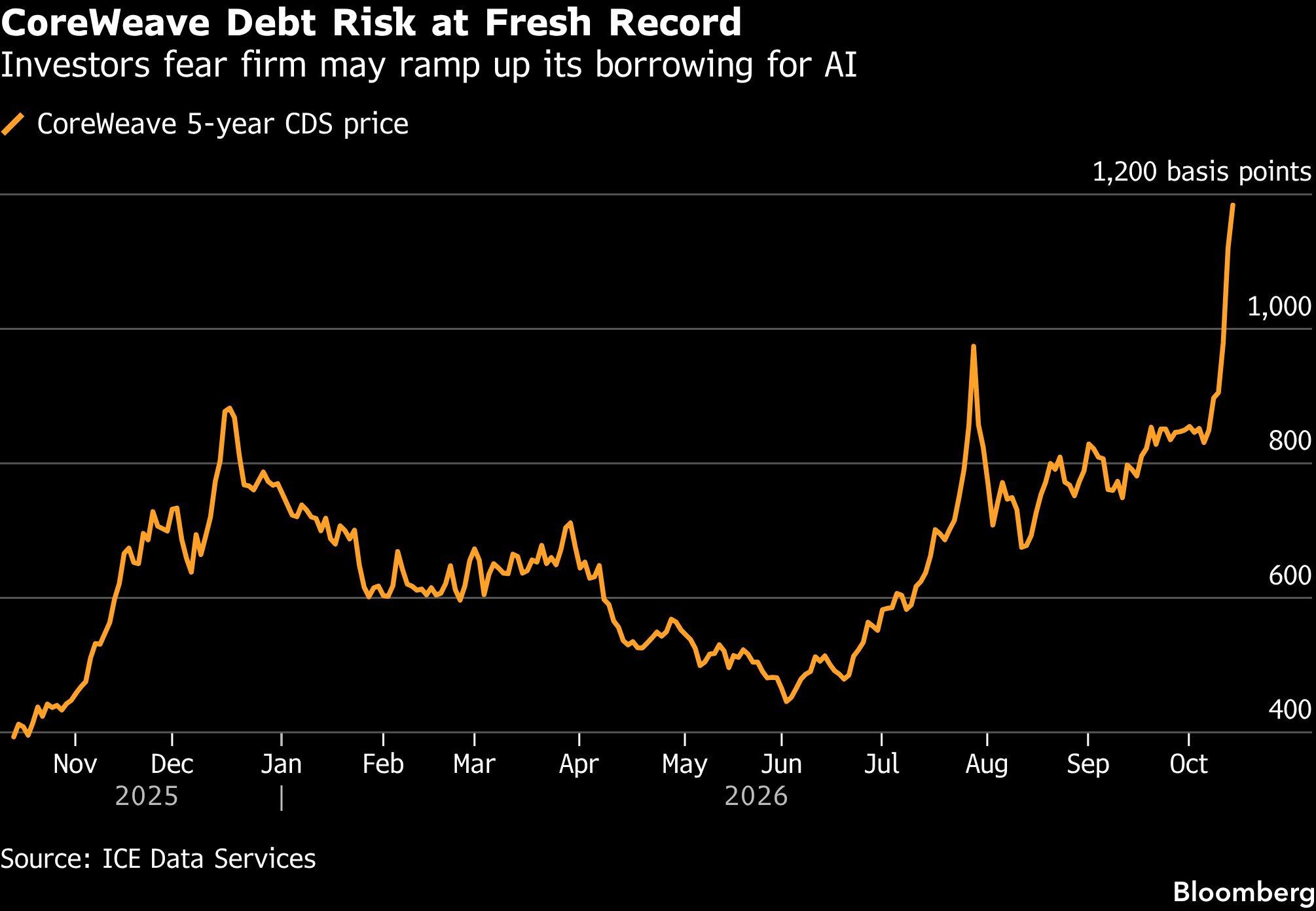
Certain corporate bonds were trading at deeply discounted prices, with yields reaching approximately 15–16%.
These developments highlight an important distinction.
A company's borrowing costs depend not only on the underlying risk-free interest rate but also on the additional compensation investors demand for assuming credit risk.
Consequently, even when Treasury yields decline, corporate borrowing costs can increase if credit spreads widen sufficiently.
Lower government bond yields do not automatically translate into easier financial conditions across the economy.
For companies dependent on external financing, the credit spread can become just as important as the direction of benchmark interest rates.
This is particularly relevant for capital-intensive industries that require substantial upfront investment before generating meaningful future cash flows.
There is, however, an important distinction between market concerns and actual financial distress.
CoreWeave has pointed to its substantial contracted revenue backlog as evidence supporting its ability to meet future obligations. Elevated credit spreads reflect market-implied risk, not proof that an eventual default is inevitable.
The broader question is whether similar funding pressures could emerge elsewhere as the AI investment cycle continues to mature.
From technological expansion to capital discipline
The artificial intelligence boom has encouraged enormous investment in data centres, advanced semiconductors, computing infrastructure and electricity capacity.
Much of this expansion is based on expectations of continued growth in demand for computational resources.
However, investment cycles eventually face a fundamental economic constraint: capital must generate sufficient returns to justify its cost.
When financing is relatively inexpensive, companies can undertake long-duration projects while accepting considerable uncertainty regarding future revenues.
As borrowing costs increase, that calculation changes.
Projects previously considered economically attractive may become less viable. Companies may face pressure to improve capital efficiency, extend investment timelines or reduce planned expenditure.
In a highly interconnected industry, the implications can extend beyond individual borrowers.
Slower infrastructure expansion could affect demand for semiconductors, memory products, industrial equipment, electricity infrastructure and construction services.
The critical risk is therefore not necessarily that demand for artificial intelligence disappears.
Rather, it is that the pace of investment could become increasingly constrained by the cost and availability of capital.
This distinction is essential when evaluating the potential macroeconomic consequences of the current credit repricing.
Rising energy prices complicate the Federal Reserve's position
The financing debate is unfolding against an increasingly challenging inflation backdrop.
Brent crude oil approached $110 per barrel on October 16 amid renewed concerns over supply disruptions and geopolitical tensions.
Higher energy prices can feed into transportation expenses, manufacturing costs and broader inflation expectations.
This creates a difficult environment for the Federal Reserve.
On one side, persistent inflation supports maintaining restrictive monetary conditions.
On the other, tighter credit conditions and a potential slowdown in capital expenditure could eventually weigh on economic growth.
If both pressures intensify simultaneously, monetary policymakers may face an increasingly uncomfortable trade-off.
Reducing interest rates could provide relief to financing conditions but risk reinforcing inflationary pressures.
Maintaining restrictive policy could help contain inflation but also increase the financial burden on highly leveraged businesses.
A combination of weaker investment growth and persistent price pressures would increase concerns about a more stagflationary economic environment.
Such an outcome is not inevitable.
Nevertheless, the interaction between energy prices, credit conditions and monetary policy deserves closer attention.
Could an American investment slowdown become a global growth problem?
The potential consequences are not limited to the United States.
China's latest trade figures illustrate how global technology demand has become an increasingly important component of international economic activity.
Chinese exports increased by 36.3% year over year in September, while imports rose by 31%, according to customs data.
Demand for semiconductors and other advanced technology products contributed to this expansion, alongside strength in other export categories.
The country's trade performance remains an important source of economic support at a time when domestic consumption and property-related activity face structural challenges.
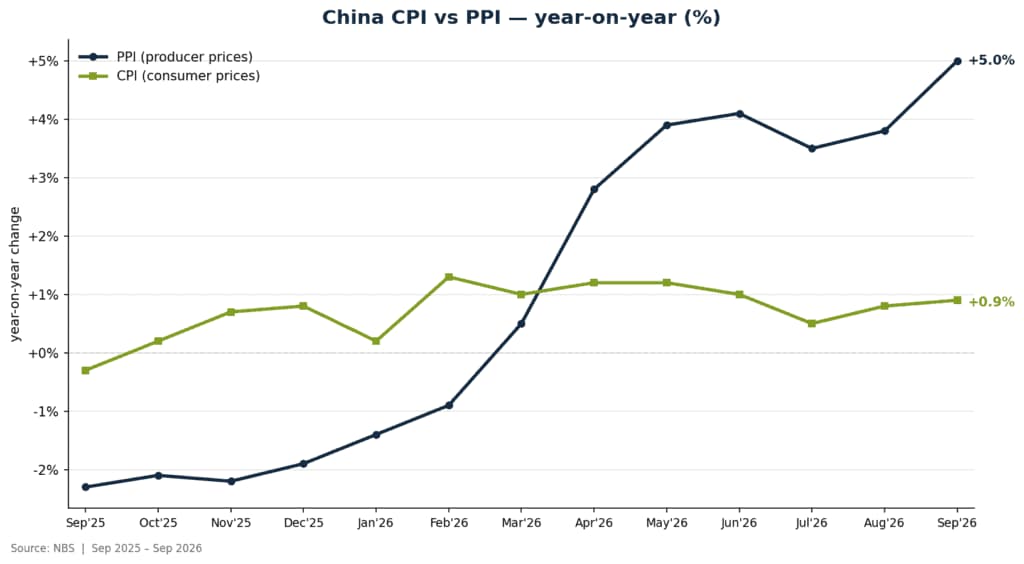
This creates a possible transmission channel.
Should US technology companies substantially reduce infrastructure investment, weaker demand could eventually move through international semiconductor supply chains, component manufacturers and capital-goods producers.
For export-oriented economies, such a slowdown could weaken industrial activity and investment momentum.
The extent of this exposure remains uncertain. China's export performance cannot be attributed exclusively to artificial intelligence, and other industries continue to contribute substantially to trade growth.
Still, the interconnected nature of global technology production suggests that a major adjustment in infrastructure spending would not remain a purely American development.
It could become a broader global investment-cycle issue.
What the divergence could mean for currencies
For foreign exchange markets, the distinction between falling yields and deteriorating credit conditions is particularly important.
Declining US Treasury yields do not always produce the same reaction in the US Dollar.
If yields fall because inflation expectations moderate and markets anticipate easier monetary policy, the Dollar could face downward pressure through narrowing interest-rate differentials.
However, if yields decline because global investors seek safety during a period of financial stress, demand for Dollar liquidity and defensive assets could partly offset that effect.
Meanwhile, economies dependent on energy imports may face additional inflationary and external-balance pressures if elevated oil prices persist.
Export-oriented economies could confront a different challenge if global capital expenditure slows.
The currency implications therefore depend on which force dominates: monetary repricing, changing growth expectations or international risk aversion.
The next signal may come from credit, not government bonds
The coming weeks could prove important for distinguishing between a temporary reassessment of risk and a more persistent shift in the global investment environment.
Three developments deserve particular attention:
- The relationship between Treasury yields and corporate credit spreads: Continued divergence would suggest that lower sovereign yields are not translating into improved financing conditions.
- Corporate investment and financing guidance: Changes to capital expenditure plans, borrowing requirements and expected cash flows would offer clues about whether tighter credit conditions are affecting real economic decisions.
- Inflation and energy-market developments: Persistent price pressures would limit monetary flexibility precisely when credit-sensitive industries may need it most.
The central question is no longer simply whether artificial intelligence can deliver substantial technological progress.
It is whether the investment required to support that progress can continue generating adequate returns under more demanding financing conditions.
The distinction matters because a technological revolution and a financially sustainable investment cycle are not necessarily the same thing.
If Treasury yields continue to decline while credit spreads widen, the bond market may not be signalling a straightforward improvement in financial conditions.
It may instead be revealing the first signs of a deeper repricing of capital, risk and future growth.
Author

Serhad Colak
Capital Insights
Serhad Colak is the founder of Capital Insights. His work focuses on macroeconomic research, monetary policy and cross-asset analysis, with particular attention to inflation, labor-market developments and interest-rate expectations.