After the labor market data, the important thing is CPI tomorrow


Today the data menu offers the small business survey, revisions to Q3 unit labor costs and productivity, and a 3-year Treasury auction ($58 billion, small potatoes.
After the labor market data, the important thing is CPI tomorrow. We have seen core CPI languish at 0.3% for three months in a row, with the y/y at 3.3% Never mind that the Fed looks at core PCE instead (2.8% in Oct). The market looks at the month-over-month and if it goes to 0.2%, cheering will be heard on Mars. If it’s 0.4%, the Fed will still cut rates next week but it will have the justification to start speaking sternly and for expectations for 2025 to get pared back even more.
Note that some diehards still think the Fed can withhold the rate cut next week. The excellent Authers at Bloomberg is one of them and we dismiss this view at our peril. But broken-record time—the Fed really does try to avoid surprising the delicate little flowers in the bond market with a surprise decision.
So far the change in yield—-down on payrolls, up on inflation forecasts—-is pretty small. Looking at the differentials, they are pretty small, too. See the chart from kshitij.com. It wouldn’t take much change to drive the dollar in either direction. We blame Germany. Its yield is high mostly because the economy is in a funk—lousy domestic demand, barely positive growth, trade worries, upset politics. As for the US yield, it “should” rise on the incoming Trump, but is apparently held back by decent demand for Treasuries, and never mind that pesky deficit.
ECR Research offers some sane and reasonable forecasts. The growth differential between the US and Europe is wide and widening. All by itself that implies widening rate differentials. The US will see 10-year US government bond yields” unlikely to decline far below 3.7% over the next few quarters and, on balance, 10-year US yields will probably rise towards 5% or higher.”
Meanwhile, the pressure is on for the ECB to do a bigger rate cut but will get only 25 bp, albeit with additional cuts next year while the Fed holds back. “10-year German yields are unlikely to decline far below 1.75% in the coming months, and these yields will likely start an uptrend to 3.5% (or higher) over the course of next year.”
Off on the side, expectations of Chinese stimulus have so far turned out to be little more than rhetoric and wishful thinking. This has been going on for almost a year. If real change materializes this time, it’s not clear to what effect except on the offshore yuan. It’s also possible that if meaningful changes are announced, it is seen as a preemptive strike against Trump. That can only trigger more rhetoric, this time from Trump himself, i.e., a genuine trade war. All those stories about how the US tariffs won’t really harm the world will fly out the window.
Also tomorrow is the Bank of Canada rate decision, with stories swirling that it will be 50 bp. We also see talk of 50 bp from the Swiss National Bank, although that talk has faded for the ECB. Let’s just say once again that while the top central banks do not exactly coordinate, they do talk with one another. We think nobody will do 50 bp but fear of it is helping the US dollar today.
Central Bank meetings
RBA December 9-10.
BoC December 11.
ECB December 12.
SNB December 12.
Fed December 18.
BoE December 19.
Bank of Japan Dec 19.
Forecast
The stage is set for the Fed to cut next week no matter what CPI tells us tomorrow, but if core stays the same or there is even the tiniest rise, the Fed will be able to speak hawkishly and the market will pull in its horns ever further about next year. This is the favorable outcome for the dollar. The opposite is true, too—if inflation falls by even 0.1%, several markets can party on, including equities, but the dollar will suffer some more. The uncertainty over this very, very small number—0.1%--is likely the source of some peculiar price movements. In the big picture, US 10-year yields “should rise” while the Bund yields slip, favoring the dollar. We just need to be patient.
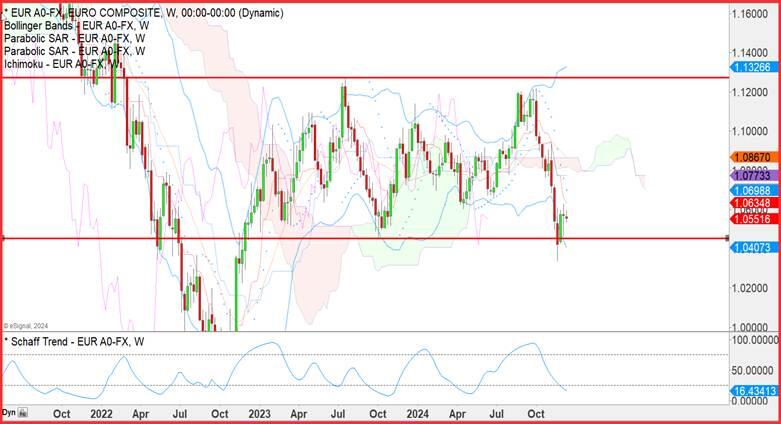
Tidbit: When in doubt, change the timeframe of the chart. Alas, the weekly euro/dollar chart does not deliver any wonderful insights. The red lines mark the recent highs and lows. In September, the euro failed to match the previous high from July, which triggered the decline. Then in the week of Oct 2 we got a low that did surpass the previous low on Nov 18. That led, of course, to the expected bounce, but now what? We cannot expect an endless ping-pong between high and low. We need a breakout and to get a breakout, we need an Event.
This is an excerpt from “The Rockefeller Morning Briefing,” which is far larger (about 10 pages). The Briefing has been published every day for over 25 years and represents experienced analysis and insight. The report offers deep background and is not intended to guide FX trading. Rockefeller produces other reports (in spot and futures) for trading purposes.
To get a two-week trial of the full reports plus traders advice for only $3.95. Click here!
This is an excerpt from “The Rockefeller Morning Briefing,” which is far larger (about 10 pages). The Briefing has been published every day for over 25 years and represents experienced analysis and insight. The report offers deep background and is not intended to guide FX trading. Rockefeller produces other reports (in spot and futures) for trading purposes.
To get a two-week trial of the full reports plus traders advice for only $3.95. Click here!
Author
Barbara Rockefeller
Rockefeller Treasury Services, Inc.
Experience Before founding Rockefeller Treasury, Barbara worked at Citibank and other banks as a risk manager, new product developer (Cititrend), FX trader, advisor and loan officer. Miss Rockefeller is engaged to perform FX-relat

















