After a historic surge: Where do Copper prices go from here?


Copper prices surged to historic levels on Tuesday after the Trump administration announced a sweeping 50% tariff on imported copper, a metal critical to a wide array of industries—from electronics and renewable energy to military equipment and construction. The move, part of a broader protectionist push under the Section 232 Investigations : The Effect of Imports on the National Security, triggered a sharp market reaction after concerns about supply shortages in an already tightening global copper market were recently weighing on prices.
Copper joins steel and aluminum under sweeping US tariffs
President Trump’s decision to impose a 50% tariff on copper imports marks the fourth across-the-board tariff of his second term, aligning the metal with steel and aluminum, which already face similar levies. The administration invoked national security concerns as the legal basis for the measure, referencing legislation that permits tariffs on materials deemed critical to defense and infrastructure.
Speaking during a cabinet meeting, Trump described the move as vital for domestic resilience, stating that copper is “essential to the U.S. economy and national defense” and that the country can no longer afford to depend on foreign sources for such a strategic resource.
Although the administration had been signaling its intention to target copper for months, the severity of the tariff—at 50%—caught many industry participants off guard. Until Tuesday, no specifics had been provided, and companies are now awaiting formal implementation details before issuing public responses.
The stakes are significant. The U.S. imported approximately 810,000 metric tons of refined copper in 2024, about half of its total consumption, according to data from the U.S. Geological Survey. Chile was the largest foreign supplier, accounting for $6 billion in shipments last year, followed by Canada. In total, U.S. copper imports were valued at $17 billion in 2024, highlighting the potential scale of disruption across supply chains.
The new tariff is likely to push input costs substantially higher for American manufacturers in copper-intensive sectors such as housing, consumer electronics, electric vehicles, and defense. Industry groups warn that these costs may ultimately be passed on to consumers, driving up prices for finished goods that rely on copper components—from appliances and smartphones to solar panels and electric grids.
While domestic copper producers may temporarily benefit from stronger pricing power, downstream industries could suffer, particularly small and mid-sized manufacturers with less flexibility to absorb higher raw material costs.
A potential complication for the Fed
Beyond the immediate industrial impact, the tariff could also carry broader macroeconomic consequences—particularly for inflation. As elevated copper prices feed into the cost structure of goods and infrastructure projects, they risk contributing to a broader uptick in price pressures, especially in sectors already affected by global supply chain constraints and labor shortages.
Should inflationary effects from the tariffs materialize in the coming months, they could complicate the Federal Reserve’s decision-making process, especially if inflation rebounds more persistently than anticipated. The central bank has recently adopted a cautious stance, monitoring data closely for signs of reacceleration before deciding on interest rate adjustments.
A tariff-driven rise in input costs could reawaken concerns about cost-push inflation, narrowing the Fed’s room to maneuver and potentially delaying any plans to cut rates—even as growth in other parts of the economy slows.
In that sense, Trump’s copper tariff is not only a strategic trade policy—it could also emerge as a new variable in the evolving inflation narrative, with implications for monetary policy
Market participants pushed price to a record high
US copper futures jumped 13% to settle at $5.6450 per pound, the highest level on record and the largest single-day percentage gain since data began in 1968, according to Dow Jones Market Data. That move caps a year-to-date rally of 38% and reflects accelerating fears over tighter domestic supply and costlier imports.
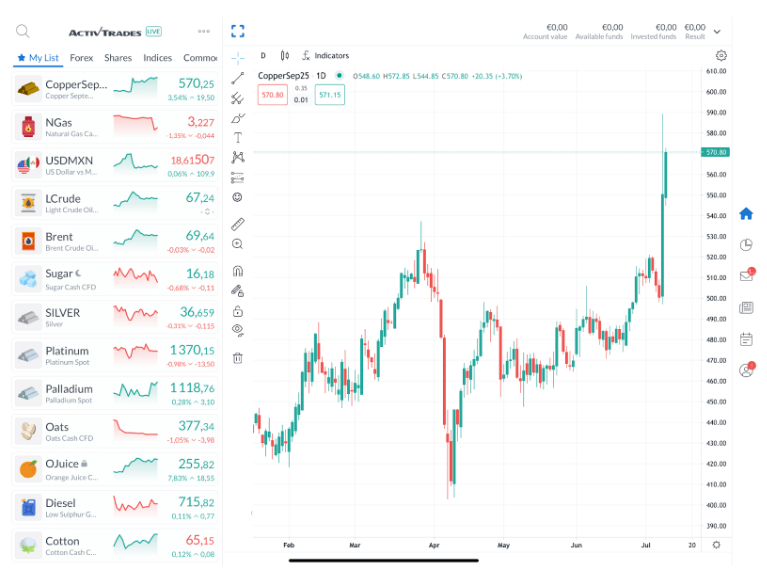
Daily Copper Prices (Futures with Delivery in September 2025) - Source: ActivTrades
Traders had been anticipating some form of restriction, with copper stockpiling ramping up in recent months. U.S. buyers imported heavily ahead of the announcement, driving up futures prices. According to Morgan Stanley, American firms have aggressively accumulated seaborne cargoes to build reserves, further fueling the rally.
Meanwhile, data from the London Metal Exchange (LME) show a spike in the cancellation rate of copper warrants—a sign that more buyers are preparing to take physical delivery from warehouses, rather than simply trade contracts.
Renewable energy and electrification: Copper demand should remain resilient despite global economic uncertainty
Copper is indispensable in modern economies. It is a key material in electrical wiring, motors, water systems, electronic devices, automobiles, and increasingly, in infrastructure supporting renewable energy and electric vehicles (EVs). As these sectors expand, so too does copper’s strategic importance.
Demand has already seen a boost from the global data center boom and energy transition efforts. Usage surged during China’s rapid modernization over the last two decades, and while growth there is moderating, Asia remains the main driver of global consumption.
According to the International Copper Study Group (ICSG), global refined copper usage is forecast to grow by 2.4% in 2025—slightly below the earlier estimate of 2.7% due to macroeconomic uncertainty. Chinese demand is expected to rise 2% in 2025 and 0.8% in 2026.
Growth in North America, Europe, and Japan is expected to remain subdued, but global demand will continue to be underpinned by electrification, digitalization, and new semiconductor manufacturing capacity in countries like India.
Global Copper output faces bottlenecks despite near-term expansion
The International Copper Study Group (ICSG) recently lowered its global supply outlook, pointing to ongoing production challenges and delays in new mining projects.
In 2025, refined copper output is projected to grow by approximately 2.9%, driven largely by expanding capacity in China and the launch of new facilities in countries such as Indonesia, India, and the Democratic Republic of Congo—particularly the Kamoa project. However, this growth appears short-lived, as global refined production is expected to contract by 1.5% in 2026.
Glencore, a major copper producer, estimates that global output needs to rise by one million metric tons annually through 2050 to meet expected demand. That would mean adding the equivalent of Chile’s Escondida mine—currently the world’s largest—every year.
However, copper mining is capital-intensive and slow-moving. In the U.S., it can take nearly 30 years for a new copper mine to go from discovery to production. The long lead times make it unlikely that supply will keep up with accelerating demand, particularly if trade barriers further limit imports.
Bottom line
In a world where copper is critical to everything from electric vehicles to AI-powered data centers, the metal has never mattered more. And with U.S. policy now reshaping its trade flows, copper's role in global economics is only set to grow. Still, traders should expect some volatility, as the market digests the implications of the tariff and continues to grapple with structural supply constraints. While some anticipate a temporary cooling after the recent spike, the longer-term trajectory points toward tightness and upward pressure.
Stay up to date with what's moving and shaking on the world's markets and never miss another important headline again! Check ActivTrades daily news and analyses here.
Stay up to date with what's moving and shaking on the world's markets and never miss another important headline again! Check ActivTrades daily news and analyses here.
Author
Carolane de Palmas
ActivTrades
Carolane graduated with a Masters in Corporate Finance & Financial Markets and got the AMF Certification (Financial Markets Regulator in France). Afterward, she became an independent trader, investing mostly in European and American stocks/indices.