ADP Private Payrolls March Preview: Consumers look to an early spring?
- Employment Change forecast to be 550,000 after 117,000 in February.
- Nonfarm Payrolls expected to add 639,000 workers, the most since October.
- Consumer sentiment vaults higher in March on rising job creation, vaccination.
- Dollar and US yields will continue to increase on good ADP numbers.

American workers have taken the recent improvement in the labor market to heart giving March the highest consumer sentiment readings in a year, despite the modest actual gains in employment and the yet massive overhang of job losses from last year’s lockdowns.
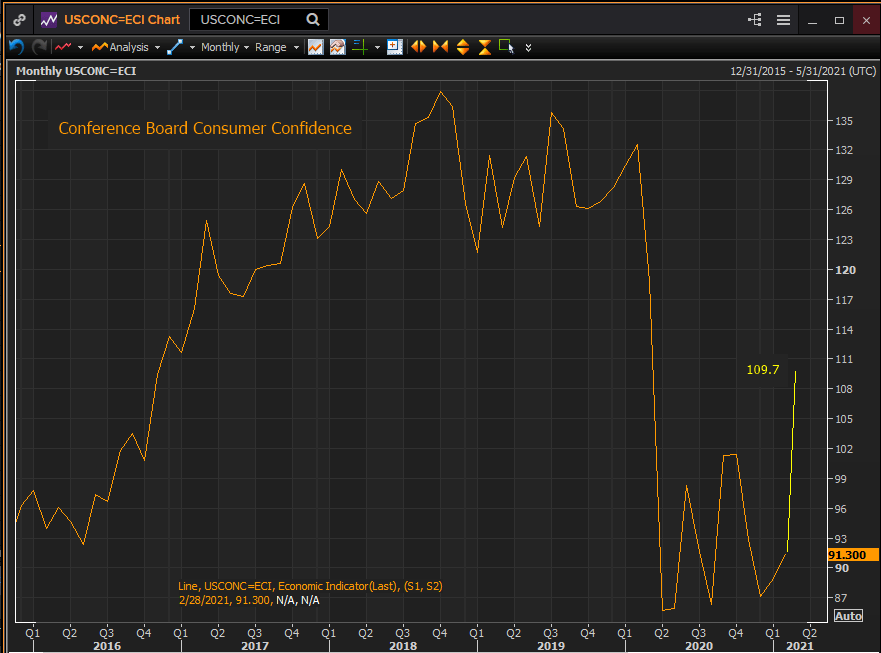
The Consumer Confidence Index from the Conference Board rose unexpectedly in March to 109.7, far ahead of the 96.9 forecast and up from 91.3 in February.
Sentiment is now at its highest level since 118.8 last March and about half-way between the February 2020 score of 132.6 and the April panic low of 85.7.
Separate indexes for the Present Situation and Expectations also rose sharply in March, to 110.0 from 89.6 and to 109.6 from 90.9.
The Michigan Consumer Sentiment Survey likewise reached its highest score in a year in March at 84.9, from 76.8 prior, easily outstripping the 78.5 forecast. This index is also about half-way between its February 2020 reading of 101 and the April low at 71.8.
Nonfarm Payrolls and ADP Employment Change
The most important ingredient in consumer confidence is employment.
Americans would not be rating the improvement in the economy and their own personal situation so highly in March if they did not expect the job gains of January and February to accelerate.
To put it more precisely, the hiring that Automatic Data Processing (ADP) and the US Labor Department (Nonfarm Payrolls) will report this week has already been experienced by the people (statistically speaking) who answered the Conference Board and Michigan Surveys. The unexpected strength in both indexes is most likely due to the growth of the labor market.
When November payrolls dropped by more than half to 264,000 from October’s 680,000, and ADP’s employment count fell from 422,000 to 302,000, the Conference Board Consumer Confidence score plunged almost ten points from 101.4 to 92.9 and the Michigan score dropped to 76.9 from 81.8.
ADP Employment Change
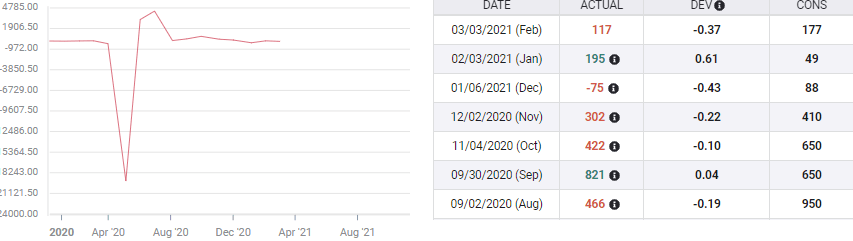
California reimposed its lockdown in December and several other states tightened restrictions in response to rising infection rates. National payrolls shed 306,000 workers and ADP 75,000 in December. Conference Board Confidence sank to 87.1 in December. Michigan’s score rose to 80.9. in December but by February had fallen back to 76.8.
Reuters
The March and April lockdowns last year cost 22.4 million jobs, mostly in the service sector. Through February about 58% or 12.9 million have been reinstated.
Conference Board Consumer Confidence rockets to 12-month high, dollar follows
Conclusion
Credit and currency markets saw the unexpected jump in consumer optimism as evidence that the US economic outlook is improving as anticipated.
The dollar rose in all the major pairs on Tuesday and US Treasury rates continued their mean reversion with the 10-year benchmark trading back above 1.7%.
The euro fell to a five-month low closing at 1.1719 and the USD/JPY finished at 110.35, above 110.00 for the first time since March 25 last year.
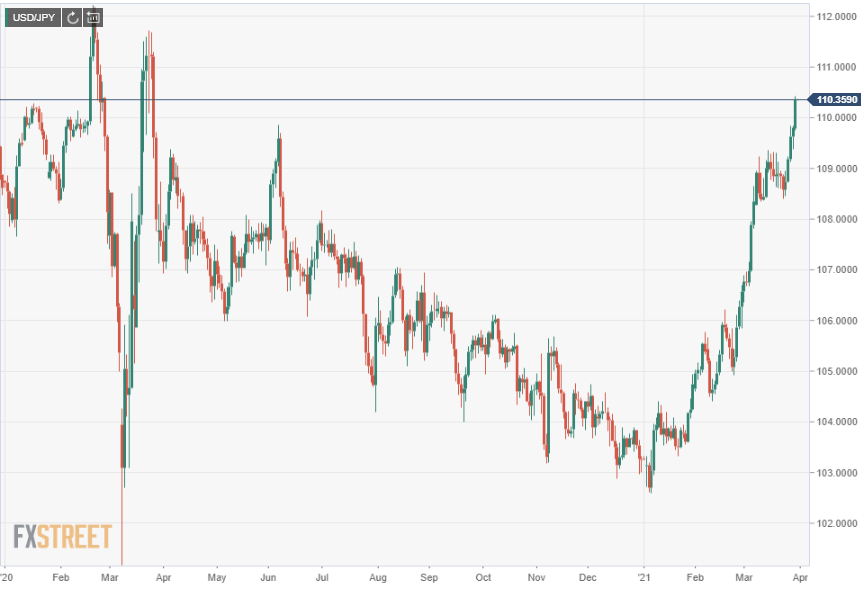
Even the USD/CAD, long a wallflower at the US fete, ended above 1.2620 resistance for the first time in three weeks.
If ADP is at or better than its forecast, it will be another piece of the US recovery puzzle.
Author

Joseph Trevisani
FXStreet
Joseph Trevisani began his thirty-year career in the financial markets at Credit Suisse in New York and Singapore where he worked for 12 years as an interbank currency trader and trading desk manager.














