ADP, NFP and the change in their correlation


Today ADP reported a 749k sure in private payroll employment in September, almost double the 400k expectation, after an upwardly revised 481k (was 428k) increase in August.
There were solid gains across industries. The service sector added another 552k jobs, with the goods sector adding 196k. Manufacturing jobs were up a hefty 130k. In services, trade/transport posted a big 186k gain, while leisure/hospitality jobs increased 92k, and education/health employment was up 90k. Professional/business services added 78k jobs. The ADP gains have massively undershot improvement in BLS payrolls and other labor market indicators since the growth rebound began, suggesting that this could continue despite this month’s solid gain. However please note that during the pandemic year ADP has done an awful job as an indicator of NFP number. In general after since May we have seen the absence of correlation between the ADP employment change figures with Nonfarm Payrolls.
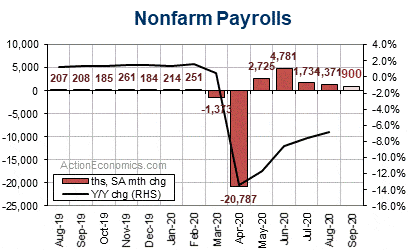
The September Nonfarm Payroll gain is seen at 900k, as most measures of output extended their rebounds in September. Initial claims have slowly tightened, and we saw another big -1,912k continuing claims plunge between the August and September BLS survey weeks. The jobless rate is expected to hold steady from 8.4%, alongside a 0.8% September hours-worked increase with a 34.6 workweek and hourly earnings to be unchanged, following August’s 0.4% rise, as the measure gives back more of the 4.7% April pop with the shift in the composition of jobs back toward lower-paid workers. The nonfarm payroll forecast assumes a 1,075k private jobs increase.
Seasonal Trends and Weather
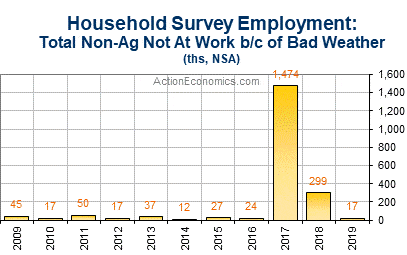
For disruptions to employment from weather as gauged in the household survey, the biggest disruptions occur in the winter months generally with the average peaking in February. There is an additional climb through the late-summer months due to disruptive hurricanes in some years. This September has seen hurricane activity but they’ve been less disruptive than some of the major events in years past, leaving modest upside weather-risk for payrolls. Of course, any weather related disruptions will be eclipsed by COVID-19.
Hourly Earnings
As stated above, a flat figure for September average hourly earnings is anticipated, after gains of 0.4% in August and 0.2% in July, but drops of -1.3% in June and -1.1% in May, as we further unwind the 4.7% April surge. Job losses have been skewed toward lower paid retail, leisure and hospitality workers, and this prompted the April spike in average hourly earnings that is now being reversed. A 4.6% y/y increase in September from 4.7% in August is forecasted.
Continuing and Initial Claims
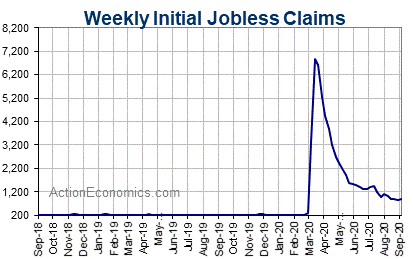
Continuing claims fell -1,912k between the September and August BLS survey weeks, after a drop of -2,459k between August and July, and a -2,280k drop between June and July survey. The economy is unwinding the 24,912k continuing claims peak in the second week of May. Initial claims fell to 866k in the September BLS survey week from 1,104k in the August survey week, and 1,422k in the July survey week. The September initial claims anticipate to average at 870k from 992k in August.
Conclusion
Employment should rose further with output in September, despite delayed stimulus and ongoing disruptions in the re-opening process. The September hours-worked is expected to increase of 0.8%, with a 34.6 workweek, while hourly earnings remain flat. The jobless rate should hold steady at 8.4%, leaving the rate below the 9.98% cycle-high from the last recession in October of 2009.
Author
Having completed her five-year-long studies in the UK, Andria Pichidi has been awarded a BSc in Mathematics and Physics from the University of Bath and a MSc degree in Mathematics, while she holds a postgraduate diploma (PGdip) in

















