A historic Treasury rout is underway. Investors are buying it at record size

Long-term Treasury yields climbed to their highest since 2002 in early October, and investors are taking record shares of the government's new debt at auction. The selling is coming from investors protecting other bets, not from buyers walking away. The 10-year yield reached 5.31% on October 5 and the 30-year 5.67% on October 7.
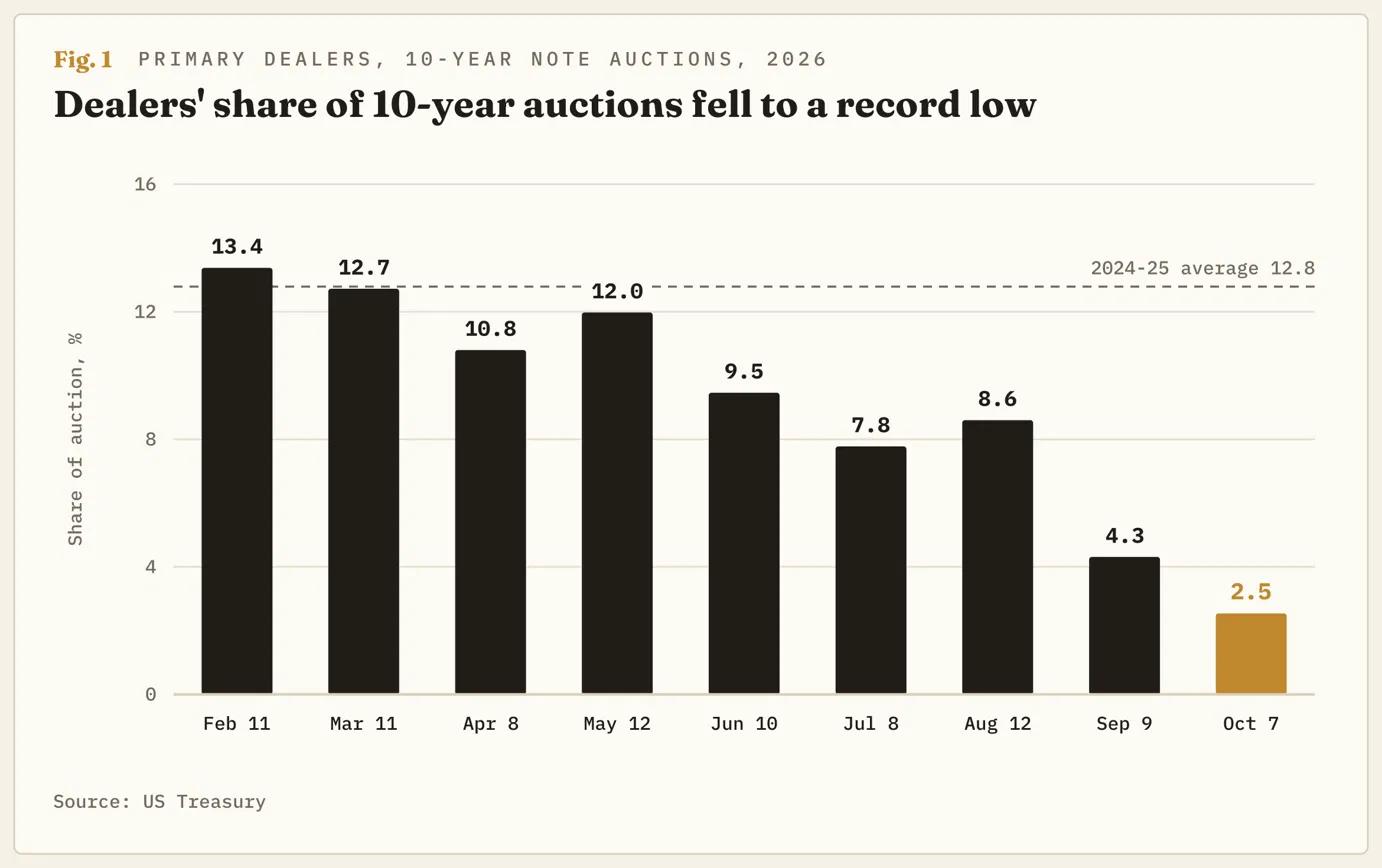
The Treasury sold $39 billion of 10-year notes on October 7 at 5.300%. Primary dealers, the banks required to bid at every auction and keep whatever other buyers don't take, were left with 2.5%. That's the smallest share at a 10-year sale in records going back to 2003. The government last paid this much to borrow for ten years in November 2000, when it raised $8 billion, about a fifth as much.
The higher the yield, the less the banks were left holding
In February, the dealers kept 13.4% of a 10-year auction at a yield of 4.18%, close to the 13% they averaged across 2024 and 2025. Their share has fallen at six of the eight 10-year auctions since, to 2.5% on October 7. Each yield rise has brought in enough extra buyers to leave the banks holding less, which is how price-focused investors behave.
At the September 10 auction of 30-year bonds, dealers kept 2.2%, the lowest at any regular fixed-rate Treasury auction since 2003. That was the month 30-year yields hit their highest level since 2002.
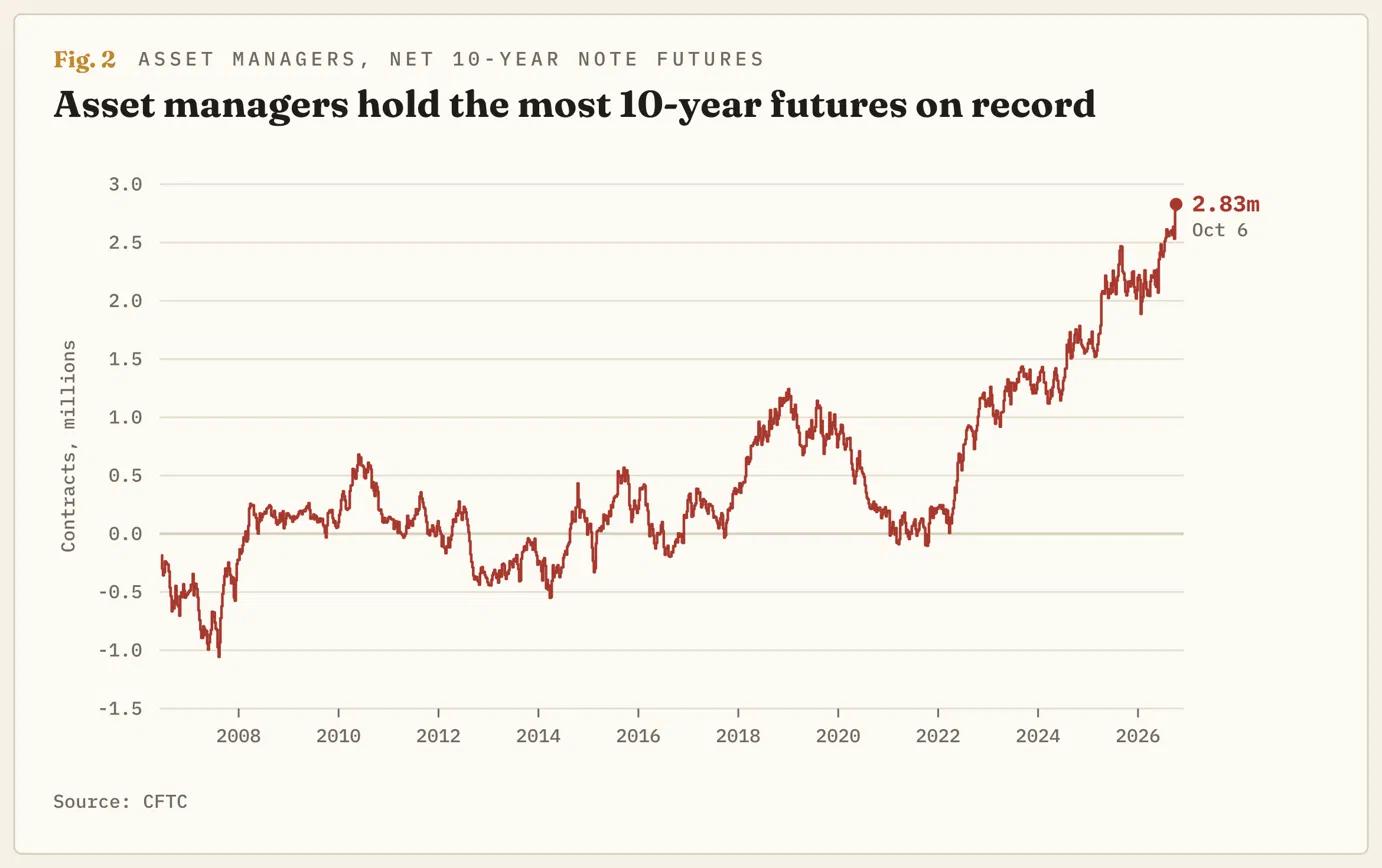
The amounts are records too. Investors other than the dealers bought $38.2 billion of the $42 billion of 10-year notes sold on August 12, the most at any 10-year sale since 2003. Last week, asset managers held 2.83 million 10-year Treasury futures, contracts that lock in a price now for notes delivered later, after subtracting the ones they sold. At $100K of notes per contract, that's $283 billion, the most in Commodity Futures Trading Commission (CFTC) data going back to 2006.
Strong auctions don't stop yields rising
In its October 6 Cyclical Outlook, PIMCO said it was warming to longer-dated bonds as their yields rise. Three days later, PIMCO Group Chief Investment Officer Dan Ivascyn told the Financial Times that a 6% 10-year yield was possible in the near term. Investors who buy more as yields rise keep auctions strong without capping yields. Strong auctions at 5.3% mean buyers are willing to pay 5.3%, and whether yields stop there depends on how much forced selling arrives.
The sellers are protecting other bets
A mortgage bond loses value faster than other bonds when rates rise, because fewer homeowners refinance and the loans are repaid more slowly. Its owners offset that by selling Treasuries or Treasury futures, which adds to rising Treasury yields and mortgage rates. Reuters counted nine large mortgage-hedging trades in early October.
Eris Innovations, a Chicago developer of futures products, told Reuters that many of the mortgages written over the past three years have rates close to current mortgage rates. A mortgage bond's sensitivity to rates changes fastest when market rates are near the loan's own rate, so those loans need the most hedging.
The largest cloud-computing companies are borrowing to build data centres. Buyers of their long-dated bonds hedge by selling Treasury futures on the day they price a deal, RBC BlueBay Asset Management told Reuters. Goldman Sachs (GS) estimates they could sell a record $420 billion of bonds in 2027, and each one is likely to arrive with a Treasury sale attached.
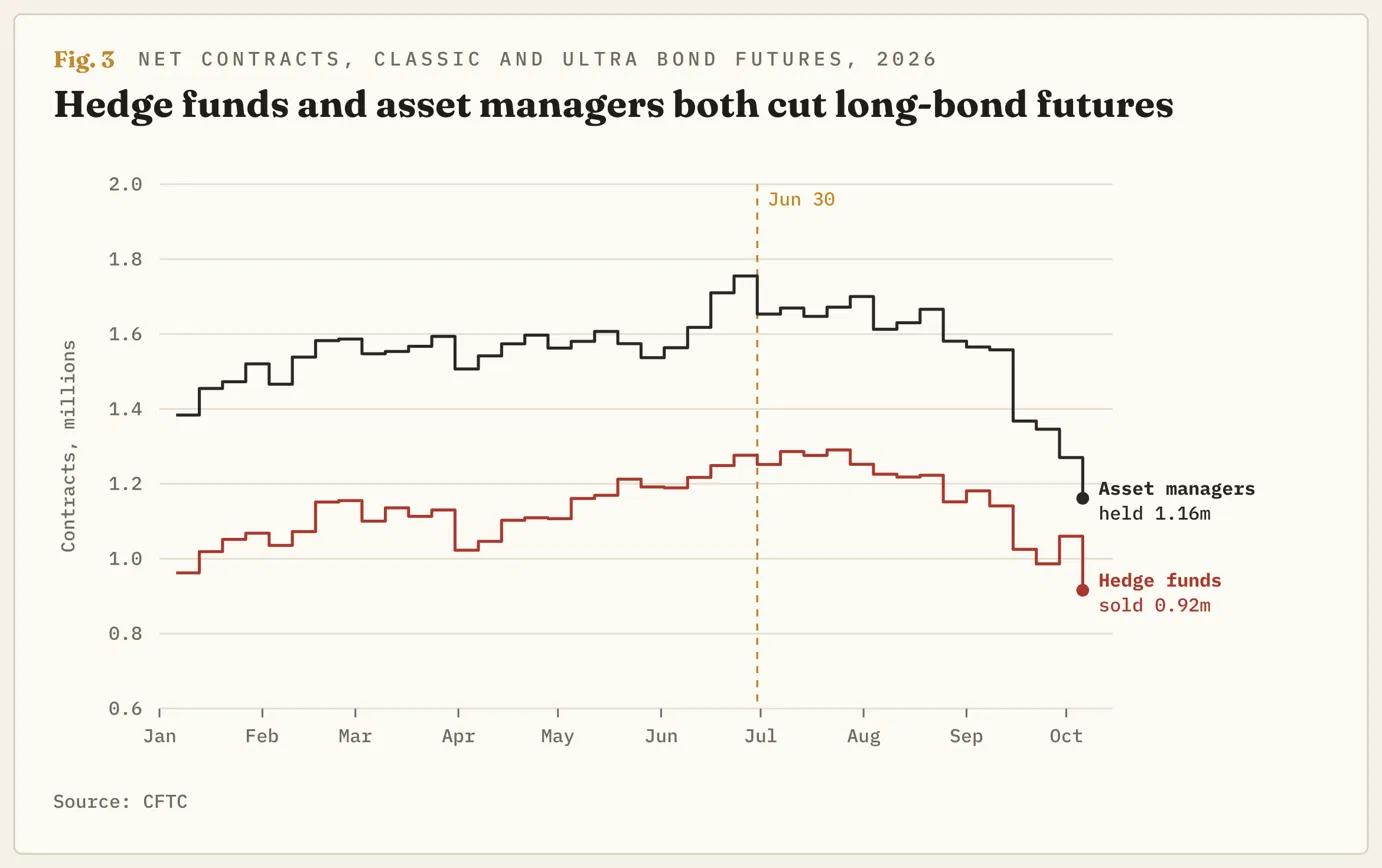
Hedge funds are the third seller. A popular hedge-fund trade buys Treasuries with borrowed money and sells futures against them, collecting the small gap between the two prices. Ending it means selling the Treasuries. Between June 30 and October 6, hedge funds cut the long-term Treasury bond futures they'd sold by more than a quarter, mostly in the final four weeks.
Asset managers, who are usually on the other side of that trade, cut their long-term bond futures by a similar share. Ivascyn told the Financial Times that some of the recent rise came from hedge funds and other investors who borrow to trade being forced out of losing positions.
November's auctions will show which side runs out first
Auction sizes for Treasury notes and bonds haven't changed since April 2024, so this rout has happened without a single extra note or bond for sale. On August 5, the Treasury said it expects to keep them unchanged for at least the next several quarters. Its next quarterly borrowing announcement is due on November 4. The dealers' share at the following 10-year and 30-year auctions will show whether buyers are still there at these yields.
Unchanged sizes and a single-digit dealer share would mean buyers are still taking everything on offer. Further rises would then depend on the forced sellers. Mortgage hedging eases as rates move away from the rates on recent loans, and hedge-fund exits tend to come in bursts, so the rise would slow once both are done. AI-company bond hedging is unlikely to fade, because it grows with every new deal.
Bigger auction sizes, or a dealers' share back near the 13% they averaged in 2024 and 2025, would mean buyers have stepped back at these yields. That could put the 10-year on course for 5.5%, the level above which Ivascyn expects stocks and corporate bonds to weaken. Both halves of the question are on the calendar, the Treasury's on November 4 and the buyers' at the auctions that follow.
Author

Joshua Gibson
FXStreet
Joshua joins the FXStreet team as an Economics and Finance double major from Vancouver Island University with twelve years' experience as an independent trader focusing on technical analysis.

















