Breaking: Canada hedline CPI rose 3.0% YoY in August

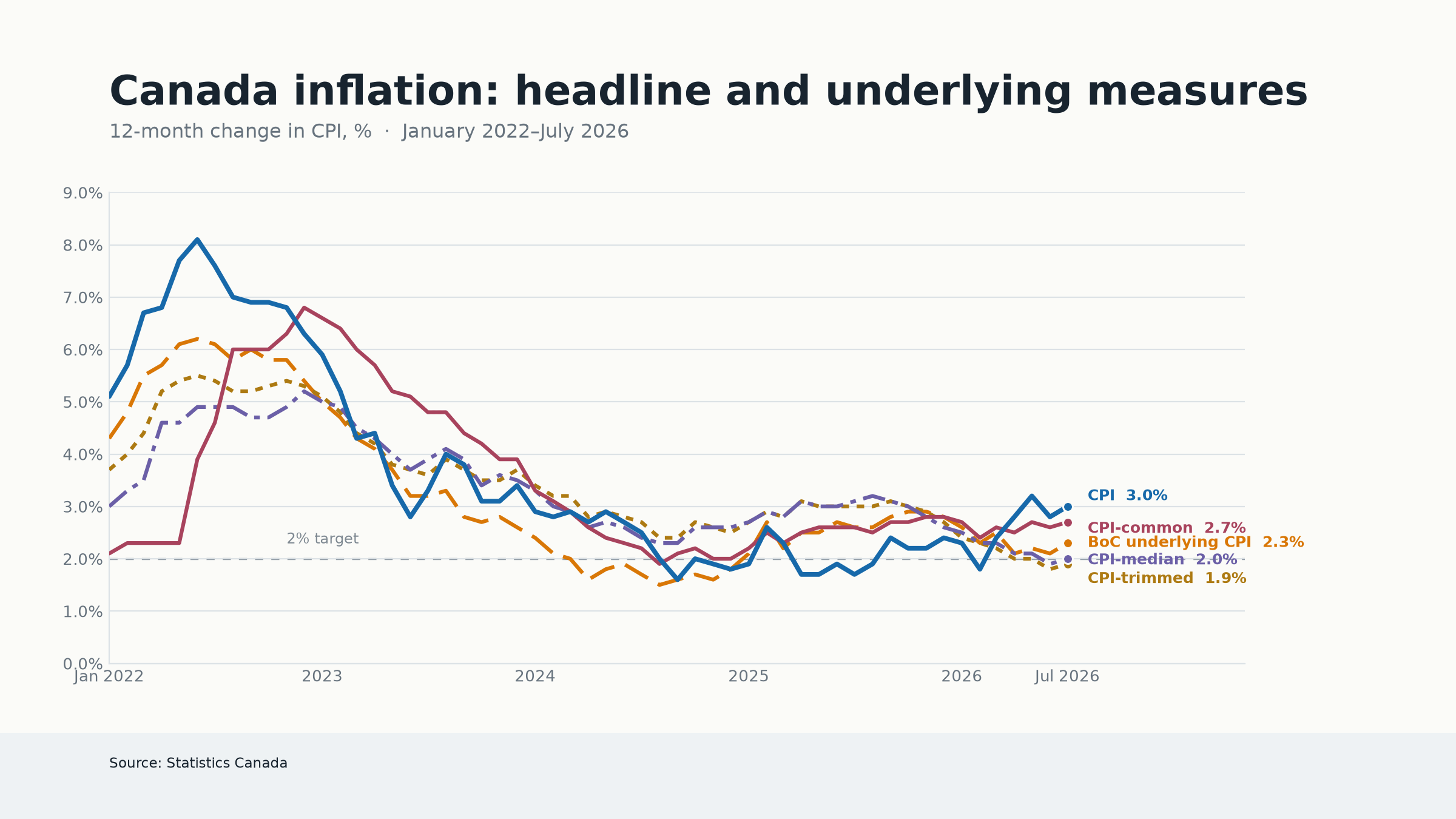
Canada’s inflation held its pace in August, with the headline Consumer Price Index (CPI) rising 3.0% from a year earlier, matching market expectations and unchanged from the 3.0% increase recorded in July. On a monthly basis, prices declined by 0.1%.
Meanwhile, the Bank of Canada’s (BoC) core measure, which excludes more volatile components such as food and energy, rose 2.4% over the past year and increased by 0.2% compared with the previous month.
Looking at the BoC’s underlying key inflation gauges, Common CPI came in at 2.6% (from 2.7%), Trimmed CPI at 1.9% (from 1.9%), and Median CPI at 2.0% (from 2.0%). Together, they show an apparent impasse in price pressures in the last month.
According to the press release, "Year over year, prices for gasoline rose at a slower pace in August compared with July, putting downward pressure on the all-items CPI. Excluding gasoline, the CPI rose 2.4% in August, after increasing 2.2% in July. In August, the slowdown in gasoline prices on an annual basis was offset by higher prices for travel tours and rent.”
Market reaction
The Canadian Dollar (CAD) builds on recent losses and motivates USD/CAD to hit fresh two-week tops beyond the 1.3900 yardstick on Monday, further extending last week’s break above its critical 200-day SMA in the 1.3830 zone.
Canadian Dollar Price Today
The table below shows the percentage change of Canadian Dollar (CAD) against listed major currencies today. Canadian Dollar was the strongest against the New Zealand Dollar.
| USD | EUR | GBP | JPY | CAD | AUD | NZD | CHF | |
|---|---|---|---|---|---|---|---|---|
| USD | 0.57% | 0.33% | 0.80% | 0.25% | 0.71% | 0.85% | 0.26% | |
| EUR | -0.57% | -0.22% | 0.21% | -0.34% | 0.13% | 0.29% | -0.32% | |
| GBP | -0.33% | 0.22% | 0.42% | -0.10% | 0.36% | 0.51% | -0.16% | |
| JPY | -0.80% | -0.21% | -0.42% | -0.56% | -0.08% | 0.03% | -0.60% | |
| CAD | -0.25% | 0.34% | 0.10% | 0.56% | 0.44% | 0.58% | -0.06% | |
| AUD | -0.71% | -0.13% | -0.36% | 0.08% | -0.44% | 0.15% | -0.54% | |
| NZD | -0.85% | -0.29% | -0.51% | -0.03% | -0.58% | -0.15% | -0.67% | |
| CHF | -0.26% | 0.32% | 0.16% | 0.60% | 0.06% | 0.54% | 0.67% |
The heat map shows percentage changes of major currencies against each other. The base currency is picked from the left column, while the quote currency is picked from the top row. For example, if you pick the Canadian Dollar from the left column and move along the horizontal line to the US Dollar, the percentage change displayed in the box will represent CAD (base)/USD (quote).
This section below was published as a preview of the Canadian inflation report at 11:00 GMT.
- Canadian inflation is expected to come in flat on a monthly basis in August.
- The underlying inflation gauges are seen unchanged from the prior month.
- The Canadian Dollar has been losing momentum vs the US Dollar recently.
Canada’s August Consumer Price Index (CPI) figures will be the focus of attention when published on Monday. Indeed, Statistics Canada data will provide markets with an update on price pressures following the Bank of Canada’s (BoC) September 2 meeting, when officials kept the interest rate steady at 2.25%, broadly in line with analyst consensus.
This time, economists expect the headline CPI to remain unchanged at 3% YoY and to rise by 0.3% on a monthly basis, below the 0.5% in July. The BoC’s core measure (which strips food and energy costs) is forecast to rise by 0.1%.
In the current context of heightened geopolitical volatility, crude Oil dynamics are likely to keep inflationary pressures anything but abated, while reignited tensions on the tariffs front are expected to also add to the sentiment.
Still around data, the BoC’s preferred gauges of underlying inflation, CPI-Common, Trimmed Mean, and Median, picked up pace in July to 2.7%, 1.9%, and 2.0%, respectively.
What can we expect from Canada’s inflation rate?
Inflation gathered some traction in July, and market participants would not rule out that trend to have further extended in August.
The BoC delivered a cautiously hawkish hold on September 2, leaving rates unchanged as economic slack and lingering trade uncertainty continue to argue for patience. Still, policymakers appear increasingly uneasy about the inflation outlook. Governor Tiff Macklem’s warning that several rate hikes could be needed suggests renewed tightening is firmly back on the table, particularly if Oil prices remain elevated or inflationary pressures begin to spread beyond energy.
So far, market participants expect nearly 36 basis points of tightening by year-end.
When is the Canada CPI data due, and how could it affect USD/CAD?
Markets will fully focus on Monday at 12:30 GMT, when Statistics Canada publishes August’s inflation prints. If inflation adds to the recent uptick, bets on further rate hikes should likely increase, providing fresh legs for the Canadian Dollar (CAD).
Pablo Piovano, Senior Analyst at FXStreet, notes that USD/CAD has been in a steady recovery so far this week, bouncing off lows in the mid-1.3700s and gaining around a cent since then.
Piovano points out that the pair has recently broken above its critical 200-day SMA in the 1.3830 region, allowing the upside impulse to return.
“If bulls regain some balance, there is a provisional hurdle at the 100-day SMA near 1.3930 prior to the September top at 1.3939 (September 2). North from here, the interim 55-day SMA comes just ahead of the key 1.4000 barrier," Piovano adds.
On the flip side, the resurgence of the bearish trend could prompt the pair to revisit its August floor at 1.3731 (August 21). If that contention gives way, then spot could embark on a potential visit to the May bottom at 1.3549 (May 1).
“Momentum now favours further recovery,” he notes, signalling that the Relative Strength Index (RSI) has bounced past the 48 level, while the Average Directional Index (ADX) around 23 suggests a modestly decent trend.
Bank of Canada FAQs
The Bank of Canada (BoC), based in Ottawa, is the institution that sets interest rates and manages monetary policy for Canada. It does so at eight scheduled meetings a year and ad hoc emergency meetings that are held as required. The BoC primary mandate is to maintain price stability, which means keeping inflation at between 1-3%. Its main tool for achieving this is by raising or lowering interest rates. Relatively high interest rates will usually result in a stronger Canadian Dollar (CAD) and vice versa. Other tools used include quantitative easing and tightening.
In extreme situations, the Bank of Canada can enact a policy tool called Quantitative Easing. QE is the process by which the BoC prints Canadian Dollars for the purpose of buying assets – usually government or corporate bonds – from financial institutions. QE usually results in a weaker CAD. QE is a last resort when simply lowering interest rates is unlikely to achieve the objective of price stability. The Bank of Canada used the measure during the Great Financial Crisis of 2009-11 when credit froze after banks lost faith in each other’s ability to repay debts.
Quantitative tightening (QT) is the reverse of QE. It is undertaken after QE when an economic recovery is underway and inflation starts rising. Whilst in QE the Bank of Canada purchases government and corporate bonds from financial institutions to provide them with liquidity, in QT the BoC stops buying more assets, and stops reinvesting the principal maturing on the bonds it already holds. It is usually positive (or bullish) for the Canadian Dollar.
Economic Indicator
Consumer Price Index (YoY)
The Consumer Price Index (CPI), released by Statistics Canada on a monthly basis, represents changes in prices for Canadian consumers by comparing the cost of a fixed basket of goods and services. The YoY reading compares prices in the reference month to the same month a year earlier. Generally, a high reading is seen as bullish for the Canadian Dollar (CAD), while a low reading is seen as bearish.
Read more.Next release: Mon Sep 14, 2026 12:30
Frequency: Monthly
Consensus: -
Previous: 3%
Source: Statistics Canada
Author

FXStreet Team
FXStreet
Composed of a group of economic journalists and FX experts, the FXStreet content team produces and oversees all content published on FXStreet. It provides a purely journalistic approach to the Forex market.