|

18 consecutive months and running: China’s central bank extends Gold-buying spree

  • The People’s Bank of China continued to add Gold to its reserves in April, extending its buying run to 18 consecutive months.
  • China’s central bank bought the highest amount of Gold since December 2024.
  • Globally, central banks resumed net purchases in April after recording net sales a month earlier.

China’s central bank, one of the major Gold purchasers worldwide, continued to add the precious metal to its vaults in April, in a sign that demand from sovereigns remains high.

The People’s Bank of China (PBoC) bought 8 tonnes of Gold in April, the highest amount since December 2024, posting its 18th consecutive month of purchases, according to the most recent data published by the World Gold Council (WGC).

China’s central bank now holds 2,322 Gold tonnes, which represents around 9% of its total reserves, the data showed.

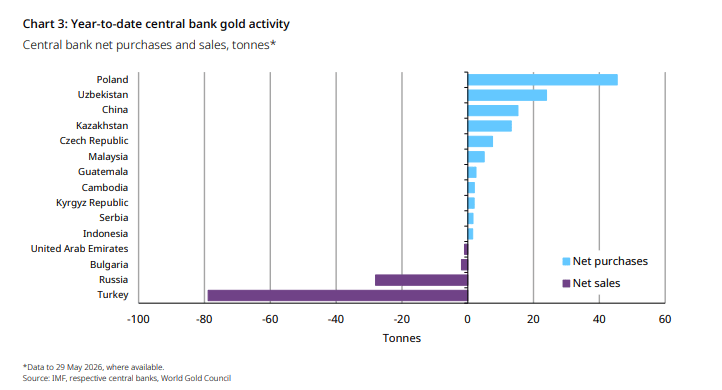
In April, the PBoC was the third Gold buyer among central banks, only surpassed by Poland and Uzbekistan.
Data from the WGC shows that global central banks resumed net Gold purchases in April, rebounding from the net sales reported in March. Back then, the immediate economic fallout from the Iran war forced some sovereigns in emerging markets to offload Gold to protect their currencies.
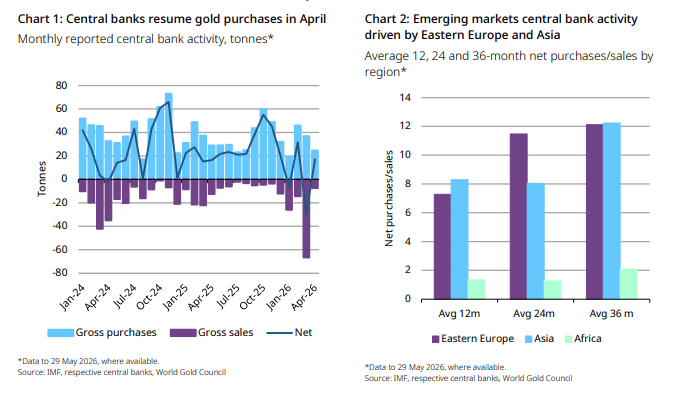
Central bank buying has been a key driver of Gold’s rally, which saw the metal almost double in price in 2025. The pace of purchases jumped significantly in 2022, after Russia’s foreign reserves were immobilized following its invasion of Ukraine.

Gold touched an all-time high of around $5,600 per troy ounce in January but has fallen about 23% since then, trading at around $4,300. 

Gold’s most recent correction, which has driven its price below its 200-day Simple Moving Average since October 2023, has been triggered by a surprisingly strong US jobs report for May, which prompted markets to price in upcoming interest-rate hikes by the Federal Reserve. As Gold doesn’t yield interest, investors have fled to other interest-bearing assets such as bonds.

Author

Valeria Bednarik

Valeria Bednarik was born and lives in Buenos Aires, Argentina. Her passion for math and numbers pushed her into studying economics in her younger years.


More from Valeria Bednarik
Share:

Editor's Picks

GBP/USD flirts with two-day lows near 1.3180

GBP/USD remains on the back foot in the latter part of Tuesday’s session, sliding to the sub-1.3200 area and challenging weekly lows. Cable’s decline comes as investors assess the political uncertainty in the UK, coupled with softer-than-expected UK PMI data and the better tone in the Greenback.

EUR/USD weakens below 1.1400 on stronger Dollar

EUR/USD adds to Monday’s losses and recedes below the 1.1400 support to clinch fresh 13-month lows in the latter part of Tuesday’s NA session. The pair’s marked sell-off comes on the back of the persistent move higher in th US Dollar, always propped up by rising bets of further tightening by the Fed.

Gold retains bearish bias near two-week low as Fed hike bets support USD

Gold recovers slightly from a fresh two-week low, near $4,080 touched during the Asian session on Wednesday, though it lacks follow-through. The US Dollar stands firm near its highest level since May 2025 amid firming expectations of a Fed rate hike, which, in turn, is seen undermining the non-yielding bullion. Furthermore, mixed US-Iran signals over Tehran's nuclear issues favor the USD bulls, suggesting that the path of least resistance for the commodity remains to the downside.

Australia CPI set to show inflation accelerated again in May

The Australian Bureau of Statistics will publish the high-impact Consumer Price Index for May on Wednesday at 01:30 GMT. Heading into the inflation test, the Australian Dollar is at its lowest level in two months against the US Dollar, having surrendered the 0.7000 psychological mark.

"Rearranging the deckchairs on the Titanic": UK's fiscal crisis outlasts another Prime Minister

Keir Starmer's resignation as the UK Prime Minister comes ten years after the Brexit referendum vote, a coincidence that financial markets have been quick to note. The British Pound trades around 1.3220 against the US Dollar on Thursday.

Regime change: Inside Kevin Warsh's first move to make the Fed unreadable on purpose

The rate did not move. That was the least interesting thing about Kevin Warsh's first meeting in charge of the Fed. The FOMC held its benchmark at 3.50%-3.75% for the fourth straight meeting, exactly as priced, and then the new chair used his first press conference to dismantle the machinery the market has leaned on for a decade.