|

WTI Price Analysis: Firmer inside immediate triangle around $70.00

  • WTI pares intraday gains, holds onto Monday’s recovery moves.
  • 50-HMA, triangle resistance restricts immediate upside, RSI retreat teases sellers.
  • Bulls need validation from $74.00 even if after crossing triangle’s resistance.

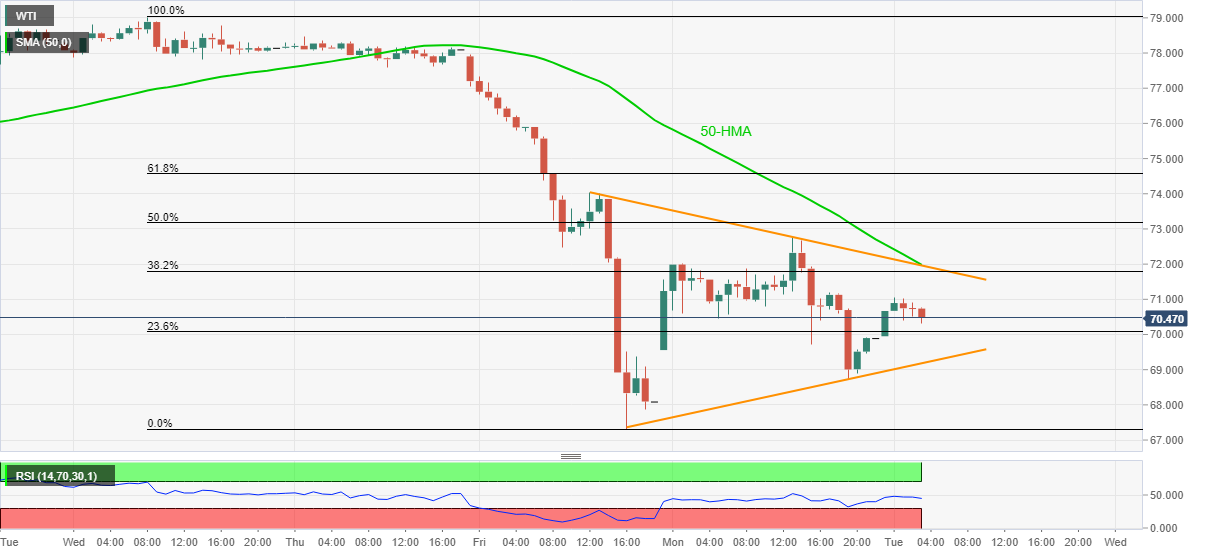
WTI crude oil retreats to $70.40 during a two-day rebound amid early Tuesday. While a two-day-old symmetrical triangle restricts the black gold’s recent moves, RSI pullback and addition of the 50-HMA to upside hurdle keep sellers hopeful.

However, a clear downside break of the stated triangle’s support line, near $69.20 by the press time, becomes necessary for the oil sellers to retake controls.

Following that, Friday’s low near $68.30 will gain the market’s attention before directing WTI bears to September’s low near $67.00 and July’s bottom close to $65.00.

On the flip side, the commodity’s advances will have a tough nut to crack around $72.00, comprising the triangle’s resistance line and 50-HMA.

Even if the quote manages to cross the $72.00, late Friday’s swing high near $74.00 may offer an additional filter before assuring the oil’s run-up towards $77.60, encompassing November 25 upside.

WTI: Hourly chart
Trend: Pullback expected

Additional important levels

Overview
Today last price70.36
Today Daily Change0.85
Today Daily Change %1.22%
Today daily open69.51
 
Trends
Daily SMA2078.24
Daily SMA5078.66
Daily SMA10073.93
Daily SMA20069.78
 
Levels
Previous Daily High72.75
Previous Daily Low68.1
Previous Weekly High79.02
Previous Weekly Low67.31
Previous Monthly High84.98
Previous Monthly Low74.06
Daily Fibonacci 38.2%70.97
Daily Fibonacci 61.8%69.87
Daily Pivot Point S167.49
Daily Pivot Point S265.47
Daily Pivot Point S362.84
Daily Pivot Point R172.14
Daily Pivot Point R274.77
Daily Pivot Point R376.79

Author

Anil Panchal

Anil Panchal

FXStreet

Anil Panchal has nearly 15 years of experience in tracking financial markets. With a keen interest in macroeconomics, Anil aptly tracks global news/updates and stays well-informed about the global financial moves and their implications.


More from Anil Panchal
Share:

Editor's Picks

USD/JPY stays below 160.50 as markets assess BoJ decision

USD/JPY fluctuates in a relatively narrow range above 160.00 on Tuesday as markets assess the Bank of Japan's (BoJ) decision to raise the policy rate by 25 at the June meeting. Meanwhile, investors keep a close eye on news coming out of the Middle East, while preparing for the critical Fed meeting.

AUD/USD trades in tight channel near 0.7050 despite hawkish RBA message

AUD/USD trades modestly lower on the day at around 0.7050 on Tuesday as markets adopt a cautious stance amid a lack of details surrounding the US-Iran peace agreement. The Reserve Bank of Australia (RBA) left the door open for possible policy tightening after leaving the interest rate unchanged, as expected, at the June meeting but failed to boost the Australian Dollar.

Gold: Recovery remains capped by $4,400 for now

Gold continues to trade with a constructive tone and flirts with the $4,350 zone per troy ounce on Tuesday. The early enthusiasm sparked by the US-Iran peace deal has faded somewhat, prompting investors to adopt a more prudent stance as they await further details of the agreement and key guidance from the Fed.

Solana's rebound gains momentum as ETF inflows return

Solana (SOL) steadies at $73 after posting three consecutive green candlesticks since the weekend. The recent recovery is supported by institutional demand, with spot Exchange Traded Funds recording net inflows of $2.81 million on Monday.

BoJ just hiked and US-Iran deal is on the table: Why Japanese Yen is still around 160.00

The Bank of Japan lifted interest rates from 0.75% to 1.00%, its highest level in more than three decades. The landmark move aims to stabilize a sharply weakening Japanese Yen, but by looking at the immediate market reaction, it doesn’t look like it’s going to work.

Why a hawkish RBA is no longer enough to lift the Australian Dollar

The Reserve Bank of Australia delivered more than what markets expected: a hawkish hold that should have supported the Aussie. But markets widely ignored it, focusing instead on slowing economic growth and proving that central bank messaging alone isn’t always enough to drive currencies.