|

WTI Price Analysis: Bulls target $41 mark, API data in focus

  • WTI looks to regain ground above $40 amid favorable technicals.
  • US oil holds higher within a potential bull pennant pattern.
  • Key support at $39.50 to keep the buyers hopeful ahead of API data.

WTI (futures on NYMEX) is trying hard to extend Monday’s rally amid cautious market mood, as investors remain caught between the US stimulus hopes and a lack of coronavirus updates on US President Donald Trump.

Oil traders look forward to the US crude stockpiles data due to be published by the American Petroleum Institute (API) later on Tuesday.

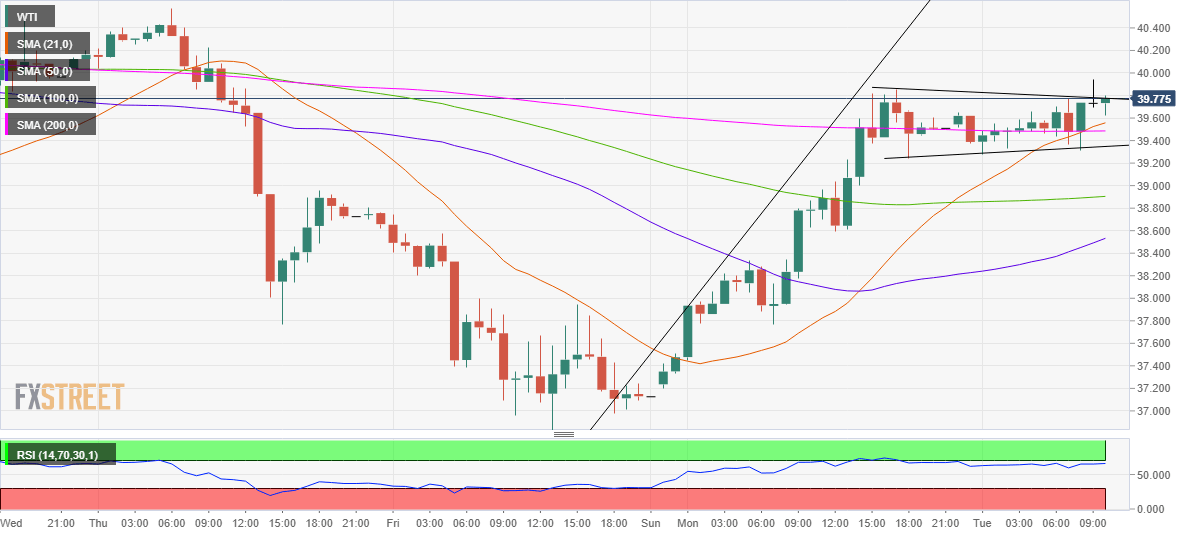
Meanwhile, looking at the hourly technical chart of the WTI barrel, the price is on the verge of a bull pennant breakout, teasing the upper barrier at 39.77.

An hourly close above the latter would validate the bullish formation, opening doors for a move towards 41.00.

However, the October 1 high at 40.57 could challenge the bulls on its way north. The hourly Relative Strength Index (RSI) lies in the bullish region while probing the overbought zone, backing the case for the additional upside.

Alternatively, acceptance below 39.50, the confluence of the 21 and 200-hourly Simple Moving Averages (HMA) could limit the downside attempts.

The next robust cushion is seen at the rising trendline support at 39.34, below which the horizontal 100-HMA at 38.90 could come into play.

WTI hourly chart
fxsoriginal

Author

Dhwani Mehta

Dhwani Mehta

FXStreet

Residing in Mumbai (India), Dhwani is a Senior Analyst and Manager of the Asian session at FXStreet. She has over 10 years of experience in analyzing and covering the global financial markets, with specialization in Forex and commodities markets.


More from Dhwani Mehta
Share:

Editor's Picks

AUD/USD keeps range near mid-0.7100s as USD bulls await US CPI

AUD/USD steadies near mid-0.7100s in the Asian session on Friday, stalling the previous day's sharp decline to an over one-week low. The August PPI report reaffirmed Fed rate-hike bets and boosted the US Dollar on Thursday, which weighed heavily on the pair. However, hawkish RBA expectations limited losses for the Aussie as USD bulls now await the release of the US consumer inflation figures before placing fresh bets.

USD/JPY holds lower ground toward 154.00; looks to US CPI

USD/JPY holds lower ground toward 154.00 in the Asian session on Friday after hot Japanese PPI data bolster a more hawkish BoJ repricing and provide fresh impetus to the Japanese Yen. However, the downside appears capped as the US Dollar preserves overnight gains ahead of the latest US consumer inflation data.

Gold moves away from one-week low, climbs above $4,450 as USD edges lower ahead of CPI

Gold builds on its modest intraday recovery from the $4,300 neighborhood, or a one-and-a-half-week low, touched earlier this Friday, and climbs above $4,350 heading into the European session. The upside potential, however, seems limited as traders opt to wait for the release of US consumer inflation figures before placing directional bets.

Cardano approaches critical support as correction risks grow
Cardano (ADA) recovers slightly, trading at $0.206 at the time of writing on Friday, inches above the critical support zone after losing more than 6% so far this week. Weakening derivatives data and fading bullish momentum suggest a bearish near-term outlook, with a decisive close below the support zone potentially triggering a deeper correction for ADA.
US core CPI data set to ease in August as markets reprice Fed September rate decision

The US Bureau of Labor Statistics will publish the August Consumer Price Index data on Friday. The report is expected to show a small decline in annual core inflation. Any divergence from analysts’ estimates could influence the Federal Reserve’s policy outlook and impact the US Dollar’s valuation.

Venezuela’s 65-billion-barrel Oil deal could reshape America’s inflation fight
The United States (US) has secured unprecedented access to part of Venezuela’s vast Oil reserves. The timing is particularly significant as the war with Iran is disrupting Middle Eastern supplies, keeping energy prices elevated and reviving concerns about inflation.