WTI Crude Oil slides toward $62.00 as geopolitical tensions ease and oversupply fears mount
- WTI Crude Oil trades near $62.00, pressured by easing geopolitical tensions and a rising supply outlook.
- Trump-Zelenskyy summit raises hopes for de-escalation in the Russia-Ukraine conflict.
- WTI holds near $62.00 support with bearish technicals, trading below the 21- and 50-day SMAs, while RSI and MACD signal fading momentum

WTI Crude Oil remains under pressure on Tuesday, trading around $62.00 per barrel, as markets digest signs of de-escalation in the Russia-Ukraine conflict and position cautiously ahead of key macroeconomic events. The fading geopolitical risk premium, coupled with concerns over a mounting global supply glut, continues to weigh on sentiment and limit upside potential for Crude Oil prices.
Peace hopes reduce risk premium, supply overhang limits upside
The broader tone in crude markets reflects tentative optimism following Monday’s high-level meeting between US President Donald Trump, Ukrainian President Volodymyr Zelenskyy, and key European leaders. Traders interpreted the summit as a diplomatic breakthrough, with discussions underway for a trilateral dialogue involving Russia, which could eventually reduce geopolitical tension and sanction-related supply disruptions.
However, the upside remains capped by persistent concerns about excess supply. The International Energy Agency (IEA) forecasts that Oil supply will outstrip demand by nearly 1.8 million barrels per day in 2025, fueled by rising production from the US, Brazil, and OPEC+ members. This imbalance continues to anchor prices, limiting the impact of any near-term demand tailwinds.
Adding to the market's caution, traders are bracing for Fed Chair Jerome Powell’s address at the Jackson Hole Symposium later this week. While a dovish tone could weaken the US Dollar (USD) and marginally boost energy demand expectations through improved economic sentiment, it is unlikely to offset the drag from elevated inventories and steady output growth.
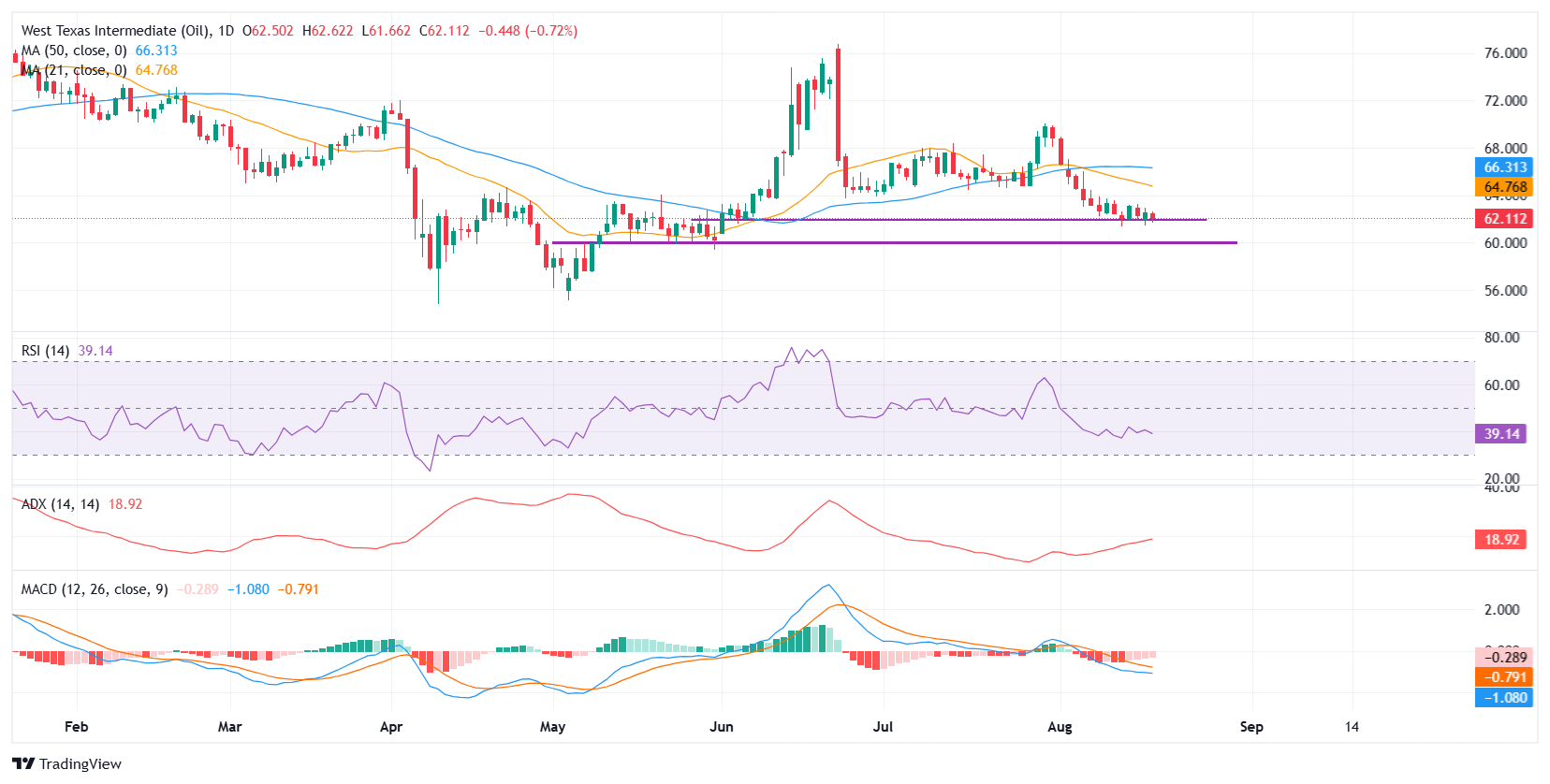
Technically, WTI Crude Oil is under pressure as it hovers near a key support at $62.00, trading below the 21-day ($64.76) and 50-day ($66.31) Simple Moving Averages. The bearish structure remains intact, and a break below this level could trigger a decline toward $60.00, with the May 8 low near $57.47 as the next downside target.
On the flip side, immediate resistance lies at $63.69 — last week’s high — followed by the $64.00-65.00 zone, which is reinforced by downward-sloping moving averages.
Momentum indicators reinforce the bearish outlook, with the Relative Strength Index (RSI 14) holding near 38.81, showing no signs of a reversal. The Moving Average Convergence Divergence (MACD) continues to signal downside pressure, remaining below the zero line with a bearish bias. Meanwhile, the Average Directional Index (ADX 14) sits at 18.92, indicating a weak trend that could result in consolidation in the ahead sessions. Unless $62.00 holds and prompts a recovery, the path of least resistance appears to be lower.
Brent Crude Oil FAQs
Brent Crude Oil is a type of Crude Oil found in the North Sea that is used as a benchmark for international Oil prices. It is considered ‘light’ and ‘sweet’ because of its high gravity and low sulfur content, making it easier to refine into gasoline and other high-value products. Brent Crude Oil serves as a reference price for approximately two-thirds of the world's internationally traded Oil supplies. Its popularity rests on its availability and stability: the North Sea region has well-established infrastructure for Oil production and transportation, ensuring a reliable and consistent supply.
Like all assets supply and demand are the key drivers of Brent Crude Oil price. As such, global growth can be a driver of increased demand and vice versa for weak global growth. Political instability, wars, and sanctions can disrupt supply and impact prices. The decisions of OPEC, a group of major Oil-producing countries, is another key driver of price. The value of the US Dollar influences the price of Brent Crude Oil, since Oil is predominantly traded in US Dollars, thus a weaker US Dollar can make Oil more affordable and vice versa.
The weekly Oil inventory reports published by the American Petroleum Institute (API) and the Energy Information Agency (EIA) impact the price of Brent Crude Oil. Changes in inventories reflect fluctuating supply and demand. If the data shows a drop in inventories it can indicate increased demand, pushing up Oil price. Higher inventories can reflect increased supply, pushing down prices. API’s report is published every Tuesday and EIA’s the day after. Their results are usually similar, falling within 1% of each other 75% of the time. The EIA data is considered more reliable, since it is a government agency.
OPEC (Organization of the Petroleum Exporting Countries) is a group of 12 Oil producing nations who collectively decide production quotas for member countries at twice-yearly meetings. Their decisions often impact Brent Crude Oil prices. When OPEC decides to lower quotas, it can tighten supply, pushing up Oil prices. When OPEC increases production, it has the opposite effect. OPEC+ refers to an expanded group that includes ten extra non-OPEC members, the most notable of which is Russia.
Author

Vishal Chaturvedi
FXStreet
I am a macro-focused research analyst with over four years of experience covering forex and commodities market. I enjoy breaking down complex economic trends and turning them into clear, actionable insights that help traders stay ahead of the curve.