WTI crude oil prices surge on supply cuts, weaker USD ahead of US inflation report
- Saudi Arabia and Russia reduce oil output by 1.5 million barrels.
- WTI prices rise, buoyed by a weaker US Dollar.
- IEA predicts a tight oil market through H2 2023 due to demand and supply factors.

Western Texas Intermediate (WTI), the US crude oil benchmark, advances sharply more than 1.70% or $1.30 per barrel on Tuesday, spurred by supply cuts established by Saudi Arabia and Russia, while China’s woes about a global economic slowdown, cushions WTI’s rise. At the time of writing, WTI is trading at $74.50 after hitting a daily low of $73.03.
China’s dampened demand and Saudi-Russia output cut boosted Oil prices
During the North American session, the 1.5 million barrel crude oil output cut by Saudia Arabia and Russia is one of the main reasons for Oil’s jump. That, alongside a weaker US Dollar (USD), amid a light economic calendar in the United States (US), is lifting WTI prices across the board.
However, Oil traders must be aware that on Wednesday, a hot June Consumer Price Index (CPI) report in the US could suggest that further tightening is needed to curb stickier inflation, which could pave the way for more US Federal Reserve (Fed) rate increases. Consequently, that can underpin US Treasury bond yields and the US Dollar, refraining WTI traders from opening fresh bets on the oil price rise.
Meanwhile, the International Energy Agency (IEA) stands firm that oil demand from China and developed countries, mixed with the latest supply cuts, would keep the Oil market tight during the second half of 2023.
According to Reuters, sources told that “top buyer China again requested less supply from the world’s biggest oil exporter, Saudi Aramco.”
WTI Price Analysis: Technical outlook
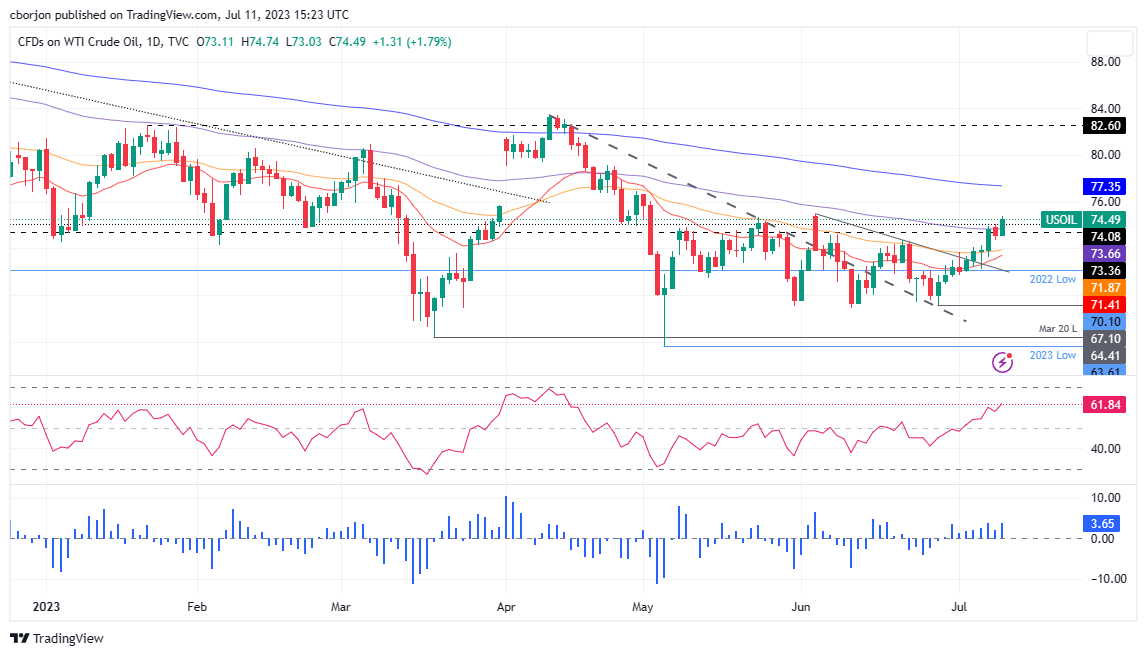
From a technical perspective, WTI buyers reclaiming the 100-day Exponential Moving Average (EMA) at $73.06 has established a floor in the near term. Still, WTI prices remain capped by the June 5 daily high of $74.92; if surpassed, that could pave the way to the psychological $76.00 figure before testing the 200-day EMA at $77.35. Conversely, if WTI does not deliver a daily close above the 100-day EMA, that could expose WTI to a fall below $73.00 and extend its losses toward the 50-day EMA at $71.87.
Author

Christian Borjon Valencia
FXStreet
Markets analyst, news editor, and trading instructor with over 14 years of experience across FX, commodities, US equity indices, and global macro markets.

















