|

WTI corrects below the $60-mark, upside bias still intact

  • WTI returns to the red after the two-day rally to 13-month tops. 
  • Potential bull flag on the 4H chart to challenge the corrective pullback.
  • 21-SMA is the level to beat for the WTI sellers.

WTI (futures on NYMEX) extends its retreat from 13-month tops reached just below the $61 mark on Monday, as markets await the US weekly supply reports for the next direction in prices.

Despite the retracement, the black gold continues to draw support from escalating Middle-East tensions, covid vaccine-driven economic optimism and broad-based US dollar weakness.

The latest pullback can be associated with the closure of the US refineries due to the deep freeze.

WTI: Technical outlook

Looking at the four-chart, the recent rally that followed the consolidation has carved a bull flag formation, with a confirmation waited for the next leg higher in the US oil.
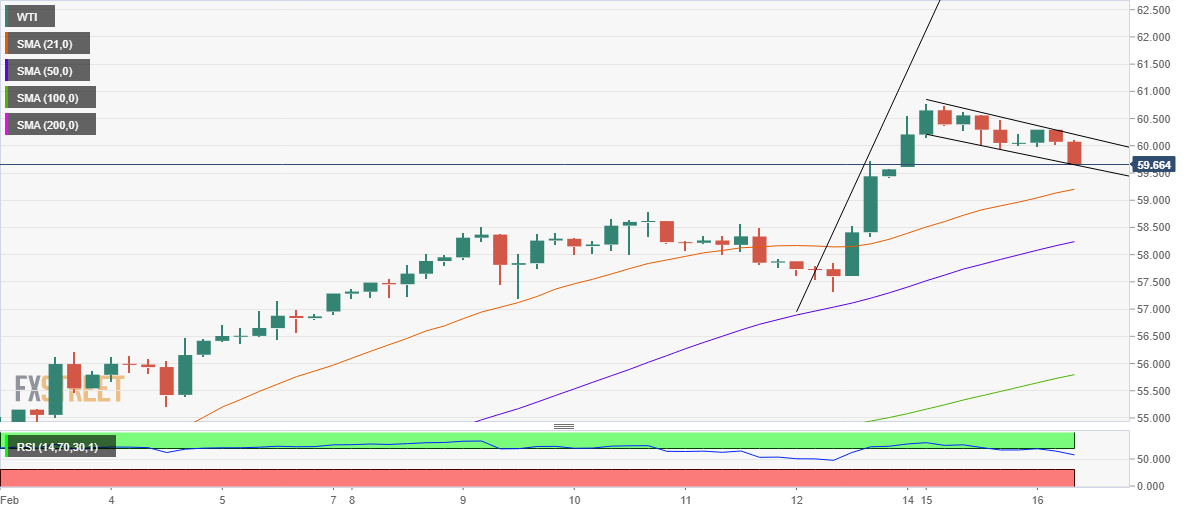
WTI: Four-hour chart

 Therefore, a sustained break above the falling trendline resistance at $60.21 could yield the upside break, opening doors for a test of the multi-month highs at $60.76, above which the $61 mark could be challenged.

To the downside, the bullish 21-simple moving average (SMA) at $59.20 is likely to protect the buyers if the corrective decline picks up pace.

Acceptance under the falling trendline support at $59.65 could invalidate the bullish pattern, although that doesn’t seem likely so far, as the Relative Strength Index (RSI), currently trades at 58.39, suggests that the positive momentum still remains in place.

WTI additional levels

WTI

Overview
Today last price59.76
Today Daily Change-0.34
Today Daily Change %-0.57
Today daily open60.05
 
Trends
Daily SMA2055.13
Daily SMA5051.53
Daily SMA10046.31
Daily SMA20042.73
 
Levels
Previous Daily High60.79
Previous Daily Low59.61
Previous Weekly High59.73
Previous Weekly Low56.89
Previous Monthly High53.94
Previous Monthly Low47.26
Daily Fibonacci 38.2%60.34
Daily Fibonacci 61.8%60.06
Daily Pivot Point S159.51
Daily Pivot Point S258.97
Daily Pivot Point S358.34
Daily Pivot Point R160.69
Daily Pivot Point R261.32
Daily Pivot Point R361.86


Author

Dhwani Mehta

Dhwani Mehta

FXStreet

Residing in Mumbai (India), Dhwani is a Senior Analyst and Manager of the Asian session at FXStreet. She has over 10 years of experience in analyzing and covering the global financial markets, with specialization in Forex and commodities markets.


More from Dhwani Mehta
Share:

Editor's Picks

GBP/USD bounces off lows, back above 1.3200

After bottoming out near 1.3160, GBP/USD manages to regain a bit of shine and reclaim the 1.3200 mark and beyond at the end of the week. Stronger-than-expected UK Retail Sales data seem to be helping the British Pound limit its losses, while the chaotic UK political environment keeps the bulls at bay for now.

EUR/USD looks consolidative around 1.1460

EUR/USD stages a modest rebound after slipping to a three-month low below 1.1420 at the end of the week. That said, the pair now looks to consolidate humble gains just above 1.1460 despite growing uncertainty surrounding the next round of US-Iran negotiations, which keeps the US Dollar’s downside contained.

Gold slips back to six-day lows, targets $4,100

Gold retreats for the third consecutive day on Friday, eroding gains seen in the first half of the week and approaching the key $4,100 mark per troy ounce. Indeed, the precious metal continues to face headwinds from the Fed's hawkish stance and renewed uncertainty surrounding the next round of US-Iran negotiations.

Breaking: Iran closes the Strait of Hormuz amid ceasefire deal violation
Iran says it is closing the Strait of Hormuz after accusing the United States (US) and Israel of violating the ceasefire. According to Iran, the decision came over the continued Israeli strikes in Lebanon. The Iranian Revolutionary Guard Corps Navy issued a warning to all vessels: "Do not approach the Strait of Hormuz; otherwise, your security will be jeopardized."
The Iran war didn't break the US economy, but what happens next?

Nearly four months after the start of the Iran war, the US economy remains remarkably resilient. While the conflict initially triggered a severe disruption to global energy markets and a sharp rise in Oil prices, recent diplomatic progress between Washington and Tehran has eased concerns about a prolonged supply shock.

Regime change: Inside Kevin Warsh's first move to make the Fed unreadable on purpose

The rate did not move. That was the least interesting thing about Kevin Warsh's first meeting in charge of the Fed. The FOMC held its benchmark at 3.50%-3.75% for the fourth straight meeting, exactly as priced, and then the new chair used his first press conference to dismantle the machinery the market has leaned on for a decade.












