|

Why McDonald’s could be heading lower

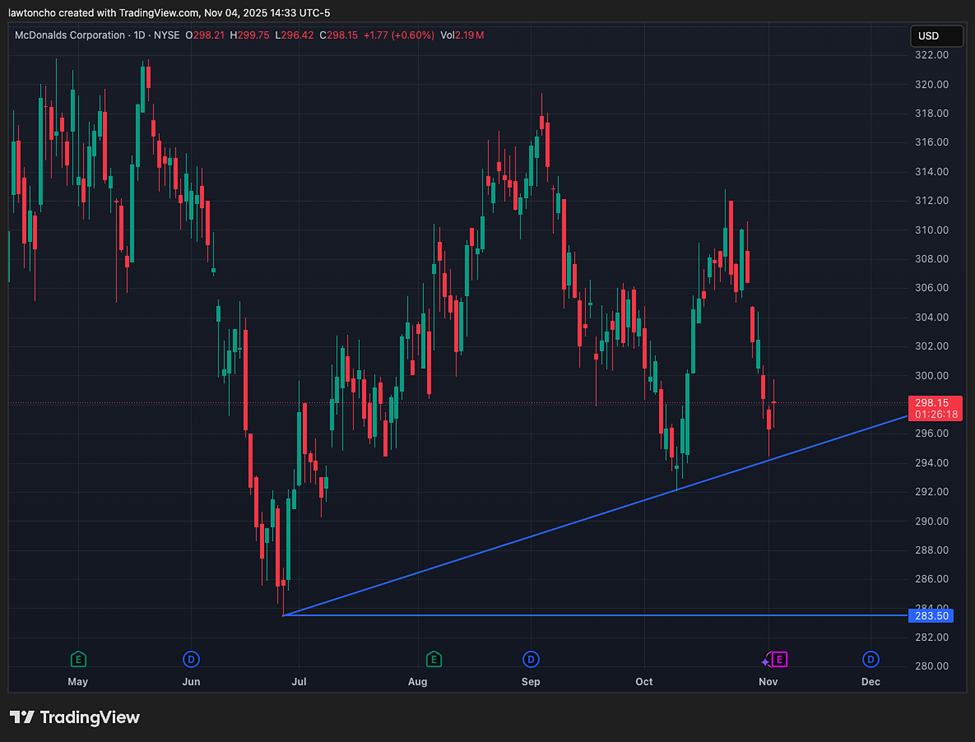
As we head into tomorrow morning’s earnings release for McDonald’s Corporation (MCD), I’ve been closely reviewing the chart and overall price action. Right now, MCD is trading along an upsloping trendline that has been respected for months, and when I look at the technicals, that structure currently favors a potential move lower.

This trendline can be drawn by connecting the stock’s low from June through its lows in October and extending that line through yesterday’s closing price. When a stock approaches earnings at the top of a technical level like this, I always prepare for both scenarios — but in this case, I’m leaning toward a possible pullback.

To provide some quick background, McDonald’s has long been recognized as one of the most established and globally known brands in the fast-food industry. Its business model, iconic brand presence, and wide consumer reach have made it a familiar name across markets. With that kind of history, MCD tends to draw strong attention from traders and long-term investors alike around key events like earnings.

From a price-action standpoint, what stands out to me most is the support zone I’m watching if price does break lower. Should MCD sell off on earnings, I am anticipating a potential reaction near the $283.50 level, which lines up with its low pivot from June. That area has served as a meaningful reference point before, so I will be watching it closely to see if buyers try to step in and defend it again.

As always, whenever I trade around earnings — especially on names with strong brand awareness and higher volatility — I rely on disciplined preparation and risk control. Earnings can move names like this quickly, so proper risk management is key. I’ll be staying patient, letting the chart play out, and adjusting accordingly once the reaction becomes clear.
Author

Lawton Ho

Lawton Ho

Verified Investing

A marketing expert sharing his journey to mastering the charts.

More from Lawton Ho
Share:

Editor's Picks

EUR/USD weakens to near 1.1900 as traders eye US data

EUR/USD eases to near 1.1900 in Tuesday's European trading hours, snapping the two-day winning streak. Markets turn cautious, lifting the haven demand for the US Dollar ahead of the release of key US economic data, including Retail Sales and ADP Employment Change 4-week average.

GBP/USD stays in the red below 1.3700 on renewed USD demand

GBP/USD trades on a weaker note below 1.3700 in the European session on Tuesday. The pair faces challenges due to renewed US Dollar demand, UK political risks and rising expectations of a March Bank of England rate cut. The immediate focus is now on the US Retail Sales data. 

Gold sticks to modest losses above $5,000 ahead of US data

Gold sticks to modest intraday losses through the first half of the European session, though it holds comfortably above the $5,000 psychological mark and the daily swing low. The outcome of Japan's snap election on Sunday removes political uncertainty, which along with signs of easing tensions in the Middle East, remains supportive of the upbeat market mood. This turns out to be a key factor exerting downward pressure on the safe-haven precious metal.

Bitcoin Cash trades lower, risks dead-cat bounce amid bearish signals

Bitcoin Cash trades in the red below $522 at the time of writing on Tuesday, after multiple rejections at key resistance. BCH’s derivatives and on-chain indicators point to growing bearish sentiment and raise the risk of a dead-cat bounce toward lower support levels.

Follow the money, what USD/JPY in Tokyo is really telling you

Over the past two Tokyo sessions, this has not been a rate story. Not even close. Interest rate differentials have been spectators, not drivers. What has moved USD/JPY in local hours has been flow and flow alone.

Bitcoin Cash trades lower, risks dead-cat bounce amid bearish signals

Bitcoin Cash (BCH) trades in the red below $522 at the time of writing on Tuesday, after multiple rejections at key resistance. BCH’s derivatives and on-chain indicators point to growing bearish sentiment and raise the risk of a dead-cat bounce toward lower support levels.
















